
Unit3_Whats_your_favourite_food-1
- 格式:ppt
- 大小:3.01 MB
- 文档页数:35

Possible article:Exploring Favorite Foods in Primary English ClassUnit 3 of the primary English textbook asks students to share their opinions about food and learn vocabulary related to different typesof cuisine. In this lesson plan, we will introduce some pedagogical activities that encourage children to talk about their favorite foods, practice basic sentence structures, and develop theircognitive and social skills.Objectives:-To enable students to communicate in English about their favorite foods using simple phrases and expressions-To enrich students' vocabulary and comprehension of food-related terms-To foster students' empathy and tolerance towards different food preferences and cultural backgrounds-To promote students' creativity and cooperation in designing and presenting their culinary creationsMaterials:-The textbook page with Unit 3 topic and vocabulary- A list of food-related questions and prompts-Pictures or samples of various foods (real or virtual)-Recipe cards or templates for a food-making activity (optional)-Feedback sheets for peer assessment (optional)Procedure:1.Warm-up: Food FlashcardsStart the lesson by showing some flashcards or images of different types of food, such as pizza, burger, sushi, noodles, chicken,carrot, apple, ice cream, etc. Ask the students to guess or name the food and tell whether they like it or not. You can also use a 5-star rating system to gather their opinions.2.Vocabulary Practice: Word AssociationUsing the vocabulary list from the textbook, ask the students to brainstorm words that are associated with food, such as taste, smell, texture, ingredients, utensils, cooking methods, etc. Write thewords on the board or on a mind map, and use them to elicit further examples from the students. You can also play a word chain game,where each student has to say a new word that starts with the last letter of the previous word.3.Speaking and Listening: Favorite Foods InterviewPair up the students and give them some interview questions to ask each other, such as:-What's your favorite food? Why do you like it?-Have you ever tried any foreign food? Which one did you like the most?-Do you prefer sweet or salty food? Hot or cold food? Spicy or mild food?-How do you usually eat your favorite food? With whom do you share it?Encourage the students to take turns asking and answering the questions, and to listen actively to their partner's answers. Youcan also provide some sentence patterns for them to use, such as:-My favorite food is ______. I like it because it tastes _______.-I haven't tried ______ before, but I'm curious about it.-I usually eat ______ for _______ meal. I share it with my _______.4. Writing and Reading: Food PoemAs a group activity, ask the students to brainstorm some adjectives that describe different foods, such as yummy, juicy, crunchy, burnt, sticky, sour, etc. Then, model a simple poem structure, such as: (Title) My Favorite Food(Line 1) (Food name) is _______ (adjective).(Line 2) It smells like _______ (noun).(Line 3) It feels _______ (adjective) in my mouth.(Line 4) I could eat it _______ (number) times a day.(Line 5) It reminds me of _______ (memory).Have the students work in pairs or small groups to create their own food poems, using the vocabulary and sentence structures they have learned. You can provide some examples or scaffolding sentences to help them, such as:-Pizza is cheesy and crispy.-It smells like fresh-baked bread.-It feels greasy and hot on my tongue.-I could eat it every day for a week.-It reminds me of my birthday party.5. Project and Presentation: Food FaceThis is a fun and creative art project that also involves some food decoration skills. Give each group a blank paper plate and someedible materials, such as fruits, vegetables, sauces, cheese, bread, etc. Explain that they have to design a face or a character usingthe food ingredients and present it to the class, explaining their choices and creativity. You can use some themes or challenges tomake it more engaging, such as:-Make a healthy food face.-Make a funny food face.-Make a traditional food face from your own culture.-Make a food face inspired by a famous person or character.After the presentations, ask the students to give feedback to each other, using some criteria such as creativity, effort, taste,variety, etc. You can also provide some reflective questions forthem to think about, such as:-How did you feel about making and sharing your food faces?-What did you learn from your classmates' presentations?-Did you discover any new favorite foods or combinations today?-How can you use English to talk about food in your daily life? Assessment:The students' performance can be assessed through various means,such as observation, participation, oral and written tasks, and peer feedback. You can use a rubric or a checklist that includes the learning objectives and some criteria for success, such as fluency, accuracy, vocabulary range, coherence, pronunciation, creativity, cooperation, etc.Conclusion:This lesson plan offers a variety of activities that cater todifferent learning styles and language skills. By exploring thetopic of favorite foods, students can enhance their communicative competence in English, broaden their cultural awareness, and develop their artistic and culinary abilities. Through collaborative and reflective tasks, students can also experience a sense of belonging and achievement in the classroom. The teacher's role is tofacilitate and scaffold the learning process, while encouraging and guiding the students to express themselves and learn from each other.。

本篇文章将为您介绍小学英语《Unit 3 Whats your favourite food》教案,该教案让小学生学习英语对话表达关于饮食的问题。
该教案适用于小学二年级的学生,旨在培养学生的英语口语能力,让学生学会与他人交流关于饮食的话题。
下面,我们将从教案的背景、教学目标、教材分析、教学策略、教学方法、教学手段、教学步骤、教学反思等方面对此教案进行阐述。
一、教案背景小学英语教育应该从基础的语音及单词开始,逐步提高英语交际能力。
这个教案的背景是中国小学二年级教学班,学生的英语基础还比较薄弱,在学习英语的同时,还要培养学生的口语表达能力。
通过研究小学英语教学大纲和相关学习资料,我发现小学英语教学主要以学生语音、单词、语法为主,而对于口语表达的教学相对落后。
学生容易陷入纯粹的英语语法和单词学习中,而忽略了英语的口语表达能力。
因此,我们应该让学生在学习语音、词汇和语法的同时,注重培养他们的口语表达能力,让他们在日常生活中自信运用英语。
本教案旨在让学生学会与他人交流关于饮食的话题,从而拓展学生的英语交际能力。
二、教学目标本教案的主要教学目标如下:1.学会询问他人关于饮食的问题。
2.学会正确应答对方关于饮食的问题。
3.掌握一些英文词汇,如蔬菜、水果、肉类等。
4.发展学生的口语表达能力,增强他们表达自己的信心。
三、教材分析本教案的教材为小学英语二年级学生用书《英语小猪》第三单元《What's yourfavourite food?》。
本单元教材主要包含以下几个方面:1.掌握基本单词和短语,如eat、food、fruit、vegetable、meat等。
2.学会如何询问他人的饮食喜好,例如“What's your favourite food?/Do youlike vegetables?/Wha t fruit do you like best?”等。
3.学会如何回答问题,例如“I like.../Yes, I like vegetables. I like.../Ilike apples best.”等。
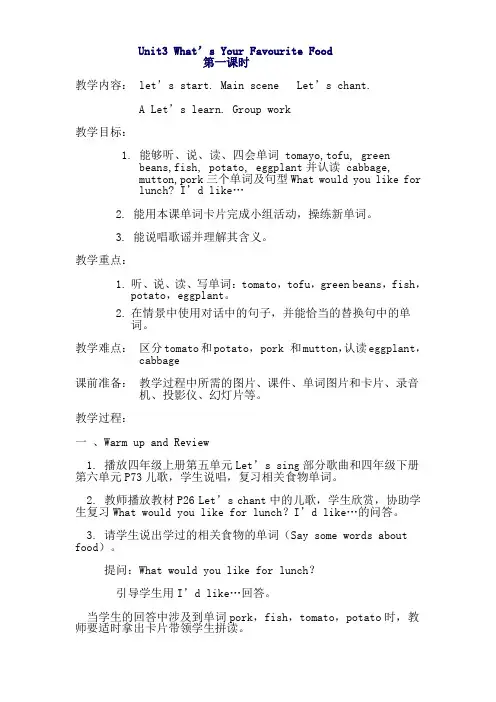
Unit3 What’s Your Favourite Food第一课时教学内容: let’s start. Main scene Let’s chant.A Let’s learn. Group work教学目标:1. 能够听、说、读、四会单词 tomayo,tofu, greenbeans,fish, potato, eggplant并认读 cabbage,mutton,pork三个单词及句型What would you like forlunch? I’d like…2. 能用本课单词卡片完成小组活动,操练新单词。
3. 能说唱歌谣并理解其含义。
教学重点:1.听、说、读、写单词:tomato,tofu,green beans,fish,potato,eggplant。
2.在情景中使用对话中的句子,并能恰当的替换句中的单词。
教学难点:区分tomato和potato, pork 和mutton,认读eggplant,cabbage课前准备:教学过程中所需的图片、课件、单词图片和卡片、录音机、投影仪、幻灯片等。
教学过程:一、Warm up and Review1. 播放四年级上册第五单元Let’s sing部分歌曲和四年级下册第六单元P73儿歌,学生说唱,复习相关食物单词。
2. 教师播放教材P26 Let’s chant中的儿歌,学生欣赏,协助学生复习What would you like for lunch?I’d like…的问答。
3. 请学生说出学过的相关食物的单词(Say some words about food)。
提问:What would you like for lunch?引导学生用I’d like…回答。
当学生的回答中涉及到单词pork,fish,tomato,potato时,教师要适时拿出卡片带领学生拼读。
三、Presentation(1) let’s learn教师播放let’s learn部分录音,学生听两遍。