
英语 (151)
- 格式:ppt
- 大小:1.21 MB
- 文档页数:18

公共英语四级-151(总分79,考试时间90分钟)Section Ⅰ Use of EnglishMr. Smith, a passenger on the transcontinental train, appeared before the judge. A police officer claimed he had attempted to 1 paying his fare. The defendant refused to consult a lawyer 2 suggested that the officer 3 aware 4 all the circumstances. He appealed 5 the judge, when interpreting the evidence, to 6 into account the absence of any 7 criminal record in his 8 His ticket, he said, was stolen shortly before the train crossed the international 9 . At that time and in that territory he was unwilling to 10 the incident to the local railway authorities or cancel the 11 of his journey, in 12 of the severe maltreatment to which he might be 13 He emphasized his readiness to 14 any 15 punishment the judge imposed. In his summary the 16 indicated he was convinced that Smith"s 17 was partly justified. Technically, 18 , he had committed an offence. Crime must not be encouraged or the processes of the law interfered 19 . He found Smith 20 and fined him one dollar.1.A. avoidB. rejectC. refuseD. neglect2.A. whoB. whileC. andD. because3.A. should not beB. would not beC. was notD. were not4.A. aboutB. would not beC. withD. of5.A. forB. toC. againstD. towards6.A. takeB. getC. makeD. keep7.A. primitiveB. preciousC. previousD. preciseA. situationB. accidentC. conditionD. case9.A. bordersB. edgesC. sidesD. ranges10.A. proposeB. mentionC. suggestD. complain11.A. lastB. restC. mostD. latest12.A. viewB. spiteC. caseD. relation13.A. objectedB. accusedC. chargedD. exposed14.A. receiveB. acceptC. admitD. acquire15.A. regularB. respectiveC. reasonableD. relative16.A. passengerB. judgeC. officerD. author17.A. suggestionB. causeC. reasonD. excuse18.A. thereforeB. moreoverC. otherwiseD. however19.A. inB. withC. ofD. for20.A. guiltyB. sorryC. crazyD. rudeSection Ⅱ Reading ComprehensionPassage 1Material culture refers to what can be seen, held, felt, used—what a culture produces. Examining a culture"s tools and technology can tell us about the group"s history and way of life. Similarly, research into the material culture of music can help us to understand the music culture. The most vivid body of material culture in it, of course, is musical instruments. We cannot hear for ourselves the actual sound of any musical performance before the 1870s when the phonograph was invented, so we rely on instruments for important information about music cultures in the remote past and their development. Here we have two kinds of evidence: instruments well preserved and instruments pictured in art. Through the study of instruments, as well as paintings, written documents, and so on, we can explore the movement of music from the Near East to China over a thousand years ago, or we can outline the spread of Near Eastern influence to Europe that resulted in the development of most of the instruments in the symphony orchestra.Sheet music or printed music, too, is material culture. Scholars once defined folk music cultures as those in which people learn and sing music by ear rather than from print, but research shows mutual influence among oral and written sources during the past few centuries in Europe, Britain, and America. Printed versions limit variety because they tend to standardize any song, yet they stimulate people to create new and different songs. Besides, the ability to read music notation has a far-reaching effect on music and, when it becomes widespread, on the music culture as a whole. One more important part of music"s material culture should be singled out: the influence of the electronic media—radio, record player, tape recorder, television, and videocassette, with the future promising talking and singing computers and other developments. This is all part of the "information revolution", a twentieth-century phenomenon as important as the industrial revolution was in the nineteenth. These electronic media are not just limited to modern nations; they have affected music cultures all over the globe.1. Research into the material culture of a nation is of great importance because______.A. it helps produce new cultural tools and technologyB. it can reflect the development of the nationC. it helps understand the nation"s past and presentD. it can demonstrate the nation"s civilization2. It can be learned from this passage that______.A. the existence of the symphony was attributed to the spread of Near Eastern and Chinese musicB. Near Eastern music had an influence on the development of the instruments in the symphony OrchestraC. the development of the symphony shows the mutual influence of Eastern and Western musicD. the musical instruments in the symphony orchestra were developed on the basis of Near Eastern music3. According to the author, music notation is important because______.A. it has a great effect on the music culture as more and more people are able to read itB. it tends to standardize folk songs when it is used by folk musiciansC. it is the printed version of standardized folk musicD. it encourages people to popularize printed versions of songs4. It can be concluded from the passage that the introduction of electronic media into the world of music______.A. has brought about an information revolutionB. has speeded up the appearance of a new generation of computersC. has given rise to new forms of music cultureD. has led to the transformation of traditional musical instruments5. Which of the following best summarizes the main idea of the passage?A. Musical instruments developed through the years will sooner or later be replaced by computers.B. Music cannot be passed on to future generations unless it is recorded.C. Folk songs cannot be spread far unless they are printed on music sheets.D. The development of music culture is highly dependent on its material aspect.Passage 2As video game images become increasingly more realistic and graphic, policy makers are debating if there is a link between the violence depicted in those games and violence in real life.A 20-year-old gunman"s shooting spree at a school in the northeastern America this month has reinvigorated discussions about violence, prompting lawmakers to call for greater examination of brutality in video games. "But evidence does not suggest violence in games causes violence in life," says James Ivory, a professor in the university"s department of communication who researches the effects of video games. "The agreement is pretty well universal among social scientists that there is not a clearlyestablishedlink between actual violent crime and violent media usage," says Ivory.He adds that it is possible, though debated, that exposure to violent video games could make a person think or respond more aggressively in a short term, in Ivory"s words, "might even make you potentially more of a jerk to somebody." But he emphasizes, temporary aggression and violent crime are worlds apart.Wayne LaPierre, head of the National Rifle Association, disagrees. He maintains that there exists in this country sadly a callous, corrupt and corrupting shadow industry that sells and sows violence against its own people, through vicious, violent video games.He named the popular game "Grand Theft Auto" as an example. One of the creators of "Grand Theft Auto", Navid Khonsari, says he grew up playing video games in Iran, Canada and the U.S. , where video games were enjoyed by people of all ages. "The discerning factor among the countries," says Khonsari, "is that while video games have been readily available, what has been limited is the accessibility to weapons.The focus on virtual violence might be limiting substantive discussions about firearm regulations and mental health treatment. "When we talk about violent video games and actual violent crime, we"re chasing something that hasn"t really been observed and we"re not talking about other things that have been observed," says Ivory.Despite the renewed focus on video game violence, investigators of the most recent U.S. school shooting have not said whether the young gunman was a player of violent video games. Interest in video games continues to grow around the globe. Analysts estimate people spent about $70billion worldwide on video games and components in 2012. North America, Western Europe and East Asia remain key markets, while gaming is on the rise in India, Brazil, Russia and Southeast Asia.1. What"s the feature of the present day video games?A. They contain too much violence.B. They seem so lifelike and vivid.C. They have no difference with the real life.D. They have become increasingly popular among youngsters.2. What"s the universal agreement among social scientists according to James Ivory?A. Violent games have nothing to do with crime committing.B. Whether video games would lead to crimes is controversial.C. There exists a cause-and-effect relationship between violent video games and crimes.D. Social scientists reach an agreement that we should keep youngsters away from video games.3. What does the word "established" (Para. 2) mean?A. Fixed.B. Direct.C. Indirect.D. Necessary.4. Wayne LaPierre cited the popular game "Grand Theft Auto" to show ______.A. how worrisome the present situation isB. the growth and the experience of the creatorC. how popular video games are around the worldD. there exists a causal relationship between video games and its negative effects5. This text can be best summarized that ______.A. a gunman"s crime has caused heated debateB. video games are to blame for the improper behaviorsC. whether video games would cause crimes is controversialD. the more video games one plays, the more violent he would be in real lifePassage 3With the extension of democratic rights in the first half of the nineteenth century and the ensuing decline of the Federalist establishment, a new conception of education began to emerge. Education was no longer a confirmation of a pre-existing status, but an instrument in the acquisition of higher status. For a new generation of upwardly mobile students, the goal of education was not to prepare them to live comfortably in the world into which they had been born, but to teach them new virtues and skills that would propel them into a different and better world. Education became training; and the student was no longer the gentleman-in-waiting,but the journeyman apprentice for upward mobility.In the nineteenth century a college education began to be seen as a way to get ahead in the world. The founding of the land-grant colleges opened the doors of higher education to poor but aspiring boys from non-Anglo-Saxon, working-class and lower-middle-class backgrounds. The myth of the poor boy who worked his way through college to success drew millions of poor boys to the new campuses. And with this shift, education became more vocational: its object was the acquisition of practical skills and useful information.For the gentleman-in-waiting, virtue consisted above all in grace and style, in doing well what was appropriate to his position; education was merely a way of acquiring polish. And vice was manifested in gracelessness, awkwardness, in behaving inappropriately, discourteously, or ostentatiously. For the apprentice, however, virtue was evidenced in success through hard work. The requisite qualities of character were not grace or style, but drive, determination, and a sharp eye for opportunity. While casual liberality and even prodigality characterized the gentleman, frugality, thrift, and self-control came to distinguish the new apprentice. And while the gentleman did not aspire to a higher station because his station was already high, the apprentice was continually becoming, striving, struggling upward. Failure for the apprentice meant standing still, not rising.1. Which of the following is true according to the first paragraph?A. Democratic ideas started with education.B. Federalists were opposed to education.C. New education helped confirm people"s social status.D. Old education had been in tune with hierarchical society.2. The difference between "gentleman-in-waiting" and "journeyman" is that ______.A. education trained gentleman-in-waiting to climb higher laddersB. journeyman was ready to take whatever was given to himC. gentleman-in-waiting belonged to a fixed and high social classD. journeyman could do practically nothing without education3. According to the second paragraph, land-grant colleges ______.A. belonged to the land-owning classB. enlarged the scope of educationC. was provided only to the poorD. benefited all but the upper class4. Which of the following was the most important for a "gentleman-in-waiting"?A. Manners.B. Education.C. Moral.D. Personality.5. The best title for the passage is ______.A. Education and ProgressB. Old and New Social NormsC. New Education:Opportunities for MoreD. Demerits of Hierarchical SocietyPassage 4In Britain, strictly speaking, there are three elements in Parliament—the Crown, the House of Lords and the House of Commons. The House of Commons is by far the most powerful and important of the three elements in Parliament and the Prime Ministers is the leader of the majority party in the House of Commons. After a general election in Britain, the Crown appoints tile Prime Minister who must be the leader of the party that has won the majority seats in the House of Commons. It is the Prime Minister who organizes the Cabinet and presides over its meetings. He or she actually decides on who will be the other ministers and so on.The work of each minister is always kept under observation by an unofficial "Shadow Cabinet" organized by the Opposition. The Prime Minister is the head of the government. He or she has the duty to report the government"s work to the King or Queen, has the right to direct all the departments, solves the issues between them and approves the decisions of departments, which do not need to be discussed in the Cabinet. He has the last word in deciding government policy.The Prime Minister not only has the power of appointment but also has the right to reorganize the government, speak for the government in the House of Commons on important decisions and answer the questions of the members of the House of Commons. As he or she is the leader of the majority party in the House of Commons, he or she can control parliament and influence other parties. He or she is the most influential person in Great Britain and in recent years, strong Prime Ministers haveshown a tendency to make policy decisions on their own, in the style of American Presidents. The Prime Minister works and lives in his or her famous residence, No. 10 Downing Street. h is named after George Downing, a British diplomat in the 17th century and has a history of over two hundred years as the British Prime Minister"s residence. The inside of "No. 10" has been reconstructed to suit its purposes. In it there are the Cabinet meeting hall, the Prime Minister" s office and so on. It is here that the Cabinet meets; the Prime Minister receives foreign guests, meets delegations sometimes and does other work. There is an oil painting gallery in which the portraits of all the Prime Ministers, from Robert Walpole to James Callaghan, are placed.1. The passage is mainly talking about __________.A. the Crown in BritainB. the appointment of the ministersC. No. 10 Downing StreetD. things about the Prime Minister in Britain2. According to the passage, what is the function of "Shadow Cabinet" in Britain?A. To watch the ministers" work.B. To maintain the power of the opposition.C. To put pressures on the Cabinet.D. To work for the crown.3. Which one is not the right of the Prime Minister?A. To report the government"s work to the Crown.B. To appoint all the ministers and reorganize the goverament.C. To declare wars against other countries.D. To direct all the departments.4. In the author"s opinion, who is the most influential person in Great Britain?A. The Crown.B. The Prime Minister.C. The House of Commons.D. The House of Lords.5. Which one is wrong according to the passage?A. No.10 Downing Street is the residence of the Prime Minister.B. No.10 Downing Street also serves as the Cabinet"s meeting Hall.C. The Crown actually appoints the ministers.D. The Prime Minister is the leader of the majority party in the House of Commons.Section Ⅲ Writing1. Directions:Study the following picture carefully and write an essay on it. In your essay, you should(1) describe the picture briefly,(2) analyze this situation, and(3) give your comments.You should write 160-200 words neatly on ANSWER SHEET 2.。
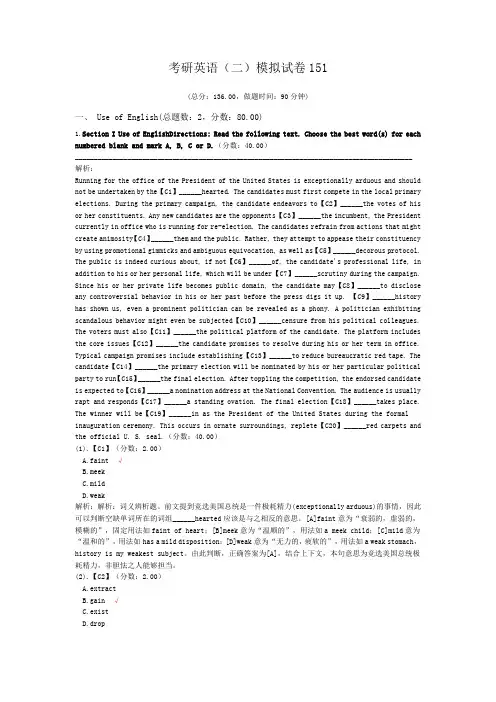
考研英语(二)模拟试卷151(总分:136.00,做题时间:90分钟)一、 Use of English(总题数:2,分数:80.00)1.Section I Use of EnglishDirections: Read the following text. Choose the best word(s) for each numbered blank and mark A, B, C or D.(分数:40.00)__________________________________________________________________________________________ 解析:Running for the office of the President of the United States is exceptionally arduous and should not be undertaken by the【C1】______hearted. The candidates must first compete in the local primary elections. During the primary campaign, the candidate endeavors to【C2】______the votes of his or her constituents. Any new candidates are the opponents【C3】______the incumbent, the President currently in office who is running for re-election. The candidates refrain from actions that might create animosity【C4】______them and the public. Rather, they attempt to appease their constituency by using promotional gimmicks and ambiguous equivocation, as well as【C5】______decorous protocol. The public is indeed curious about, if not【C6】______of, the candidate's professional life, in addition to his or her personal life, which will be under【C7】______scrutiny during the campaign. Since his or her private life becomes public domain, the candidate may【C8】______to disclose any controversial behavior in his or her past before the press digs it up. 【C9】______history has shown us, even a prominent politician can be revealed as a phony. A politician exhibiting scandalous behavior might even be subjected【C10】______censure from his political colleagues. The voters must also【C11】______the political platform of the candidate. The platform includes the core issues【C12】______the candidate promises to resolve during his or her term in office. Typical campaign promises include establishing【C13】______to reduce bureaucratic red tape. The candidate【C14】______the primary election will be nominated by his or her particular political party to run【C15】______the final election. After toppling the competition, the endorsed candidate is expected to【C16】______a nomination address at the National Convention. The audience is usually rapt and responds【C17】______a standing ovation. The final election【C18】______takes place. The winner will be【C19】______in as the President of the United States during the formal inauguration ceremony. This occurs in ornate surroundings, replete【C20】______red carpets and the official U. S. seal.(分数:40.00)(1).【C1】(分数:2.00)A.faint √B.meekdD.weak解析:解析:词义辨析题。

初中英语词汇表注: n 名词v动词adj形容词adv 副词prep介词conj连词phr. 短语num数词pron代名词第一册1----8331what [hw?t] pron 什么2is [iz] v 是3what's [hw?ts] what is 的缩写形式4your [ju ?] pron 你的 ,你们的5name [neim] n 名字6my [mai] pron 我的7I [ai] pron 我8am [?m] v 是9I'm[aim]I am 的缩写形式10in [in] prep 在 ...里 (内 ,上 )11row [r ?u] n (一 ) 排,(一 )行12one [w?n] num 一13number ['n ?mb?] n 数字 ,号码14two [tu:] num 二15too [tu:] adv 也16three [θri:]num 三17are [ɑ:]v 是18you [ju:] pron 你 ,你们19yes [jes] adv 是20four [f?:] num 四21five [faiv] num 五22no [n?u] adv & adj不,不是23not [n?t] adv 不24hi [hai] int 喂(问候或唤起注意 )25class [klɑ:s]n (学校里的 )班级 ,年级26grade [greid] n 年级27six [siks] num 六28seven ['sevn] num 七29eight [eit] num 八30nine [nain] num 九31ten [ten] num 十32zero ['zi?r ?u] num & n零33plus [pl?s] prep 加,加上34it [it] pron 它35It's [its] it is 的缩写形式36how [hau] adv (指程度 )多少 ,怎样37old [?uld] adj ...岁的 ,老的38eleven [i'levn] num 十一39twelve [twelv] num 十二40minus ['main ?s] prep 减 ,减去41thirteen ['θ?:ti:n] num 十三42fourteen ['f ?:'ti:n] num 十四43fifteen ['fif'ti:n] num 十五44hello [h?'l ?u] int 喂 (问候或唤起注意) 45please [pli:z] int 请46can [k?n] v.aux 能 ,可以 ,会47spell [spel] v拼写英语词汇 2182 个25 页48that [e?t] pron 那 ,那个49secret ['si:krit] n 秘密50this [eis] pron 这 ,这个51in [in] prep 用 ...(表达 )52English ['i?gli?] n & adj英语 ,英国人53in English [in'i?gli? ]phr. 用英语 (表达 )54 a [ei] art 一(个,件 ...)55clock [kl ?k] n 钟56and [?nd] conj 和,又 ,而57pencil-box ['penslb ?ks] n 铅笔盒58an [?n] art一(个;件.)59pencil ['pensl] n 铅笔60ruler ['ru:l ?] n 尺子61pen [pen] n 钢笔62sharpener ['?ɑ:p?n?] n 卷笔刀63eraser [i'reis?] n 橡皮擦64room [ru:m] n 房间65book [buk] n 书66map [m?p] n 地图67desk [desk] n 书桌68cup [k?p] n 杯子69bag [b?g] n 书包70compute r[k?m'pju:t ?]n 电脑 ,电子计算机71mouse [maus]n 鼠 ,耗子 ,鼠标72bed [bed] n 床73keyboard ['ki:b ?:d] n 键盘74isn't ['iznt]is not 的缩写形式75pear [p??] n 梨76cake [keik] n 蛋糕 ,饼,糕77banana [b?'nɑ:n?]n 香蕉78apple ['?pl] n 苹果79orange [' ?:rind ?] n 橙子 ,橘子80egg [eg] n 蛋81bike [baik] n 自行车82bus [b?s] n 公共汽车83car [kɑ:]n 汽车 ,小汽车84jeep [d?i:p] n 吉普车85Chinese['t ?ai'ni:z ]adj 中国的 ,中国人的; n中国人,汉语n中国人 ,汉语86Japanese[,d??p ?'ni:z] adj 日本的 ,日本人 n 日本人,日语87look [luk] v 瞧 ,看88who [hu:] pron 谁89she [ ?i:] pron 她90he [hi:] pron 他91bird [b?:d] n 鸟92Its [its] pron 它的93do[du:] v.aux(构成否定句 ,疑问句的助动词 )94don't [d?unt] do not 的缩写形式95know [n?u] v知道 ,懂得96think [θi?k]v想 ,认为97Mr=mister ['mist?] n 先生 (用于姓名前 )- 1 -98very ['veri]adv 很 ,非常99picture ['pikt??]n 图画 ,照片100Mrs ['m?s?z]n 夫人101boy [b?i]n 男孩102girl [g?:l] n 女孩103woman ['wum?n]n 妇女 ,女人104man [m?n]男人 ,人105cat [k?t]n 猫106his [hiz]pron 他的107teacher ['ti:t??] n 教师108her [h?:]pron 她的109everyone ['evriw?n]pron 每人 ,人人110here [hi?] adv 这里 ,这儿111today [t?'dei]adv & n 今天112at [?t]prep在113school[sku:l]n学校114at school phr. 在学校115sorry ['s?ri]adj 对不起 ,抱歉的116where [hw??] adv 在哪里117home [h?um]n 家118at home phr. 在家119How are you ?你(身体 )好吗 ? 120fine [fain]adj (身体 )好的121thanks [θ??ks]n谢谢 (只用复数 ) 122OK adv ( 口语 )好 ,对 ,不错 ,可以123thank [θ??k]v 谢谢124goodbye [,gud'bai]int再见 ,再会125bye [bai]int 再见126parrot ['p?rt]n 鹦鹉127sister ['sist?] n 姐 ,妹128father ['fɑ:e?]n父亲129mother ['m?e?] n 母亲130box [b?ks]n 盒子 ,箱子131excuse [iks'kju:z]v原谅132me [mi:]pron 我133 Here you are给你134but [b?t] conj 但是135these [ei:z]pron 这些136they [eei]pron 他 (她 ,它 )们137good [gud]adj 好的138those [e?uz]pron 那些139boat [b?ut]n 船140hill [hil]n 小山141tree [tri:]n 树142their [e??] pron 他们 (她们 ,它们 )的143much [m?t?] adv 多 ,很 ,非常144 very muchphr. 很 ,非常145all [?:l]adv 都 ,完全146right [rait]adv & adj 对的 ,正确的147 all rightphr. 好,行 ,不错148mum [m?m]n (口语 )妈妈149friend [frend] 朋友150brother ['br?e?] n 兄 ,弟151nice [nais]adj 令人愉快的英语词汇 2182 个25 页152to [tu:]prep (表示方向 ) 到 ,向动词不定式符号153meet [mi:t]v 见面 ,会面 ,遇见154child [t?aild]n 小孩155children ['t?ildr?n]n child 的复数形式156welcome ['welk?m]v 欢迎157our ['au?] pron 我们的158come [k?m]v 来159 come inphr. 进来 ,进入160morning ['m?:ni?]早晨 ,上午161class [klɑ:s]n 同一个班的学生162on [?n]prep在 ,在 ...上163duty['dju:ti]n职责 ,责任164on duty phr. 值日165we [wi:]pron我们166aren't [ɑ:nt]are not 的缩写形式167have [h?v]有168new [nju:]adj 新的169student ['stju:d?nt]n 学生170twin [twin]双胞胎之一171look [luk]v 看上去 ,显得172the [e?] art这(那)个,这(那)些173same[seim]adj 同样的 ,同一的174look the same phr. 看起来很像175America [?'merik?n] & adj 美国人 (的 )176sit [sit]v坐177down[daun]adv 向下178sit down phr. 坐下179over ['?uv?] adv 在那边 ,在另一边180there[e??] adv 那里 ,那儿181over there phr. 在那边182after['ɑ:ft?]prep 在 ...以后 ,在...后面183look after phr. 照顾 ,照看184Miss [mis]n女士 ,小姐 (对未婚妇女的称呼 )185way [wei]n 路,道路186This way,please. 请走这边187put [put]v 放188coat [k?ut]n 外套 ,上衣189them [em]pron 他 (她 ,它 )们190washroom ['w??rum]n 盥洗室 ,厕所191let [let]v 让192us [?s]pron 我们193let's [lets] us 的缩写形式194go [g?u]v去195Let's go我们一起去196classmate ['klɑ:smeit]n同班同学197nice [nais]adj 好的 ,漂亮的198love [l?v]v 爱 ,喜爱199No ['n?mb?] n number 的缩写形式200middle ['midl]adj 中间的 ,中级的201 middle schooln 中学202well [wel]int 喔 ,那么 ,好吧203fax [f?ks]n传真204phone [f?un]电话 ,电话机205ID n 身份征- 2 -英语词汇 2182 个25 页206policeman [p?'li:sm?n] n 警察207 ask [ɑ:sk]v问208sir [s?:] n (用于尊称 )先生 ,阁下209yes [jes]adv(用于疑问 ,征询等 ) 什么 ,是吗210licence ['lais?ns] n 执照 ,许可证211 look atphr. 看 ,观看212dear [di?] int ( 表示惊讶等 )哎呀213see [si:] v 看见 ,看到214I'll [ail] I will的缩写形式215will [wil] v.aux 将 ,会,要216take [teik] v拿到 ,带到217address [?'dres] n 地址218age [eid?] n 年龄219glad [gl?d] adj 高兴的 ,乐意的220why[hwai] int( 表示惊讶 ,不耐烦 ,恼怒等 ) 嗨221 forgot [f?'g?t] v (forget的过去时)忘记222now [nau] adv 现在223China ['t ?ain?] n 中国224or [?:] conj 或者 ,还是225work [w?:k] v & n 工作226goes [g?uz] go 的单数第三人称现在时227family ['f?mili] n 家 ,家庭228 family treen 家谱229grandmother ['gr?nd,m ?e?] n (外 )祖母230grandma['gr?ndmɑ:]n (口语 )奶奶 ,外婆231grandfather ['gr?nd,fɑ:e?]n (外 )祖父232grandpa ['gr?ndpɑ:]n (口语 )爷爷 ,外公233dad [d?d] n (口语 )爸爸 ,爹爹234wife [waif] n 妻子235husband ['h?zb?nd] n 丈夫236daughter ['d ?:t?] n 女儿237son [s?n] n 儿子238parent ['p ??r?nt] n 父 (母)亲239parents ['p??r?nts] n 父母亲 ,双亲240big [big] adj 大的241England ['i?gl?nd] n 英格兰242aunt [ɑ:nt]n 姨母 ,舅母 ,姑母 ,伯母 ,婶母243uncle ['??kl] n 叔,伯 ,舅 ,姨父 ,姑父244afternoon ['ɑ:ft?'nu:n]n 下午 ,午后245do [du:] v 做 ,干,行动246How do you do ?你好!247seat [si:t] n 座位248have a seat坐下 ,就坐249like [laik] prep像 ,跟 ...一样250look like phr.看起来像251hat [h?t] n 帽子 (一般指有边的帽子 )252doctor ['d ?kt?] n 医生253worker ['w ?:k?] n 工人254 guess [ges] v猜255behind [bi'haind] prep 在...后面256chair[t] n 椅子257ball [b?:l] n 球258under [' ?nd?] prep 在 ...下面259floor [fl?:] n (室内 )地 ,地板260can't [k?nt] can not 的缩写形式261photo ['f ?ut?u] n 照片262wall [w?:l] n 墙263shoe [?u:] n 鞋264near [ni?] prep 在 ...附近265door [d?:] n 门266of [?v] prep ...的267classroom ['klɑ:srum]n 教室268answer ['ɑ:ns?]v 回答269blackboard ['bl?kb ?:d] n 黑板270some [s?m] pron 一些 ,若干271schoolbag ['sku:l,b?g] n 书包272flower ['flau ?] n 花273find [faind] v 找到 ,发现274broom [bru:m] n 扫帚275window ['wind ?u] n 窗276raincoat ['reink ?ut] n 雨衣277cap [k?p] n 便帽 ,军帽278football ['futb ?:l] n 足球279table ['teibl] n 桌子280Hong Kong [ 'h??'k?? ]n 香港281Macao [m?'kau] n 澳门282SAR n 特别行政区283there [e??]表示存在 ,有 ..,作引导词284there's [e??z] there is 的缩写形式285lock [l?k] v& n 锁286many ['meni] adj 许多的 ,多的287thing [θi?]n 东西 ,事情288must [m?st] v.aux 必须 ,应当289open [' ?up?n] v 打开290get [get] v得到 ,获得291help [help] v帮助292purse [p?:s] n 钱包293money ['m ?ni] n 钱 ,货币294worry ['w?ri] v (使 )担忧295 Let me see让我想想296fifty ['fifti] num 五十297colour ['k ?l?] n 颜色298black [bl?k] adj 黑色的299house [haus] n 房子300small [sm?:l] adj 小的301playhouse ['pleihaus] n 儿童游戏房302like [laik] v 喜欢303 play [plei] v玩,打(球)304up [?p] adv 在上面 ,在高处 ,向上 ,起来305 with [wie] prep和306great [greit] adv (口语 )好极了 ,很好307look [luk] n 瞧 ,看308have a look phr. 看一看309ping-pong [' pi?p??] n 乒乓球310how many phr. 多少311kite [kait] n 风筝312young [j??] adj 年轻的 ,幼小的313pioneer [,pai ?'ni?] n 先锋- 3 -英语词汇 2182 个 25 页314 Young Pioneern 少先队员 367 time [taim]n 时间315 men[men] man 的缩写形式 368 about [?'baut]adv 大约 316 women ['wimin]woman 的复数形式 369 thirty ['θ?:ti]num 三十317only ['?unli]adv 仅仅 ,只 370 get up ['get?p]phr. 起床318work [w?:k]n 工作371 late [leit]adj & adv 迟的 (地 ),晚的 (地 ) 319 at workphr. 在工作372 o'clock [?'kl?k]⋯点钟320 sky [skai]n 天空373 midnight ['midnait]午夜 321 count [kaunt]v 数 ,点数 374 noon [nu:n]中午 ,正午 322 river ['riv?] n 江 ,河 375 past [p ɑ:st]prep ( 超)过 ,经过 323 dog [d?g]n 狗 376 half [h ɑ:f]n 半 ,一半 324 light [lait]n 灯377 quarter ['kw?:t?] n 一刻钟 ,四分之一 325 any ['eni]adj(用于否定句 ,疑问句等 )什么 ,任何378 for [f?:] prep 为 ,给 326 animal ['?niml] n 动物 379 break [breik]n(课间 )休息 ,中断 327 people ['pi:pl]n 人 ,人们 380 lunch [l?nt?]n 午餐 328 little ['litl]adj & adv 小的 ,一点儿 ,稍许 381 breakfast ['brekf?st]n 早餐 329 sheep [?i:p]n 绵羊 382 clean [kli:n]v 把 ...弄干净 ,擦干净 330 come on ['k?m?n]phr. 来吧 ,跟着来 ,赶快 383 supper ['s?p?]n 晚餐 331 red [red]adj & n 红色 (的 )384 have supper phr. 吃晚餐332 colour ['k?l?] n 颜色; v 给 ...着色 385 TVn 电视 ,电视机 333 yellow ['jel?u]adj & n 黄色 (的 ) 386 watch TV phr. 看电视 334 blue [blu:]adj & n 蓝色 (的) 387 game [geim]n 游戏 ,运动 335 white [hwait]adj & n 白色(的) 388go home phr. 回家336 green [gri:n]adj & n 绿色 (的) 389 p.m.下午 ,午后 337 purple ['p?:pl]adj & n 紫色 (的 ) 390 London['l?nd?n]n 伦敦 338 brown [braun]adj&n 棕色 (的 ),褐色 (的 ) 391 Tokyo['t?uki?u]n 东京 339 orange ['?:rind?] adj & n 橙色 (的 ) 392 Sydney['sidni]悉尼 340 grey [grei]adj & n 灰色 (的),灰白 (的 ) 393 hour[au?]n 小时 341 sweater ['swet?] n 毛衣 ,厚运动衫 394 a.m.午前 ,上午 342 light [lait]adj 淡 (浅 )色的 ,轻的 395 hundred['h?ndr?d]num 百 343 want [w?nt]v 要,想要 396 yourself[ju?'self]pron 你自己 344 which [hwit?] pron & adj 哪一个 ,哪些 397 bedroom['bedrum]n 卧室 345 one [w?n]pron 用来代替单数的人或物 398 doll[d?l]n 玩具娃娃 346 clothes [kl?uez]n 衣服 399 else[els]adv & adj 别 (的 ),其他 (的) 347 line [lain]线,绳索 400 sure[?u?]adv&adj 的确 ,一定 确信的 ,肯定的 348 whose [hu:z]pron 谁的 401 between[bi'twi:n]prep 在 (两者 )之间 349 blouse [blauz]n 女衬衫 402 tall[t?:l]adj 高的 350 dress [dres]n 女服 ,(统称 )衣服 403 funny ['f?ni]adj 滑稽的 ,有趣的351 shirt [??:t]n (男式 )衬衫 404 favourite ['feiv?rit]adj 特别喜爱的 352 trousers ['trauz? ]n 裤子 405 e-mail [i:'meil]n 电子邮件 353 skirt [ sk?:t]n 女裙 406 speak [spi:k]v 讲 ,说 354 dark [d ɑ:k]adj 深(浓) 色的 ,黑暗的 407 next ['nekst]adj 下一个 355 yours [ju?z]pron 你的 ,你们的 408 term [t?:m]n 学期356 mine [main]pron 我的 409 could [kud]v.aux ( 口语 ,表示许可或请求 )可以 ,行 357 hers [h?:z]pron 她的410 minute ['minit]分钟 ,一会儿 358 put on phr.穿上 (衣服等 ),戴上 (帽子等 )411 Tuesday ['tju:zdi]n 星期二 359 theirs [e??z]pron 他们 (她们 ,它们 )的 412 February ['febru?ri]n 二月360 ours ['au?z]pron 我们的 413 eighteenth ['ei'ti:n num θ]第十八 361glove[gl?v]n 手套414 listen ['lisn]v 听362about [?'baut]prep 关于 ,对于415 careful ['k??f?l]adj 小心的 ;仔细的363 What about...? phr. (询问消息 ,征求意见)⋯怎么416 carefully ['k??f?li]adv 小心地 ;仔细地样 ?417 draw [dr?:]v 画 ;绘制364 beside [bi'said]prep 在...旁边 418 has [h?z]v(动词 have 的单数第三人称 ) 有 365 watch [w?t?] n & v 手表、观看 ,注视 419face [feis]n 脸;面孔 366give [giv]给420eye [ai]n 眼睛- 4 -英语词汇 2182 个25 页421ear [i?] n 耳朵422leg [leg] n 腿423hand [h?nd] n 手424long [l??] adj 长的425short [??:t] adj 短的 ;矮的426mouth [mauθ] n 嘴427 say [sei] v说;讲428tick [tik] n (钟表等滴嗒的 )声音429heavy ['hevi] adj 重的430empty ['empti] adj 空的431certainly ['s?:t?nli] adv 当然432full [ful] adj 满的433 be full (of) phr. 充满 ....的434carry ['k?ri] v 携带 ;搬运 ;运送435too [tu:] adv 太436so [s?u] adv 这么 ;那么437 listen tophr. 听438tape [teip] n 磁带439there [e??] int 好啦 (表示安慰 )440all [?:l] adj 整个 ;所有的441basket ['bɑ:skit]n 篮子442bottle ['b ?tl] n 瓶443 a bottle ofphr. 一瓶 ...444juice [d?u:s] n (水果 ;蔬菜 ;肉等的 )汁 ;水汁445head [hed] n 头 ;头部446nose [n?uz] n 鼻子447hair [h??] n 头发448arm [ɑ:m]n 手臂 ;胳膊449foot [fut] n 脚 (pl.feet)450wardrobe ['w?:dr ?ub] n 衣柜451day [dei] n 日 ;天452 from [fr ?m] prep从.....起453America [?'merik ?n] n 美国454zoo [zu:] n 动物园455away [?'wei] adv 离开456put away phr. 把 .....什么收起来 (放好 ) 457out [aut] adv 在外458come out phr. 出来459sock [s?k] n 短袜460other ['?e?] adj 别的 ;其他的461wrong [r ?:?] adj 不正确的 ;错误的462broken ['br ?uk?n] adj 弄坏了的463so [s?u] pron 这样 ;如此464catch [k?t ?] v 捉 ;抓住465get down phr. 下来 ;落下466him [him] pron 他 (宾格 )467right [rait] adv 正好 ;恰好 ; 正确468goodness ['gudnis] n 善良 ;美德469plane [plein] n 飞机470with [wie] prep对 ....;关于471mend [mend] v修补 ;修理472knife [naif] n (pl.knives) 小刀473robot ['r ?ub?t] n 机器人474body [ 'b?di] n 身体475 broke [br?uk] v(动词break[breik]的过去时 )折断 ;打破476lost [l?st] adj 丢失的 ;丢去的477tell [tel] v 告诉 ;讲述478round [raund] adj 球形的 ;圆的479mummy ['m?mi] n (口语 )妈妈480pleasure ['ple ??] n 愉快 ;高兴481food [fu:d] n 食物482 drink [dri?k] n & v饮料喝483hungry ['h??gri] adj 饥饿的484thirsty ['θ?:sti] adj 口渴的485water ['w?:t ?] n & v 水 ;浇水486eat [i:t] v 吃487rice [rais] n 米饭 ;大米488bread [bred] n 面包489meat [mi:t] n 肉490tea [ti:] n 茶491milk [milk] n 牛奶492glass [glɑ:s]n 玻璃杯493 a glass ofphr. 一 (玻璃 )杯494would like phr.想要 (语气婉转地表示请求等 )495something ['s?mθi?]pro 某事 (物 )某东西496porridge ['p?rid?] n 粥 ;稀饭497fish [fi?] n 鱼498dumpling ['d ?mpli?] n 饺子499fruit [fru:t] n 水果500piece [pi:s] n 一张 (片 ;张 )501 a piece ofphr. 一片 (一张、块 )502hamburger ['h?mb ?:g?] n 汉堡包503noodle ['nu:dl] n 面条504potato [p?'teit?u] n pl.potatoes 马铃薯 ;土豆505chips [t?ip] n (口语 )炸士豆儿条506coke [k?uk] n (口语 ) 可口可乐507coffee ['k ?fi] n 咖啡508madam ['m?d ?m] n 夫人 ;女士509dear [di?] adj 亲爱的 ;可爱的510ice [ais] n 冰511cream [kri:m] n 奶油 ;乳脂512ice cream n 冰淇淋513USAn 美国514different ['dif ?r ?nt] adj 不同的515vegetable ['ved?it?bl] n 蔬菜516sometimes ['s?mtaimz] adv 有时517sport [sp?:t] n 运动518come on phr. 来 ;过来519ouch [aut?] int ( 突然感到病痛时发出的声音)啊呀520be good at phr. 在 ...方面 (学得 ,做得 )好 ; 善于521basketball ['b?skitb ?:l] n 蓝球522easy ['i:zi] adj 容易的523 pass [pɑ:s]v传递524try [trai] v 试 (做 ); 设法 ; 努力525yo-yo ['j ?uj?u] n 溜溜球 (一种玩具 )526go [g?u] n 尝试 (做某事 )527 throw [θr?u] v投,掷- 5 -英语词汇 2182 个25 页528hard [hɑ:d]adj 困难的529ride [raid] v 骑 (自行车 ,马等 )530swim [swim] v 游泳531 skate [skeit] v滑冰,溜冰532fly [flai] v 放( 风筝 ,飞机模型等 )533card [kɑ:d]n 纸牌 ,卡片534volleyball ['v?li,b?:l] n 排球535jump [d??mp] v 跳536sing [si?] v唱 ,唱歌537run [r ?n] v跑538high [hai] adj & adv 高的 ( 地)539then [een] adv 那么 ,然后540question ['kwest??n] n 问题541postal ['p?ust?l] adj 邮政的542code [k?ud] n 密码 ,符号543ski [ski:] v滑雪544tennis ['tenis] n 网球 (运动 )545table tennis n 乒乓球546roller-skating ['r ?ul?skeiti?] n 滑旱冰547chess [t?es] n 国际象棋548fan [f?n] n (口语,电影 ,运动等的 )迷549 player ['plei ?] n 比赛者 ,选手550team [ti:m] n 队 ,组551every ['evri] adj 每一 ,每个的552Friday ['fraidi] n 星期五553make [meik] v 做,制作554 make the bedphr. 整理床铺555homework ['h ?umw?:k] n 家庭作业556 do homeworkphr. 做作业557read [ri:d] n 读 ,阅读558write [rait] v 写559 sleep [sli:p] v睡,睡觉560look for ['luk f ?r] phr. 寻找561cook [kuk] v & n 烹调 ,煮 ,烧炊事员 ,厨师562 talk [t ?:k] v说话,谈话563talk with ['t ?:k wie ]phr. 和 ....交谈564open [' ?up?n] n 打开565close [kl?uz] v关; 闭566take photos phr. 照象567wear [w??] v穿568Sunday ['s?ndi] n 星期日569park [pɑ:k]n 公园570toy [t ?i] n 玩具 ;玩物571lake [leik] n 湖572clear [kli ?] adj 清晰的 ;清楚的 ;明亮的573shop [??p] n 商店574closed [kl ?uzd] adj 关着的575day [dei] n 日 ,一天576Friday ['fraidi] n 星期五577 early ['?:li] adj & adv早的(地)初期578supermarket ['sju:p ?,mɑ:kit]n 超级市场579Wednesday ['wenzdi] n 星期三580may [mei] v.aux 可以 ; 可能 ;也许581 borrow ['b?r ?u] v借582 from [fr ?m] prep从;从....起583Thursday ['θ?:zdi] n 星期四584week [wi:k] n 周 ;星期585Monday ['m?ndei] n 星期一586Saturday ['s?t ?di] n 星期六587Sunday ['s?ndi] n 星期日588hey[hei] int 嘿 ;喂 (唤起注意 .表示惊讶或询问 ) 589dictionary ['dik ??neri] n 字典 ;词典590back [b?k] adv 回 (原处 ) ;向后591 tomorrow [t ?'m?:r ?u]n&adv明天;在明天592CD n 激光唱片 (缩写词 )593lot [l?t] n 许多594 a lot phr.非常595give...a hand phr. 给予 .....帮助596evening ['i:vni?] n 傍晚 ;晚上597from ⋯ to ⋯ phr. ⋯从⋯到⋯598 after classphr. 课后599help...withphr. 帮助 (某人 )做 (某事 )600model ['m?dl] n 模型 ;模范 ;样式601park [pɑ:k]n 公园602rest [rest] n 休息603 have a (good) restphr. 休息604maths [m?θs]n (英式拼法 ) 数学605math [m?θ]n (美式拼法 )数学606all [?:l] adv 全体 ;全部607hard [hɑ:d]adv 努力608fun [f ?n] adj 有趣的 ;愉快的609yeah [j ??] adv (口语 )是的 ;嗯610 take [teik] v花费(时间)611straight [streit] adj 直的612use [ju:z] v 用 ;使用 ;应用613wheel [hwi:l] n 轮 ;机轮614into ['intu:] prep 到 .....里 ; 向内615music ['mju:zik] n 音乐 ;乐曲616 boat [b?ut] v划船617lake [leik] n 湖618 into ['intu:] prep到...里,向内619worried ['w?rid] adj 担心的 ,烦恼的620save [seiv] v 救 ,挽救 ,节省621ticket ['tikit] n 票 ,券622New York ['nju:leid ] n 纽约623 learn [l?:n] v学,学习624learn...from phr. 向 ...学习625meeting ['mi:ti?] n 会 ,会议626bring [bri?] v 带来 ,拿来627foreign ['f ?rin] adj 外国的628difference ['dif ?r ?ns] n 不同 ,差异629each [i:t?] adv & pron 各自 ,各个630each other pron 互相631talk about phr. 谈论 ,交谈632USAn 美国633Australia [?:s'treilj ?] n 澳大利亚634Canada ['k?n ?d?] n 加拿大635UK n 联合王国- 6 -英语词汇 2182 个 25 页636 Japan [d??'p?n]日本690 make phone callsphr. 打电话 637 America [?'merik?] n 美国691 wash [w??]v 洗 ,漱洗 638 a little phr. 一点 ,少量692 dish [di?]n 一道菜 ,盘 ,碟639 French [frent?] 法语693 electronic [ilek'tr?nik]adj 电子的 640 great [greit]adj 伟大的 ,很大的 ,重要的694 mail [meil]n 邮政 ,邮递641 the Great Wall n 长城695 smoke [sm?uk]v&n 吸烟 ,烟 642 hotel [h?u'tel]n 旅馆 ,饭馆 696 fog [f?g]n 雾 643 building ['bildi?]n 建筑物 697 smog [sm?g ]n 烟雾644 follow ['f?l?u]v 跟随698 dance [d ɑ:ns]v 跳舞645 call [k?:l]v&n 称呼 ,叫喊 ,打电话给 电话 ,通话699 living room n 起居室 646 family name n 姓 700 dining room n 餐厅 647 first [f?:st]num & adv 第一 ,首先 ,最初 701 driver ['draiv?] n 司机 ,驾驶员 648 postcard ['p?ust,k ɑ:d]n 明信片 702 farmer ['f ɑ:m?]n 农民 649 teach [ti:t?] v 教 ,教书 703 soldier ['s?uld??]n 士兵 ,战士 650 dinner ['din?] n 正餐 ,晚餐 704 businessman ['biznism?n]商人 651 soon [su:n]adv 不久 ,一会儿 705 assistant [?'sist?nt]助手 ,助理652 stay [stei]v 停留 (在某处 )706 a shop assistant phr. 售货员 ,店员 653 high school n 中学707 nurse [n?:s]n 护士 654 Toronto [t?'r?nt?u]n 多伦多 (加拿大港市 )708 postman ['p?ustm?n]n 邮递员 655schoolboy['sku:lb?i]n (中小学的 )男学生709factory ['f?ktri]n 工厂656country ['k?ntri]国家710station ['stei??n]n 车站 ,所 ,站657 make friends phr. 交朋友 711 bus station n 公共汽车站658 France [fr ɑ:ns]法国712 hospital['h?spitl]n 医院 659 textbook['tekstbuk]n 课本713 farm [f ɑ:m]n 农场660 Englishman ['i?gli?mn]n(pl.Englishmen) 英国 (男 ) 人 714 post[p?ust]n 邮政 ,邮寄 ,邮件 661 Australian [?:s'treilj?n]adj 澳大利亚人 715 office['?:fis]n 办公室 662 Canadian [k?'neidi?n]n 加拿大人 716 post office n 邮局663 city ['siti]n 城市717 study ['st?di]v 学习 ,研究 664 foreigner ['f?:rin?] n 外国人 718 party ['p ɑ:ti]n 聚会665 visit ['vizit]访问 ,参观 ,拜访 719 friendly ['frendli]adj 友好的666 word [w?:d]n 词 ,单词 720 also['?:ls?u]adv 也667 well [wel]adv 好 721 medicine['medisin]内服药 ,医学668 why [hwai]adv 为什么722 in the dayphr. 在白天 669 English-speaking adj 说英语的723 at night phr. 在晚上 ,在夜里670 letter['let?] n 信 724 make moneyphr. 赚钱 671 hot[h?t]adj 热的 ,辣的 725 weekend ['wi:k'end]周末672 hot dog n 热狗 (红肠面包 )726 job [d??b]n 工作673 not...at allphr. 一点也不 727 writer ['rait?] n 作家 ,作者 674 different['dif?r?nt]adj 不同的 728 cleaner ['kli:n?] n 清洁工675 kind[kaind]种 ,类 729 turn [t?:n]n (依次轮流的 )顺序 ,轮流 676 a kind of phr. 一种 ,一类730 grow [gr?u]v 种植 ,生长 677 every ['evri]adj 每一的 ,每个的 731 baker ['beik?] n 面包师678 meal [mi:l]n 一餐 ,一顿饭732 artist ['ɑ:tist]n 画家 ,艺术家 679 noodle ['nu:dl]面条733 hobby ['h?bi]n 业余爱好 680 vegetable ['ved?it?bl]n 蔬菜 734 be [bi:]v (am,is,are)是 ,成为 681restaurant['rest??nt]饭馆735 place [pleis]n 地点 ,地方682 often['?:f?n]adv 常常 736 weekday ['wi:kdei]n 工作日 , 平日 (除星期六 ,日以683 potato[p?'teit?u]n 马铃薯 ,土豆 外 ) when [hwen]adv 什么时候 ,何时 684 well[wel]adj & adv 好,(身体 )健康 737 685 why[hwai]adv 为什么 738 leave [li:v]离去 ,出发686 because[bi'k?:z]conj 因为 739 begin [bi'gin]v 开始 ,着手687 housework ['hausw?:k]n 家务劳动 740 have sports phr. 进行体育活动 688machine [m?'?i:n]机器 741 go to bed phr. 睡觉689again [?'gen]adv 又 ,再742usually['ju:?u?li]adv 通常- 7 -英语词汇 2182 个25 页743right now phr. 立刻 ,马上744sometimes ['s?mtaimz] adv 有时745take off phr. 脱衣服746after school phr. 放学后 ,下课后747get to phr. 到达748exercise ['eks?saiz]n 锻炼 ,做操 ,练习749do morning exercisesphr. 做早操750shopping ['??pi?] n 买东西751go shopping phr. (去 )买东西752garden ['gɑ:dn]n 花(果 ,菜 )园753be [bi:] v (am,is,are)是 ,成为754over [' ?uv?] adv 结束 ,完了755do (some) reading phr. 朗读 ,阅读756living-room n 起居室757playground ['pleigraund] n(学校的 )操场758walk [w ?:k] v 走 ,步行 ,散步759news [nju:z] n 新闻 ,消息760match [m?t ?] n 比赛 ,竞赛761quickly ['kwikli] adv 迅速762sun [s?n] n 太阳763moon [mu:n] n 月亮764bridge [brid ?] n 桥765train [trein] n 火车766ship [?ip] n 船 ,轮船767 on footphr. 走路 ,步行768holiday ['h ?l?di] n 假日 ,假期769year [ji ?] n年770by [bai] prep 乘车 (船等 )771by plane phr. 乘飞机772by ship phr. 乘船773air [??] n天空 ,空气774by air phr. 乘飞机775sea [si:] n 海 ,海洋776by sea phr. 乘船777take time phr. 花费 (时间 )778how long phr. 多久779walk [w ?:k] v 走 ,步行 ,散步780clean [kli:n] adj 干净的 ,清洁的781story ['st?:ri] n 故事782 far [fɑ:]adj & adv远783problem ['pr ?bl?m] n 问题 ,难题784earlier ['?:li?] adj & adv ( early 的比较级 )更早的 (地 ) 785ill [il] adj 病的 ,不健康的786tear [t??] n ( 常用复数 ) 眼泪 ,泪珠787chicken ['t?ikin] n 鸡 ,鸡肉788tofu ['t ?ufu:] n 豆腐789fridge [frid ?] n 电冰箱790list [list] n 清单 ,一览表 ,名单 ,目录791shopping list phr. 购物清单792buy [bai] v买793kilo ['ki:l ?u] n 千克 ,公斤794sell [sel] v卖 ,售795how much phr. 多少 ,多少钱796cheap [t?i:p] adj 便宜的797expensive [iks'pensiv] adj 昂贵的798tomato[t ?'meit?u] n(pl.tomatoes) 西红柿 ,蕃茄799onion ['?nj?n] n 洋葱800carrot ['k?r ?t] n 胡萝卜801pork [p?:k] n 猪肉802all day phr. 一整天 ,一天到晚803 a lot of phr. 许多 ,很多804open [' ?up?n] adj 开着的805market ['mɑ:kit]n 市场 ,集市806dollar['d ?l?]n 元 (美 ,加拿大等国的货币单位 ) 807cent [sent] n (货币 )分808pound [paund] n 镑 (重量单位 )809health [helθ]n健康 ,卫生810fast [fɑ:st]adj & adv 快的 (地 ),迅速的 (地 )811of course phr. 当然 ,自然的事812travel ['tr?vl] v & n 旅行813safe [seif] adj 安全的 ,平安的814minibus ['mini,b ?s] n 小型公共汽车815 and so onphr. 等等816price [prais] n 价格 ,价钱817example [ig'zɑ:mpl]n 例子 ,榜样818for example phr. 例如819stand [st?nd] v 站 ,立820field [fi:ld] n 地 ,田地821one day phr.(过去或将来 )有一天 ,某一天822job [d??b] n 工作823bright [brait] adj 明亮的 ,灿烂的824foreign ['f ?rin] adj 外国的825sunglasses['s?nglɑ:siz]n 太阳镜826each [i:t?] pron 各自 ,各个827language ['l??gwid? ] n 语言828helpful ['helpf ?l] adj 有帮助的 ,有益的829 get on (a bus) phr. 上车830business ['biznis] n 商业 ,生意 ,事物831company ['k?mp?ni] n 公司832manager ['m?nid ??] n 经理 ,负责人833century ['sent?uri] n 世纪 ,百年第二册834----1644834lesson ['lesn] n 课,功课835fun [f?n] n 有趣836when [hwen] conj 当 ......时837traffic ['tr?fik] n 交通838bad [b?d] adj 坏的839matter ['m?t ?]v(否定句 ,疑问句 )要紧 ,有关系840 on timephr. 准时841September [sep'temb?] n 九月842happy ['h?pi] adj 快乐的 ,幸福的843best [best] adj &adv 最好的 (地 )844wish [wi ?] n &v 祝愿 ,希望 ,想要845second ['sek?nd] num &adj 第二 (的 )846idea [ai'di ?] n 主意 ,想法 ,意见847last [lɑ:st]adj 最后的 ,刚过去的- 8 -英语词汇 2182 个25 页848 given namephr. 名字 849 mean [mi:n]v 表示 ...的意思 ,意味着850meaning ['mi:ni?]意思 ,意义 ,含义851important[im'p?:t?nt]adj 重要的 ,重大的852 use[ju:z]v 用 ,使用 ,运用853 Ms [m ?z]n 女士 (用于婚姻状况不明的女名)854 before [bi'f?:]prep &adv 在 ..之前 ,以前 855 never['nev?] adv 从来 ,决不 856just [d??st]adv 刚刚 ,方才857third [θ?:d]num &adj 第三的858 afraid [?'freid]adj 害怕的 859 live[liv]居住860sound [saund]&v 声音 ,听起来 861 have to phr. 不得不 ,必须 862 time [taim]n 次数 863 more [m?:]adv 更 ,更加 864 not...any more phr. 不再865laugh [l ɑ:f]v & n 笑 ,大笑 ,笑声 866waste [weist]n& v 浪费 ,废弃物 867 a waste of time phr. 浪费 (白费 ) 时间868 fifth [fif θ]num& adj 第五 (的) 869trip [trip]n & v旅游 ,旅行870 field tripphr. 野外旅游 871 hometown ['hom'taun]故乡 ,家乡 872 discuss [di'sk?s]v 讨论 ,议论 873fish [fi?]v 钓鱼874fishing ['fi?i?]n 钓鱼 875 go fishingphr. 去钓鱼 876 east [i:st]n& adj 东方 (的 ),东部 (的 ) 877 agree [?'gri:]v 同意 ,赞成 878 boating ['b?uti?]n 划船 879 go boatingphr. 去划船 880 maybe ['meibi]adv 也许 ,大概 881 mountain ['mauntin]山, 高山 882hike [haik]n& v 远足 ,徒步旅行883hiking [haikin]徒步旅行884 go hikingphr. 去徒步旅行 885 picnic ['piknik]野餐886 the day after tomorrow phr. 后天 887 top [t?p]n 顶部 888 problem ['pr?bl?m]n 问题 ,难题 889 quick [kwik]adj 快的 ,迅速的 890 quickly ['kwikli]adv 快地 ,迅速地 891 start [st ɑ:t]v 开始 ,着手 892 trip [trip]over phr. (被 ...)绊倒 893tired ['tai?d]adj 累 ,疲乏894hurry ['h?ri]v 赶快 ,慌忙895 hurry upphr. 赶快 896 tie [tai]v 捆,(系,栓 )紧 897 die [dai]v 死亡 898 city [ 'siti]n 城市899 take [teik ]v 花费 ( 时间 ), 消耗 900 eighth [eit θ]num 第八901 salesgirl ['seilzg?:l]n 女售货员902 far [f ɑ:]adj & adv 远的 (地 ) 903 beautiful ['bju:t?f?l]adj 美丽的 ,漂亮的 904 together [t?'gee?] adv 一起 905 autumn ['?:t?m]n 秋天 ,秋季906 festival ['fest?v?l]n & adj 节日 (的 ),喜庆 (的 ) 907ninth [nain θnum ] &adj 第九 (的 ) 908 free [fri:]adj 自由的 ,空闲的909 mid-autumn n 中秋 910 mooncake n 月饼 911 nut [n?t]n 坚果 ,坚果核912 sweet [swi:t]adj 甜的 ,可爱的 913 inside [,in'said]prep 在 ...里面914store ['in'said](美)商店 ,大百货公司915 come overphr. 过来 ,顺便来访916thanksgiving [,θ??ks'givi?]n 感谢,感恩 917 Thanksgiving=Thanksgiving Dayphr. 感恩节 918 get together phr. 相聚 919 October [?k't?ub?] n. 十月 920 taste [teist]v 品尝 ,有...味道 921pie [pai]n(用肉或水果做成的 )馅饼922outside ['aut'said]prep & adv 在...外923 in the open airphr.在户外 ,在野外 924 harvest ['h ɑ:vist]n 收获 925 than [e?n]conj 比 ....,比较 ....926 another [?'n?e?]adj&conj 另一个 (的 ),又一个 (的 ) 927 delicious [di'li??s]adj 美味的 ,可口的928 better ['bet?]adj(goo 或 well 的比较级 )更好的 929 pumpkin ['p?mpkin]南瓜930 twelfth [twelf θ]num&adj 第十二 (的 ) 931 turkey ['t?:ki]n 火鸡932 celebrate ['selibreit]v 庆祝 933 wait [weit]v 等,等待 934 feed [fi:d]v 喂 ,饲养 935 cow [kau]n 母牛 ,乳牛936 interesting ['int?risti?]adj 有趣的 ,有意思的 937 tractor ['tr?kt] n 拖拉机 938 taxi ['t?ksi]n 出租汽车939 slow [sl?u]adj 慢的 ,缓慢的 940 slowly ['sl?uli]adv 缓慢地 941 grow [gr?u]v 种植 ,生长 942 wheat [hwi:t]n 小麦943 country ['k?ntri]乡村 ,郊外 944hear [hi?] v 听见 ,听说 945bleat [bli:t]v& n 羊叫 (声 )946 agree with phr. 同意 ...意见 (想法 )符合 ,一致 947 corn [k?:n]n (美 )玉米 ,谷类庄稼948most[m?ust]adj&adv(many 或 much 的最高级 )最多的949 summer ['s?m?] n 夏天 ,夏季950 winter ['wint?] n 冬天 ,冬季951 stop [st?p]v 停止 ,中止 952 pick [pik]v 采摘 (花 ,果实 )953 exciting [ik'saiti?]adj 令人兴奋的 954 town [taun]城镇955 star [st ɑ:]n 星星 ,恒星- 9 -。

高中英语易混单词151个高中英语易混单词151个在学习英语的过程中,我们会发现和中文一样,英语也有很多相似的单词,但是意思完全不一样,以下是店铺搜索整理的关于高中英语易混单词151个,供参考积累!想了解更多相关信息请持续关注我们店铺!1) quite 相当 quiet 安静地2) affect v 影响,假装 effect n 结果,影响3) adapt 适应 adopt 采用 adept 内行4) angel 天使 angle 角度5) dairy 牛奶厂 diary 日记6) contend 奋斗,斗争content 内容,满足的context 上下文contest 竞争,比赛7) principal 校长,主要的 principle 原则8) implicit 含蓄的 explicit 明白的9) dessert 甜食 desert 沙漠 v 放弃 dissert 写论文10) pat 轻拍 tap 轻打 slap 掌击 rap 敲,打11) decent 正经的 descent n 向下,血统 descend v 向下12) sweet 甜的 sweat 汗水13) later 后来 latter 后者 latest 最近的 lately adv 最近14) costume 服装 custom 习惯15) extensive 广泛的 intensive 深刻的16) aural 耳的 oral 口头的17) abroad 国外 aboard 上(船,飞机)18) altar 祭坛 alter 改变19) assent 同意 ascent 上升 accent 口音20) champion 冠军 champagne 香槟酒 campaign 战役21) baron 男爵 barren 不毛之地的 barn 古仓22) beam 梁,光束 bean 豆 been have 过去式23) precede 领先 proceed 进行,继续24) pray 祈祷 prey 猎物25) chicken 鸡 kitchen 厨房26) monkey 猴子 donkey 驴27) chore 家务活 chord 和弦 cord 细绳28) cite 引用 site 场所 sight 视觉29) clash (金属)幢击声 crash 碰幢,坠落 crush 压坏30) compliment 赞美 complement 附加物31) confirm 确认 conform 使顺从32) contact 接触 contract 合同 contrast 对照33) council 议会 counsel 忠告 consul 领事34) crow 乌鸦 crown 王冠 clown 小丑 cow 牛35) dose 一剂药 doze 打盹36) drawn draw 过去分词 drown 溺水37) emigrant 移民到国外 immigrant 从某国来的移民38) excess n 超过 exceed v超过 excel 擅长39) hotel 青年旅社 hostel 旅店40) latitude 纬度 altitude 高度 gratitude 感激41) immoral 不道德的 immortal 不朽的42) lone 孤独的 alone 单独的 lonely 寂寞的43) mortal 不死的 metal 金属 mental 神经的 medal 勋章 model 模特meddle 玩弄44) scare 惊吓 scarce 缺乏的45) drought 天旱 draught 通风,拖拉 draughts (英)国际跳棋47) assure 保证 ensure 使确定 insure 保险48) except 除外 expect 期望 accept 接受 excerpt 选录 exempt 免除49) floor 地板 flour 面粉50) incident 事件 accident 意外51) inspiration 灵感 aspiration 渴望52) march 三月,前进 match 比赛53) patent 专利 potent 有力的 potential 潜在的54) police 警察 policy 政策 politics 政治55) protest 抗议 protect 保护56) require 需要 inquire 询问 enquire 询问 acquire 获得67) revenge 报仇 avenge 为……报仇68) story 故事 storey 楼层 store 商店69) strike 打 stick 坚持 strict 严格的70) expand 扩张 expend 花费 extend 延长71) commerce 商业 commence 开始72) through 通过thorough 彻底的(al)though 尽管thought think 过去分词73) purpose 目的 suppose 假设 propose 建议74) expect 期望 respect 尊敬 aspect 方面 inspect 视察 suspect 怀疑75) glide 滑翔 slide 使滑行 slip 跌落76) steal 偷 steel 钢77) strive 努力 stride 大步走78) allusion 暗示 illusion 幻觉 delusion 错觉 elusion 逃避79) prospect 前景 perspective 透视法80) stationery 文具 stationary 固定的81) loose 松的 lose 丢失 loss n 损失 lost lose过去式82) amend 改正,修正 emend 校正83) amoral unmoral immoral 同义不道德的'84) capitol 大厦 capital 首都85) casual 随便的 causal 表原因的86) extend 延伸 extent 长度 extant 现存的87) inability 没能力 disability 残疾88) personnel 人事 personal 个人的89) statue 塑像 statute 法令 stature 身长 status 地位90) widow 寡妇 window 窗户91) socks 短袜 stockings 长筒袜92) tax 税 taxi 出租93) definite 不定的 infinite 无限的94) grim 严酷的 grime 污点95) crayon 蜡笔 canyon 山谷96) recent 最近 resent 生气97) phrase 短语 phase 阶段98) mission 使命 emission 散发,发射 mansion 大厦99) vision 视觉 version 译本100) gasp 上气不接下气 grasp 抓住101) delicate 微妙的 dedicate 献身101) idle 空闲的 idol 偶像102) induce 促使,劝诱 deduce 推测 reduce 减少 seduce 诱使103) lapse 流逝 elapse 消逝 eclipse 日食104) rude 粗鲁的 crude 天然的105) source 水源sauce 酱油saucer 茶托resource 资源recourse 求援106) sled (儿童)雪橇 sledge 雪橇107) stripe 条纹 strip 条 trip 旅行108) vocation 职业 vacation 假期 evocation 召集 revocation 撤回109) ardor 热情 adore 崇拜 adorn 装饰110) area 区域 era 时代111) resemble 象…… assemble v 集合,装配 assembly n 集合,装配112) assume 假定 resume 恢复113) attain 达到 obtain 获得 abstain 放弃114) award 授予 reward 奖赏115) baggage (American English) luggage 行李116) badge 徽章 bandage 绷带117) blade 刀刃 bald 秃的 bold 大胆118) bloom 开花 blossom 开花(结果实) bosom 胸口119)blush 脸红 flush 发红(脸)120) bride 新娘 bribe 贿赂121) growl 咆哮 howl 狼叫122) depress 使沮丧 suppress 镇压 oppress 压迫123) dime 一角 dim 暗淡的124) dizzy 眼花缭乱 dazzle 使眼花125) brown 褐色 brow 眼眉 blow 打击126) bullet 子弹 bulletin 公告127) carton 纸板盒 cartoon 动画128) chivalry 骑士精神 cavalry 骑兵队129) collar 领子 cellar 地窖 color 颜色130) vanish 消失 evanish 使消失131) intrude 入侵 extrude 逐出 detrude 推下132) contort 扭弯 distort 弄弯 retort 反驳133) eminent 杰出的 imminent 逼近的134) decline 下降 recline 放置 incline 倾斜135) exclaim 呼喊 proclaim 宣布 acclaim 欢呼 declaim 朗诵136) edict 法令 indict 控告137) perfuse 泼洒 profuse 浪费的138) reject 拒绝 eject 逐出 inject 注射 deject 使沮丧139) literacy 识字 literary 文学的 literature 文学 literal 文字的140) median 中央的,中线的 medium 媒体141) expel 驱逐 repel 反击 impel 推动 dispel 驱散142) rip 撕 ripe 熟的143) wench 绞车 wrench 扭伤144) confidant 知己 confident 有信心的145) dine 吃饭 diner 吃饭人 dinning n 吃饭 dinner 晚饭146) dreg 渣滓 drag 拖拉147) faint 失去知觉 feint 佯攻148) imprudence 轻率 impudence 无耻149) specie 硬币 species 种类150) hanger 钩子 hangar 棚厂 hunger 饥饿151) suite 一(套,批) suit一套衣服【高中英语易混单词151个】。