新人教版小学英语五年级上册1-2单元重点知识点
- 格式:doc
- 大小:459.00 KB
- 文档页数:2
*** *** 五年级上册1-2 单元知识点
一. 默写下面单词:
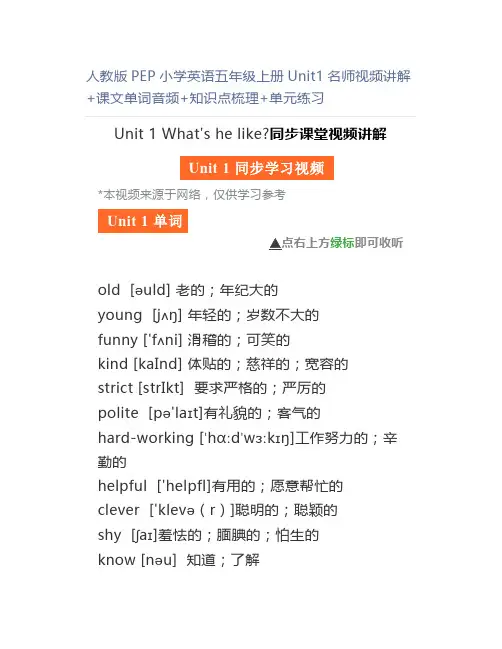
一单元:(1)老的: old (2) 年轻的: young (3) 滑稽的: funny (4) 体
贴的,慈祥的: kind (5) 严格的: strict (7) 有礼貌的: polite (8) 辛勤的:
hard-working (9) 有用的: helpful (10) 聪明的: clever (11) 害羞的: shy
二单元:(1)星期一:Monday 星期二:Tuesday 星期三:Wednesday 星
期四:Thursday 星期五: Friday 星期六: Saturday 星期日:Sunday (2) 周 末:
weekend (3) 洗我的衣服: wash my clothes (4) 看电视: watch TV (5) 做
作业: do homework (6) 看书: read books ( 7)踢足球: play football
二. 读出下列单词并知道其汉语意思:
一单元:(1) know 知道,了解 (2)our 我们的 (3) will 将要 (4)sometimes
有时(5)robot 机器人 (6)him 他(不能做主语) (7)speak 说某种语言(8)
finish 完成( 9)music 音乐art 美术 science 科学 English 英语 maths数学
Chinese 语文
二单元:(1)cooking(名词:烹饪),cook(动词:烹饪),boat(名词:船 ),
而 boating(名词:划船)(2)often 常常 (3)park 公园 (4)tired 疲倦的 (5)
play sports:做体育运动 (6)should应该(7)every 每个 (8)day 一天 (9)
schedule 工作计划( 10)on the weekend 在周末 play sports/do sports 做体育运动
Listen to music 听音乐
三. 重点句子:
(1 单元)
1. (1) Who’s your art teacher?谁是你的美术老师?— Mr. Jones.
(2) Who is he? — — He is our music teacher. (3) Who is she?— — She is our⋯
2. Is he young? 他年轻吗?— Yes, he is. /No, he isn ’t.
Is she funny? — — Yes, she is. / No, sheisn ’t.
3. Do you know your Chinese teacher?— Yes, I do. / No, I don ’. t
4. 询问他人的外貌或性格: What’s he/she like? - He/ She is kind.
What’ s Wu Yi fan like?吴一帆怎样?— He’ s ha-rwd orking. 他很勤奋。
5. Ms Wang will be our new Chinese teacher.王老师会成为我们的新语文老师。
6. He is very helpful at home. 他在家很能干。 My grandpa made him.
7. Robin is short but strong. 罗宾个子矮,但是身体强壮。 His name is Robin.
8. He can speak Chinese and English他. 会说中文和英语。
9. He makes me finish my homework. 他让我写作业。
(2 单元) 1. 询问星期几上什么课: What do you have on⋯ ? — We have⋯ class.
What do you have on Thursdays? 星期四你们上什么课?— I have math, English and
music. 我们上数学、英语和音乐课。*** *** 10. 询问做什么事/活动: What do you do ⋯ ? —I often play ping-pong.
如:What do you do on Thursdays, Grandpa?爷爷,星期四你要做什么?
— I have a cooking class with your grandma.我和你奶奶去上烹饪课。
What do you often do on the weekend?
----I often watch TV, sometimes I read books.
11. Do you often read books in this park?你经常在这个公园看书吗?
Do you often play football here? Do you often wash your clothes on the weekend? —
Yes, I do.是的 — No, I don 不’ 是t.
12. Look at my picture. 看我的图片。
13. You look tired. 你看起来很累。 I don`t like sports.我不喜欢运动。
14. You should play sports every day.你应该每天做运动。
四.语音:
1. 字母 y 在单词中的发音:双音节或多音节词末发 [i ]
例: baby happy windy sunny sorry candy many family party
婴儿开心的 有风的 晴朗的 对不起 糖果 许多家庭 聚会
2. 字母组合 ee, ea在单词中的发音: [ i: ]
例: feet(复数) beef meet see feed tea read eat repeat
脚 牛肉 遇见看见喂养 茶阅读吃 重复
注:ea字母组合除了发 [i: ] ,还有可能发 [e ]等发音,如:bread面包,或者发 [ei ],
如 great 好极了
五.语法知识:
1、be动词的三种形式: am, is, are,用法是:
识记口诀:我用 am, 你用 are, is用于他、她、它,所有复数都用 are
I + am, He/ She/ It/人名 /物名 +is , We/ You/ They + are
2、Ms., Miss, Mr., Mrs.的区别 :
Ms (用于女子的姓氏或姓名前,不指明婚否)女士;
Miss(用于未婚女子的姓氏或姓名前,以示礼貌)小姐,女士;
Mrs (用于已婚女子的姓氏或姓名前)太太;夫人。
Mr (用于男子的姓氏或姓名前)先生;
3、and和 but 的区别:
and “和,与 ”,表并列关系 He is tall and thin. 他又高又瘦。
but 但“是 ”,表转折关系 He is short but strong. 他个子矮,但是身体强壮。
4、on、at、in 的区别:
on+具体某一天(年月日 /星期),如: on Monday/Tuesday
at+具体时刻( ⋯ 点钟),如: at 12 o ’clo在ck十二点整
in+ 大 致 时间( 年 月 , 早 中 晚 ), 如 : in this year 在 今 年 ; in the
morning/afternoon/evening
5. 组词:
Mon+ day= Monday bed+ room= bedroom Satur+ day= Saturday
Wednes+ day= Wednesday Thurs+ day= Thursday bath+ room= bathroom
Sun+ day= Sunday class+ room= classroom Tues+ day= Tuesday