
语法:直接引语变间接引语
- 格式:ppt
- 大小:5.41 MB
- 文档页数:29


初中英语语法:直接引语变间接引语的五点变化
1. 时态的变化
直接引语变为间接引语时,若主句为过去时态,变为间接引语的 宾语从句通常要将时态往后推一个,即:一般现在时变为一般过去时, 一般将来时变为过去将来时,现在实行时变为过去实行时,现在完成 时变为过去完成时,一般过去时也变为过去完成时,等等 ( 若直接引语 为过去完成时,变为间接引语能够不变 ) 。另外,若直接引语中有情态 动词 can, may 等,也应变成过去式 could, might 等( 情态动词 must 能够变为 had to ,也可不变, should, ought to, had better 等能够
不变):
I want to stay here. he said. 他说:“我想留在这儿
f He said that he wan ted to stay there. 他说他想留在那儿
She said, “It 's raining very hard.
大。” 他说:“雨下得很
fHe said that it was raining very hard. 他说雨下得很大。
Jim said, I can speak Chinese. ” 吉姆说:“我会讲汉
fJim said that he could speak Chinese. 吉姆说他会讲汉语
(1) 若直接引语为客观真理,则变为间接引语时时态不变:
He said, “The sun rises in the east. ” 他说:“太阳从东 方升起。”
fHe said that the sun rises in the east. 他说太阳从东方
升起 (2) 有时因为直接引语有特定的过去时间状语,变为间接引语时 时态也可不变:
He said, “ was born in 1988. ” 说:“我是 1988 年生的。”
—He said that he was born in 1988. 他说他是 1988 年生的。

直接引语变间接引语
一、 直接引语变间接引语
A. 疑问句的间接引语
1.一般疑问句和反意疑问句
一般疑问句改为间接引语时,要用陈述语序,并要加连词if 或 whether,其主句动词常用ask,
wonder, wantto know, didn't know等。句末不用问号。
My teacher asked me, Do you like American country music 我老师问我:你喜欢美国乡间音乐吗?
转变为: My teacher asked me ifwhether I liked American country music。 我老师问我是否喜欢美国乡间音乐。
You haven't been to Beijing, have you asked he。 他问:你没去过北京,是吗?
转变为: He asked me ifwhether I had been to Beijing。 他问我是否去过北京。
2.特殊疑问句
间接引语为特殊疑问句时,间接引语前仍然用特殊疑问词作为连词引导宾语从句,注意从句务必用陈述语序,主句谓语动词常用ask。
He asked, How do you like it 他问:你觉得怎样?
转变为: He asked me how I liked it。 他问我觉得它怎样。
She asked me, What's the matter with you 她问我:你怎样啦?
转变为: She asked me what was the matter with me。 她问我我怎样啦。 How many books do you have she asked。 她问:你有多少本书?
转变为: She asked me how many books I had。 她问我有多少本。
1 语法讲解 直接引语变间接引语
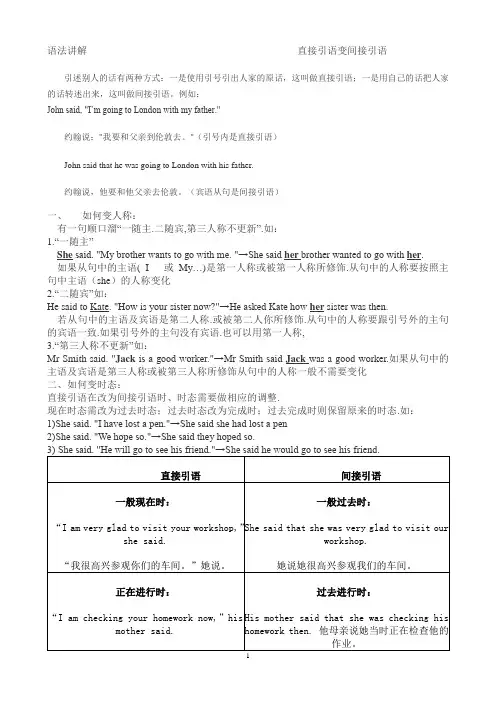
引述别人的话有两种方式:一是使用引号引出人家的原话,这叫做直接引语;一是用自己的话把人家的话转述出来,这叫做间接引语。例如:
John said, "I‟m going to London with my father."
约翰说:"我要和父亲到伦敦去。"(引号内是直接引语)
John said that he was going to London with his father.
约翰说,他要和他父亲去伦敦。(宾语从句是间接引语)
一、 如何变人称:
有一句顺口溜“一随主.二随宾,第三人称不更新”.如:
1.“一随主”
She said. "My brother wants to go with me. "→She said her brother wanted to go with her.
如果从句中的主语( I 或My…)是第一人称或被第一人称所修饰.从句中的人称要按照主句中主语(she)的人称变化
2.“二随宾”如:
He said to Kate. "How is your sister now?"→He asked Kate how her sister was then.
若从句中的主语及宾语是第二人称.或被第二人你所修饰.从句中的人称要跟引号外的主句的宾语一致.如果引号外的主句没有宾语.也可以用第一人称,
3.“第三人称不更新”如:
Mr Smith said. "Jack is a good worker."→Mr Smith said Jack was a good worker.如果从句中的主语及宾语是第三人称或被第三人称所修饰从句中的人称一般不需要变化
二、如何变时态:
直接引语在改为间接引语时、时态需要做相应的调整.
现在时态需改为过去时态;过去时态改为完成时;过去完成时则保留原来的时态.如:
语法核心突破
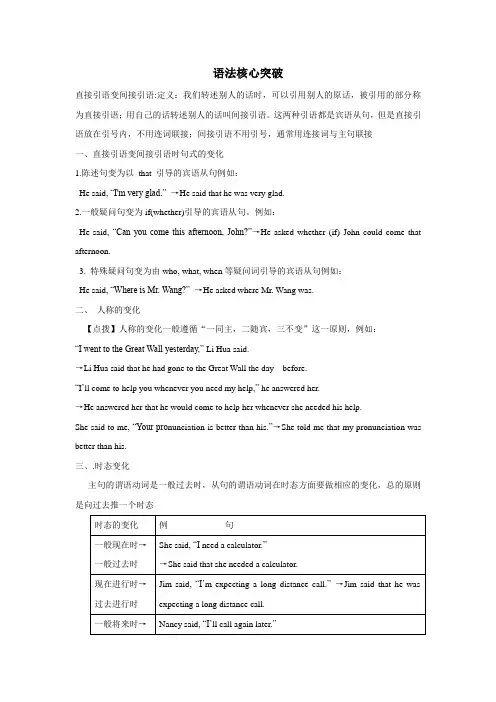
直接引语变间接引语:定义:我们转述别人的话时,可以引用别人的原话,被引用的部分称为直接引语;用自己的话转述别人的话叫间接引语。这两种引语都是宾语从句,但是直接引语放在引号内,不用连词联接;间接引语不用引号,通常用连接词与主句联接
一、直接引语变间接引语时句式的变化
1.陈述句变为以 that 引导的宾语从句例如:
He said, “I'm very glad.” →He said that he was very glad.
2.一般疑问句变为if(whether)引导的宾语从句。例如:
He said, “Can you come this afternoon, John?”→He asked whether (if) John could come that
afternoon.
3. 特殊疑问句变为由who, what, when等疑问词引导的宾语从句例如:
He said, “Where is Mr. Wang?” →He asked where Mr. Wang was.
二、 人称的变化
【点拨】人称的变化一般遵循“一同主,二随宾,三不变”这一原则,例如:
“I went to the Great Wall yesterday,” Li Hua said.
→Li Hua said that he had gone to the Great Wall the day before.
“I’ll come to help you whenever you need my help,” he answered her.
→He answered her that he would come to help her whenever she needed his help.
She said to me, “Your pronunciation is better than his.”→She told me that my pronunciation was