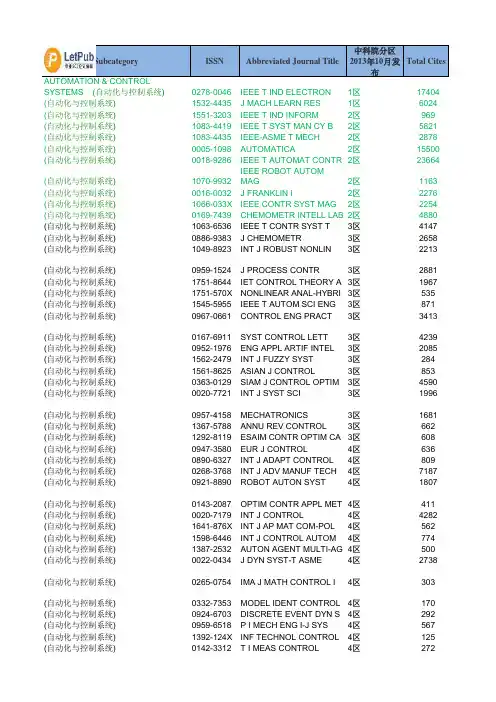
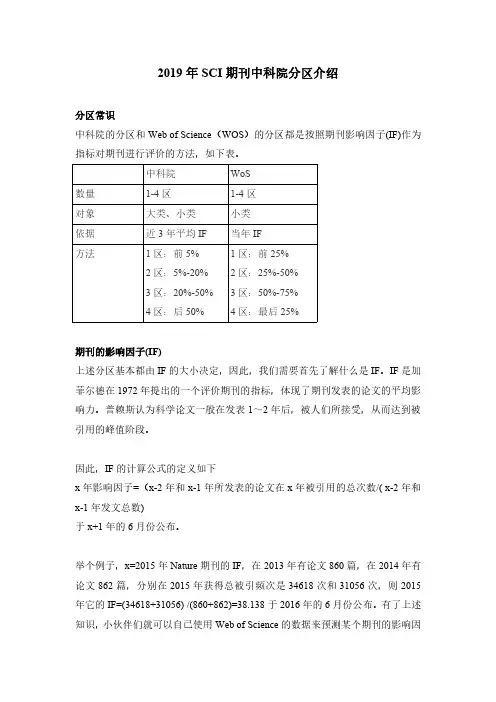
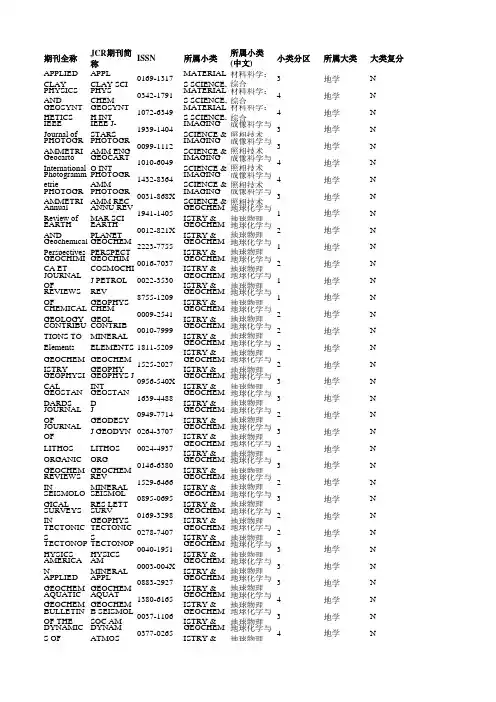
sci 中科院分区表格
- 格式:doc
- 大小:15.85 KB
- 文档页数:5
sci 中科院分区表格
English answer:
Q1: What is the Scimago Journal & Country Rank (SJR)?
A1: The Scimago Journal & Country Rank (SJR) is a
prestigious ranking system that evaluates the scientific
impact of journals and countries. It is developed by the
Spanish National Research Council (CSIC).
Q2: What are the criteria used to calculate the SJR?
A2: The SJR is calculated based on the following
criteria:
Citation Impact: The average number of citations
received by articles published in the journal.
Prestige: The prestige of the journal, as determined
by the number of citations received by articles published in high-impact journals.
Collaboration: The level of collaboration among
authors who publish in the journal.
International Impact: The percentage of citations
received from international sources.
Q3: How is the SJR presented?
A3: The SJR is presented in the form of a table, with
journals and countries ranked according to their SJR scores.
The table is divided into four quartiles, with Q1 being the
highest quartile and Q4 being the lowest quartile.
Q4: What is the relationship between the SJR and the
Journal Impact Factor (JIF)?
A4: The SJR and the JIF are two different metrics used
to evaluate the impact of journals. While the JIF focuses
on the number of citations received by articles in a
journal over a two-year period, the SJR takes into account a wider range of factors, including the prestige of the
journal and the international impact of its articles.
Q5: What are the advantages of using the SJR?
A5: The SJR has several advantages over the JIF,
including:
It provides a more comprehensive assessment of the
impact of journals.
It is not as susceptible to manipulation as the JIF.
It is more transparent than the JIF.
Chinese answer:
Q1: 什么是 Scimago 期刊与国家排名 (SJR)?
A1: Scimago 期刊与国家排名 (SJR) 是一个著名的排名系统,用于评估期刊和国家的科学影响力。它是由西班牙国家研究委员会
(CSIC) 开发的。
Q2: 计算 SJR 使用什么标准?
A2: SJR 根据以下标准计算:
引用影响: 期刊中发表的论文收到的平均引用次数。
声望: 期刊的声望,由发表在高影响力期刊中的论文收到的引用次数决定。
协作: 在期刊中发表论文的作者之间的协作水平。
国际影响: 从国际来源收到的引用百分比。
Q3: SJR 如何呈现?
A3: SJR 以表格的形式呈现,其中期刊和国家根据其 SJR 得分进行排名。该表格分为四个等级,Q1 为最高等级,Q4 为最低等级。
Q4: SJR 与期刊影响因子 (JIF) 之间是什么关系?
A4: SJR 和 JIF 是两种用于评估期刊影响力的不同指标。虽然 JIF 关注期刊中文章在两年内收到的引用次数,但 SJR 考虑了更广泛的因素,包括期刊的声望和其文章的国际影响力。
Q5: 使用 SJR 的优势是什么?
A5: SJR 相对于 JIF 具有以下优势:
它提供了一个更全面的期刊影响评估。
它不像 JIF 那样容易受到操纵。
它比 JIF 更透明。