
MIT-SCIENCE-Lectures-lec1present
- 格式:pdf
- 大小:5.00 MB
- 文档页数:42
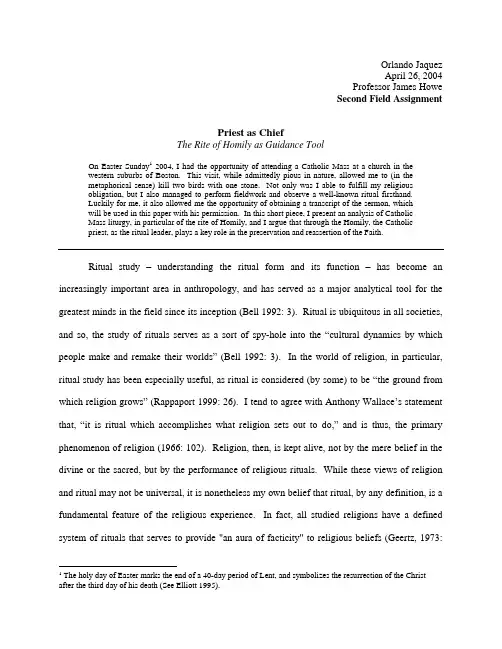
Orlando Jaquez April 26, 2004 Professor James Howe Second Field Assignment Priest as Chief The Rite of Homily as Guidance Tool On Easter Sunday1 2004, I had the opportunity of attending a Catholic Mass at a church in the western suburbs of Boston. This visit, while admittedly pious in nature, allowed me to (in the metaphorical sense) kill two birds with one stone. Not only was I able to fulfill my religious obligation, but I also managed to perform fieldwork and observe a well-known ritual firsthand. Luckily for me, it also allowed me the opportunity of obtaining a transcript of the sermon, which will be used in this paper with his permission. In this short piece, I present an analysis of Catholic Mass liturgy, in particular of the rite of Homily, and I argue that through the Homily, the Catholic priest, as the ritual leader, plays a key role in the preservation and reassertion of the Faith. Ritual study – understanding the ritual form and its function – has become an

7.88 Lecture Notes - 7
7.24/7.88J/5.48J
The Protein Folding Problem
Tropomyosin and S-peptide
• Sequence determinants of Coiled Coil Structure
• Tropomyosin
• Circular Dichroism
• Tropomyosin thermal denaturation/renaturation
• Chain Recognition, Association, Registration
A. Revisit Sequence determination of Coiled Coils
H – X – X -H – P – X - P – H – X – X – H – P – X - P- H – X – X - H-P – X -P
Lets draw as helical wheel:
Note side chain interactions above and below plain:
Now lets flip the sequence 18:
Sequence:
• 1,4 residues: hydrophobic core
• 5,7: selectivity, polarity
• 2,3, 6: Quaternary interactions; cellular functions
Perhaps: But for TM and other coiled coils, easy to see that they encode:
Lets review muscle structure:
Theta in degrees;
Light waves are transverse vibrations; can be vibrating in various planes

5. THE COLOMBIAN EXCHANGE (2/19/04)
(Students present reports on organisms they have chosen to study.)
For each crop, animal species, weed, or illness, one has to consider: How did it spread?
with or without human help? What was its specific value or contribution or impact? by
itself? in combination with others? How did it fit with species already there? with other
new species? How did human desires/intentions/preferences/ideas influence its spread
and impact, if at all?
New World to Old World crop transfers: maize corn, beans, squash, peanuts, potatoes,
sweet potatoes, pumpkin, tomatoes, chiles, chocolate, manioc, tobacco, tropical fruits.
etc.
Old World to New: wheat, grapes, olives, sugar, bananas, apples, etc.
Transfer of domestic animals very one-sided, Old to New: cows, pigs, horses, sheep,
goats

Lecture Notes - 3
7.24/7.88J/5.48J
The Protein Folding Problem
• Reprise RNase refolding
• General Features of Globular proteins
• Interior Packing
Rnase Refolding
We can cartoon the experiments:
Assume that reduced form is unfolded and populates an ensemble of unfolded
states in 8M urea:
[Unfolded] [Intermediate] [Native]
[U]
Rapidly exchanging statistical ensemble of random coils
[I]
???
[N]
Native fold, $ S-S bonds, 1 out of 105 possible sets of S-S bonds
[Aggregated]
Non-native (no enzymatic activity), non-native (scrambled) disulfide bonds.
At the end of the reaction we have native state
Soluble inactive – misfolded or perhaps small oligomers
Precipitated: Anfinsen showed that these were S-S bonded network = he called
“scrambled”
Critical question is nature of the intermediates as go from here to there: