
管理学罗宾斯第11版04
- 格式:ppt
- 大小:1.65 MB
- 文档页数:22
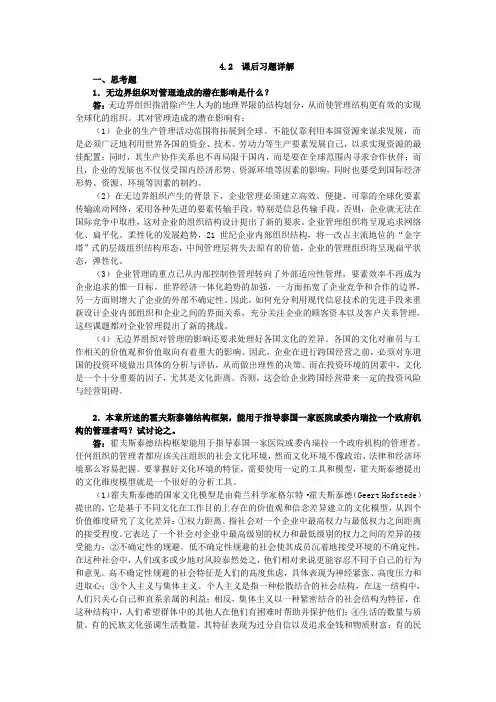
4.2 课后习题详解一、思考题1.无边界组织对管理造成的潜在影响是什么?答:无边界组织指消除产生人为的地理界限的结构划分,从而使管理结构更有效的实现全球化的组织。
其对管理造成的潜在影响有:(1)企业的生产管理活动范围将拓展到全球。
不能仅靠利用本国资源来谋求发展,而是必须广泛地利用世界各国的资金、技术、劳动力等生产要素发展自己,以求实现资源的最佳配置;同时,其生产协作关系也不再局限于国内,而是要在全球范围内寻求合作伙伴;而且,企业的发展也不仅仅受国内经济形势、资源环境等因素的影响,同时也要受到国际经济形势、资源、环境等因素的制约。
(2)在无边界组织产生的背景下,企业管理必须建立高效、便捷、可靠的全球化要素传输流动网络,采用各种先进的要素传输手段,特别是信息传输手段。
否则,企业就无法在国际竞争中取胜,这对企业的组织结构设计提出了新的要求。
企业管理组织将呈现追求网络化、扁平化、柔性化的发展趋势,21世纪企业内部组织结构,将一改占主流地位的“金字塔”式的层级组织结构形态,中间管理层将失去原有的价值,企业的管理组织将呈现扁平状态,弹性化。
(3)企业管理的重点已从内部控制性管理转向了外部适应性管理,要素效率不再成为企业追求的惟一目标。
世界经济一体化趋势的加强,一方面拓宽了企业竞争和合作的边界,另一方面则增大了企业的外部不确定性。
因此,如何充分利用现代信息技术的先进手段来重新设计企业内部组织和企业之间的界面关系,充分关注企业的顾客资本以及客户关系管理,这些课题都对企业管理提出了新的挑战。
(4)无边界组织对管理的影响还要求处理好各国文化的差异。
各国的文化对雇员与工作相关的价值观和价值取向有着重大的影响。
因此,企业在进行跨国经营之前,必须对东道国的投资环境做出具体的分析与评估,从而做出理性的决策。
而在投资环境的因素中,文化是一个十分重要的因子,尤其是文化距离。
否则,这会给企业跨国经营带来一定的投资风险与经营阻碍。

罗宾斯管理学第四章练习题Chapter 4 – Managing in a Global EnvironmentTrue/False QuestionsA MANAGER’S DILEMMA1. According to the company profile in “A Manager’s Dilemma,” Cemex is an example of a company that suffers from parochialism.False (moderate)2. Geocentric is the orientation that best describes the attitude of Cemex toward international business.True (moderate)3. Cemex can be described as a company in Stage 1 of doing business globally.False (moderate)4. The environmental factor that is most important to the adjustment of Cemex expatriate managers is the economic environment.False (moderate)WHAT’S YOUR GLOBAL PERSPECTIVE?5. Americans tend to suffer from parochialism.True (moderate)6. A drawback of the geocentric perspective is that it is inflexible.False (moderate)7. Managers with an ethnocentric attitude would not trust foreign employees with key decisions or technology. True (moderate)8. Managers with a polycentric attitude would view every foreign operation as difficult and hard to understand. True (moderate)9. The polycentric attitude is a world-oriented view focusing on using the best approaches and people from around the globe.False (moderate)UNDERSTANDING THE GLOBAL ENVIRONMENT10. The European Union and the North American Free Trade Agreement created regional trading and cooperative agreements.True (easy)11. The ultimate goal of the European Union (EU) is to have common customs duties and unified industrial and commercial policies as well as a single currency and a regional central bank.True (difficult)12. The primary motivation for the creation of the European Union (EU) was to allow Europeans to reassert their position against the industrial strength of the U.S. and Japan.13. The three original partners of NAFTA are the U.S., Canada, and Mexico.True (easy)False (difficult)15. Mercosur is a trading group made up of South American countries.True (moderate)16. Multinational corporations became commonplace in the mid 1960s.True (moderate)17. Multinational corporations maintain significant operations in two or more countries simultaneously but are based in one home country.True (moderate)18. The transnational corporation characterizes the ethnocentric attitude towards the management of an organization's global business.False (difficult)19. Transnational corporations run their business from their home country.False (easy)HOW ORGANIZATIONS GO GLOBAL20. The first stage when an organization goes international is exporting its products to other countries.True (moderate)21. The second stage of an organization going international is the initial overt entry where the organizationhires foreign representation or contracts with foreign manufacturers.True (difficult)22. In stage three of an organization going international, managers aggressively pursue international markets and may license or franchise to another firm the right to use the organization's brand name, technology, or product specifications.True (difficult)MANAGING IN A GLOBAL ENVIRONMENT23. The legal-political environment is an important factor of managing in a foreign environment.True (easy)24. Only when a country's legal-political environment is unstable or revolutionary is it of concern to managers. False (easy)25. Research indicates that organizational culture has a stronger impact on employees than national culture. False (difficult)26. Mexico is an example of a collectivist nation.True (difficult)27. The United States is an example of a country with lower power distance.28. An increased level of anxiety among its people characterizes a society with high uncertainty avoidance. True (easy)29. Hofstede found that the U.S. culture is well above average on quantity-of-life measures of culture.True (easy)IS A GLOBAL ASSIGNMENT FOR YOU?30. Organizational socialization refers to the process employees go through to adapt to an organization's culture. True (moderate)Multiple ChoiceA MANAGER’S DILEMMA31. According to the company profile of Cemex in “A Manager’s Dilemma,” which of the following environmental factors is most important in the adjustment of the Cemex expatriate managers?a.political environmentb.legal environmentc.economic environmentd.cultural environment (moderate)e.technological environment32. At which of the following stages of doing business globally would Cemex best fit?a.Stage 1b.Stage 2c.Stage 3 (moderate)d.Stage 4e.Stage 533. Which of the following best describes Cemex as a global organization?a.domestic corporationb.multinational corporationc.transnational corporation (moderate)d.transparent corporation34. Which of the following best describes the attitude toward international business of Cemex?a.ethnocentricb.polycentricc.geocentric (moderate)d.parochialWHAT’S YOUR GLOBAL PERSPECTIVE?35. One reason for parochialism in the U.S. is that Americans tend to study _____________ in school.a. only English (easy)b. only two languagesc. English and Frenchd. English and Germane. German and Spanish36. Which of the following describes the current state of world use of languages?a. Germans and Italians, unlike other Europeans, only speak their native language.b. Americans tend to study many other languages in school.c. Most Japanese begin learning English by their third year of high school.d. Americans tend to think of English as the only international business language. (moderate)37. _____________ is a sign that Americans suffer from parochialism.a. Multinationalismb. Monolinguism (moderate)c. Geocentrismd. Polycentrisme. Globalism38. Parochialism isa. acceptance of diverse points of view.b. a desire to leave one's own culture for a foreign culture.c. a tendency to view the world through a single perspective. (moderate)d. recognition of diverse religious beliefs.e. acceptance of one dominant and one secondary "correct" cultural view.39. Which of the following would be an example of a manager displaying a parochial attitude in a foreign environment?a. enjoying the silence in a meeting with Japaneseb. learning how to drink alcohol with meals while negotiating with French counterpartsc. wanting to speed up the pace of bargaining with Spanish traders (difficult)d. speaking Spanish in Mexicoe. reading about the Muslim faith prior to visiting Iraq40. For U.S. businesses to have successful global management, which of the following statements provides the best advice?a. Americans should continue to push for the use of English only.b. Stick to your own customs to avoid embarrassing incidents.c. Make sure foreign business people know you are American so they will speak to you in English.d. Patronize foreign customs until your counterparts become comfortable with the American values.e. Develop an understanding of multicultural differences. (moderate)41. A(n) _____________ attitude is a parochialist belief that home country practices are best.a. ethnocentric (easy)b. polycentricc. geocentricd. internationale. global42. Which of the following is the least favorable attitude for an American manager who wishes to be successful in international business?a. multiculturalb. multicountryc. geocentricd. polycentrice. ethnocentric (easy)43. A(n) _____________ attitude is the view that host country managers know best practices for running their operations.a. ethnocentricb. polycentric (easy)c. geocentricd. internationale. global44. A world-oriented view that focuses on using the best approaches and people from around the globe is referred to as a _______________.a. ethnocentricb. polycentricc. geocentric (easy)d. internationale. global45. Which of the following is not an advantage of a polycentric perspective?a. extensive knowledge of foreign marketb. best people and work approaches used regardless of origin (difficult)c. more support from host governmentd. extensive knowledge of foreign workplacee. committed local managers with high morale46. Which of the following is an advantage of a geocentric perspective?a. extensive knowledge of foreign marketb. best people and work approaches used regardless of originc. more support from host government (difficult)d. extensive knowledge of foreign workplacee. committed local managers with high morale47. The geocentric attitude is a _____________ view.a. nationalb. countryc. culture-boundd. narrowe. world (moderate)48. _____________ management requires enhanced sensitivity to differences in national customs and practices.a. Ethnocentricb. Polycentricc. Global (moderate)d. Parochiale. Domestic49. Successful global management requires _____________.a. rigid application of home country practices.b. enhanced sensitivity to differences in national customs and practices. (moderate)c. Americanization of foreign managers.d. teaching English to foreign nationals.e. a "hands off" attitude.UNDERSTANDING THE GLOBAL ENVIRONMENT50. The Maastricht Treaty was signed in _____________.a. 1989.b. 1990.c. 1991.d. 1992. (moderate)e. 1993.51. The Maastricht Treaty created _____________.a. N.A.F.T.A.b. the E.U. (moderate)c. the Pacific Rim Bloc.d. G.D.P.e. the Economic Alliance of Nations.52. Which of the following is not a member of the European Union?a. Greeceb. Irelandc. Swedend. Norway (difficult)e. Finland53. By the end of this century, there is likely to be a Greater European Economic Alliance that encompasses at least _____________ countries with over _____________ million people.a. 15, 250b. 18, 300c. 21, 425 (difficult)d. 24, 500e. 30, 80054. Which of the following is an impact of the creation of the European Union?a. There is elimination of border taxes, but increased border subsidies between the countries.b. There are no barriers to travel between countries.c. There are no border taxes, but they have retained multiple markets. (difficult)d. There are increased border controls in general.e. A person may travel, but not work, in the participating countries.55. The single European Union (EU) currency will be called thea. Franc.b. Franc-mark.c. Pound.d. Euro. (moderate)e. EUC.56. Which of the following statements is true regarding the European Union?a. Its membership, originally at 12 countries, has shrunk to its present 10 countries.b. It hopes to have a single currency by the year 2002. (difficult)c. Other European countries are avoiding relationships with the EU.d. Though some progress has been made, the EU has basically been a failure.e. The EU is seeking to discourage trade.57. Which of the following is not a member of the Southern Cone Common Market?a. Chileb. Brazilc. Mexico (difficult)d. Argentinae. Bolivia58. The Southern Cone Common Market, made up of Chile, Brazil, Argentina, Paraguay, Uruguay, and Bolivia, is also known as _____________.a. EU.b. Mercosur. (moderate)c. NAFTA.d. SAFTA.e. Association of South American Countries.59. Which of the following statements most accurately reflects the present state of regional cooperative economic agreements?a. The NAFTA countries are expected to merge with the EU countries by the year 2015.b. Regional agreements are expanding worldwide. (difficult)c. Religious barriers have discouraged growth.d. Due to political unrest, Latin American countries have not been able to maintain agreements.e. These agreements are not expected to last due to an increase in nationalistic tendencies.60. The trading bloc made of Brunei, Indonesia, Malaysia, the Philippines, Singapore, Thailand, and Vietnam is _____________.a. NAFTA.b. EU.c. TAFTA.d. ASEAN. (moderate)e. Mercosur.61. International businesses have been around since about what date?a. the 15th centuryb. the 17th centuryc. the 19th century (difficult)d. the 20th centurye. about 195562. Multinational Corporations (MNCs) have only become commonplace since approximately what date?a. mid 1960s (moderate)c. 1945d. mid 1980se. 199063. Which of the following is a basic definition of a multinational corporation?a. A company that maintains significant operations in at least two different countries.b. A company that maintains significant operations in at least two different countries but is based in one home country. (difficult)c. A company that maintains significant operations in at least two different countries and has multiple home bases.d. A company that does business and pays taxes in at least two countries.e.There is no accepted definition of multinational corporation.64. Which of the following is the basic difference between multinational corporations and transnational corporations?a.Multinational corporations typically do business with more countries than transnational corporations.b.Transnational corporations are run by the parent company but must be owned by a local, national company.c.Decision-making in transnational corporations takes place locally rather than from the home country. (difficult)d.Multinational corporations pay more in taxes than transnational corporations.e.There is basically no difference between the two forms of business.65. Which of the following is not a feature of a transnational corporation?a.Decision-making takes place at the local level.b.Nationals are typically hired to run operations in each country.c.Marketing strategies are tailored to each country's culture.d.Product strategies are tailored to each country's culture.e.Products are manufactured only in the local country. (easy)66. Which of the following types of global organizations reflects the polycentric attitude?a. multinationalb. transnational (difficult)c. polycentricd. regionale. borderless67. The _____________ organization approaches global business from the geocentric approach.b. transnationalc. polycentricd. regionale. borderless (difficult)68. According to the text, the ______________ approaches global business from a geocentric attitude.a. multinational corporationb. transnational corporationc. polycentric corporationd. regional corporatione. borderless organization (difficult)HOW ORGANIZATIONS GO GLOBAL69. How many stages are there in an organization's evolution into a global organization?a. oneb. twoc. three (easy)d. foure. five70. Which of the following characterizes the first stage of an organization’s global evolution?a. exporting its products to other countries (difficult)b. cross-culturally training its managersc. hiring foreign brokers to represent the organization's product lined. sending domestic employees on regular foreign business tripse. gaining an understanding of basic foreign tax laws71. When an organization evolves into a global organization, stage _____________ is the most passive step.a. one (moderate)b. twoc. threed. foure. five72. According to the text, most organizations start doing business globally by _____________.a.exporting and importing (easy)b.licensing and franchisingc.strategic alliancesd.joint venturese.setting up foreign subsidiaries73. Which of the following characterizes stage two of an organization’s global evolution?a. exporting its products to other countriesb. cross-culturally training its managersc. hiring foreign representation (difficult)d. licensing another firm to use its brand namee. beginning foreign product manufacturing74. Joint ventures are also termed _____________.a.licenses.b.franchises.c.foreign subsidiaries.d.subsidiaries.e.strategic alliances. (moderate)75. Creating a strategic alliance occurs during which stage of an organization's global evolution?a.oneb.twoc.three (easy)d.foure.five76. A domestic and a foreign firm sharing the cost of developing new products or building production facilities in a foreign country is called a _____________.a.franchising agreement.b.joint venture. (moderate)c.foreign subsidiary.d.brokering agreement.e.production agreement.77. Which of the following characterizes stage th ree of an organization’s global evolution?a.cross-culturally training its managersb.sending domestic employees on regular foreign business tripsc.hiring foreign brokers to represent the organization's product lined.management contracts with a foreign firm to produce its productse.management may create a joint venture (difficult)78. Creating a foreign subsidiary occurs during which stage of an organization's global evolution?a. oneb. twoc. three (easy)d. foure. five79. _____________ present(s) the greatest risk to an organization going international.a. Joint venturesb. Strategic alliancesc. Licensingd. Foreign subsidiaries (difficult)e. FranchisingMANAGING IN A GLOBAL ENVIRONMENT80. Which of the following is NOT listed by your text as an area of significant challenge for an American manager working in a foreign country?a. legal environmentb. economic environmentc. cultural environmentd. religious environment (difficult)e. political environment81. Compared to many other countries, the U.S. legal-political environment is considered _____________.a.radical.b.stable. (moderate)c.unstabled.fixed.e.static.82. Compared to many other countries, changes to the U.S. legal-political environment are considered_____________.a.very fast and effective.b.fast, but not efficient.c.radical.d.slow. (moderate)e.fast, especially when power between the parties shifts.83. Three of the most obvious economic concerns for U.S. managers doing business in foreign countries are _____________.a.fluctuating currency exchange rates, inflation rates, and tax policies. (difficult)b.fluctuating currency exchange rates, tax policies, and pay rates for foreign employees.c.tax policies, pay rates for foreign employees, and banking system variances.d.inflation rates, banking system variances, and fluctuating currency exchange rates.e.pay rates for foreign employees, banking system variances, and delays to accounts receivable.84. Which of the following describes the impact from inflation that managers must consider?a.In small nations, inflation can reach 200 percent.b.It increases the price of labor. (moderate)c.It decreases the price for raw materials, but increases the price for finished goods.d.The direction of its impact on the price of goods varies.e.Its impact is easier on U.S. than foreign organizations.85. Managerial concern about international tax policies _____________.a.is due to varying tax rules from country to country. (easy)b.is more than it should be.c.is low because U.S.-based firms do not pay foreign taxes.d.tends to limit U.S. trade with countries such as England.e.will be reduced with the passage of the Common Foreign Tax Agreement (CFTA) expected to beratified by the end of this decade.86. A country's national culture _____________.a.is very different from the concept of organizational culture.b.is by far the biggest impediment to international business.c.shapes its inhabitant's behavior and worldview. (moderate)d.should not be considered in business agreements due to potential charges of discrimination.e.is an important but minor issue of concern.87. Concerning the interaction between national culture and organizational culture, which of the following is true?a.They tend to cancel out each other.b.National culture is easier to change.c.In the business world, national culture and organizational culture do not interact.d.National culture has a greater impact than organizational culture on employees. (moderate)e.National culture is a social issue, and organizational culture is a business issue.88. Which of the following international management concerns is the most difficult to gain information about?a. legalb. ethicalc. cultural (moderate)d. economice. political89. The reason that a nation's cultural differences are the most difficult to gain information about is because_____________.a.people tend to be sensitive about their own culture.b.providing this information to foreign organizations reduces a competitive business advantage.c.there is little written on the issue.d.it is the most complex issue, and multinational and transnational organizations are relatively new phenomena.e."natives" are least capable of explaining the unique characteristics of their own culture.(difficult)90. According to the text, the most valuable framework to help managers better understand differences between national cultures was developed by ______________./doc/51148ac0bbf3f90f76c66137ee06eff9aef84978.html ton Freidmanb.Michael Porterc.Geert Hofstede (moderate)d.Abraham Maslow91. Which of the following is not a dimension of national culture found by Geert Hofstede?a. individualism versus collectivismb. power distancec. cognitive versus behavioral orientation (difficult)d. uncertainty avoidancee. quantity versus quality of life92. _____________ is a cultural dimension in which people are supposed to look after their own interests and those of their immediate family.a. Power distanceb. Collectivismc. Quantity of lifed. Uncertainty avoidancee. Individualism (easy)93. _____________ is a cultural dimension in which people expect others in their group to look after them and protect them when they are in trouble.a. Power distanceb. Collectivism (easy)c. Quantity of lifed. Uncertainty avoidancee. Individualism94. Hofstede found that the degree of individualism found in a country is closely related to which of followingnational characteristics?a. ageb. wealth (moderate)c. political frameworkd. locatione. language95. The United States is strongly individualistic but low on power distance. Which of the following countries does not demonstrate the same pattern?a. Great Britainb. Australiac. Canadad. Venezuela (difficult)e. Netherlands96. _____________ is a cultural measure of the extent to which a society accepts the unequal distribution of power in institutions and organizations.a. Power distance (easy)b. Uncertainty avoidancec. Quantity of lifed. Quality of lifee. Culture shock97. Which of the following would you find in a country with a high power distance?a. Society accepts narrow differences in organizations.b. Title carries little power, but status power is high.c. little respect for those in authorityd. a meeting with organizational representatives with equal titles (moderate)e. equal distribution of power within organizations98. _____________ is a cultural measure of the degree to which people tolerate risk and unconventional behavior.a. Power distanceb. Uncertainty avoidance (easy)c. Quantity of lifed. Quality of lifee. Culture shock99. According to the text, organizations in which of the following cultures are likely to have formal rules and little tolerance for unusual ideas and behaviors?a.high power distanceb.low power distancec.high uncertainty avoidance (easy)d.low uncertainty avoidance100. _____________ is a national culture attribute describing the extent to which societal values are characterized by assertiveness and materialism.a. Power distanceb. Uncertainty avoidancec. Quantity of life (moderate)d. Quality of lifee. Culture shock101. _____________ is a national culture attribute that reflects the emphasis placed upon relationships and concern for others.a. Power distanceb. Uncertainty avoidancec. Quantity of lifed. Quality of life (moderate)e. Culture shock102. Which of the following is most like the U.S. in terms of power distance, uncertainty avoidance, and quantity-of-life dimensions?a. Singaporeb. Great Britain (easy)c. Portugald. Pakistane. Chile103. _____________ is the feelings of confusion, disorientation, and emotional upheaval caused by being immersed in a new culture.a. Power distanceb. Uncertainty avoidancec. Quantity of lifed. Quality of lifee. Culture shock (easy)IS A GLOBAL ASSIGNMENT FOR YOU?104. The process that employees go through to adapt to an organizat ion’s cultures is referred to as ______________. /doc/51148ac0bbf3f90f76c66137ee06eff9aef84978.html anizational specialization/doc/51148ac0bbf3f90f76c66137ee06eff9aef84978.html anizational socialization (moderate)c.culture shockd.locus of control105. According to the text, studies have shown that most people effectively and comfortably adjust to a new culture after about ______________.a.four to six daysb.four to six weeksc.four to six months (moderate)d.one year。
《管理学》第11版罗宾斯Sail我是2014年参加的浙财会计学学硕考试,在考研的路上,也经过了许多波折坎坷,但总是告诉自己,前面就是光明。
时间在不断流逝,我们的心是否还依旧平稳,不管如何,希望大家一定要坚持下去,不要让自己后悔,有一段话,献给在考研路上努力奋斗着的童鞋们:贵在主动,重在过程,有心有序,有度有恒,求实求真,躬身力行。
我希望在你们挥汗奋斗的日子里,我能够带给你们一定的光明和正能量,相信自己,坚强地走下去。
加油!A Blueprint for AchievementPractice while others are complaining.Believe while others are doubting.Plan while others are playing.Study while others are sleeping.Decide while others are delaying.Prepare while others are daydreaming.Begin while others are procrastinating.Work while others are waiting.Save while others are wasting.Listen while others are talking.Smile while others are frowning.Compliment while others are criticizing.Persist while others are quitting.Progress while others are lagging behind.Then, you will succeed while others are failing.目录第一篇管理导论 2第1章管理与组织领导 21.1管理者为什么对组织很重要? 21.2谁是管理者以及他们在那里工作? 21.3管理者的职能、角色和技能。