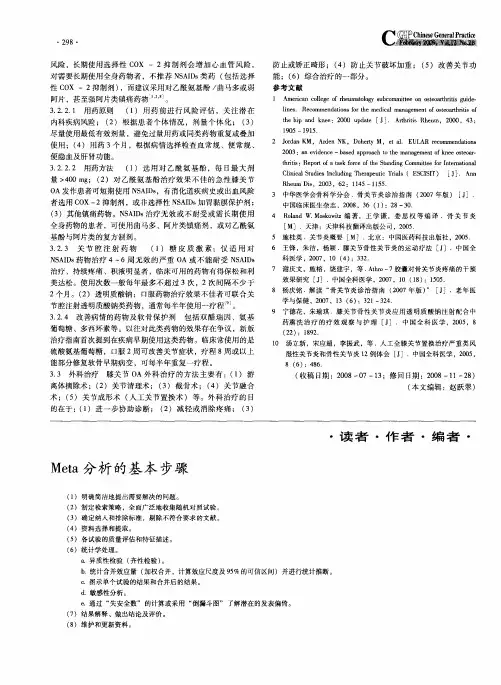
meta分析中的基本使用
- 格式:docx
- 大小:36.98 KB
- 文档页数:3
meta分析中的基本使用
Basics of Meta-analysis:
1. Identify the research question: The first step in
conducting a meta-analysis is to clearly define the research
question or hypothesis. This will help to guide the search for
relevant studies and determine the inclusion and exclusion
criteria for the meta-analysis.
3. Select eligible studies: After identifying the relevant
studies, the next step is to screen these studies based on pre-defined inclusion and exclusion criteria. This process is
usually performed by two independent researchers to ensure
reliability and to minimize bias. Disagreements between the
researchers are resolved through discussion or consultation with
a third researcher.
7. Assess heterogeneity: Heterogeneity refers to the
variability in effect sizes across studies. Understanding and
accounting for heterogeneity is a crucial step in meta-analysis.
Various statistical tests, such as Q-statistic and I^2 statistic,
can be used to assess the heterogeneity. If significant
heterogeneity is identified, subgroup analyses or sensitivity
analyses can be conducted to explore the potential sources of
heterogeneity. 8. Conduct publication bias assessment: Publication bias
refers to the tendency of studies with statistically significant
results to be more likely to be published, while studies with
non-significant or negative results are less likely to be
published. Publication bias can lead to overestimation of the
overall effect size in a meta-analysis. Various methods, such as
funnel plots, Egger's regression test, and Begg's rank
correlation test, can be used to assess and address publication
bias.
Advantages of Meta-analysis:
2. Improved generalizability: By including a larger and more
diverse sample of participants, meta-analyses are more
generalizable to the broader population. This enhances the
external validity of the findings.
3. Enhanced precision: Meta-analysis provides a more precise
estimate of the effect size by pooling the results from multiple
studies. This reduces random error and increases the precision
of the estimate.
In conclusion, meta-analysis is a powerful statistical
technique that can provide more robust and reliable estimates of
effect sizes by aggregating evidence from multiple studies. By
following the basic steps outlined above, researchers can
conduct a rigorous and systematic meta-analysis that enhances the understanding of a particular research question and informs
evidence-based practice.