英语名词讲解
- 格式:docx
- 大小:24.95 KB
- 文档页数:4
1 / 4
第一讲 名词篇
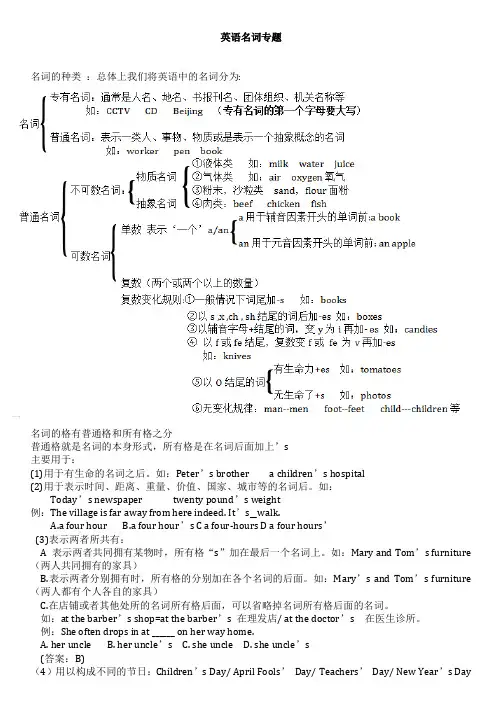
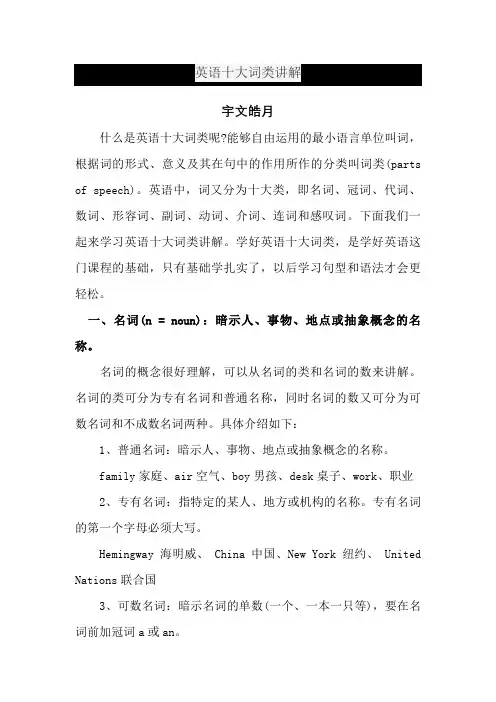
一、名词的含义:指人或者物品的名称。分为专有名词和普通名词
(一)专有名词:指地点、机构、事物的名称,其特点是首字母要大写。
Eg:China、Betty
(二)普通名词:分为可数名词和不可数名词
二、名词的数:
在英语里面,名词分可数名词(即能数清楚的单词)和不可数名词(不能数清楚的单词)。
(一)不可数名词即数不清楚的名词没有单复数之分,用时只当单数名词用Eg: sun
water bread food
air rice
不可数名词做主语,谓语动词用单数。Eg:The water ____________(be)clean.
(二)可数名词有单复数之分,
1、单数即指一个,前面要用a或an,表示:一个....
eg: a pencil, a basketball,an apple
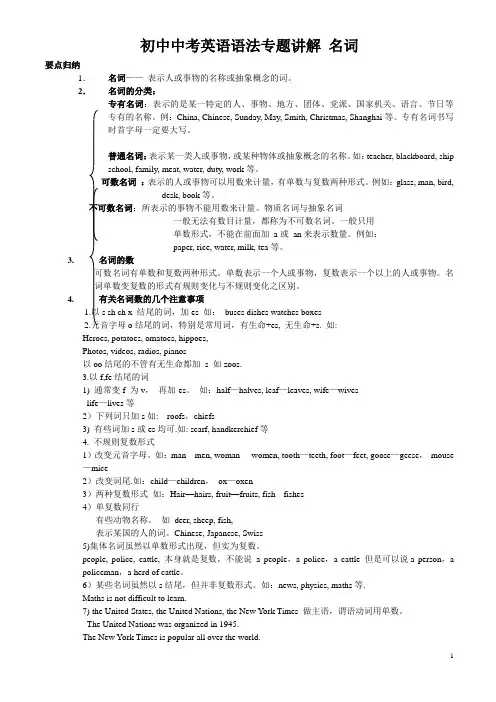
2、复数即两个或两个以上的,名词单数变复数,要作相应的变化,情况如下:
(1)规则变化
①、 一般在名词词尾加-s. 如:desks, pens、boys
①、 以s, x, ch, sh结尾的名词的词尾加-es.如:watches, buses, boxes.
①、以“辅音字母+y”结尾的名词,改y为i再加es. 如:families, cities.
①、以f或fe结尾的名词,改f或fe为v再加es.如:lives, knives.
①、 以o结尾的名词,有生命的在词尾加es. 如:tomatoes,potatoes
初中阶段主要有:Negro(黑人)hero(英雄)爱吃tomato(西红柿)和potato(土豆)
以o结尾的无生命的名词+s. 如:pianos, radios,zoos
(2)不规则变化:(要特殊记)
child→children man→men woman→women
tooth→teeth foot→feet sheep→sheep
deer→deer Chinese—Chinese Japanese—Japanese
fish --fish mouse---mice
2 / 4
三、名词所有格:意为:...的,多数情况其后面要有名词
名词在句中表示所属关系的语法形式叫做名词所有格,相当于物主代词,在句中作定语、宾语或主语。所有格分三种:一是名词词尾加’s构成,二是由介词of加名词构成。前者多表示有生命的东西,后者多表示无生命的东西。三是双重所有格。
1. ’s所有格的构成:
单数名词在末尾加’s the boy’s father, Jack’s book, her son-in-law’s photo, Jim's bed , the
man's wife, the fox's tail
复数名词 以s结尾的名词复数,在末尾加’ the teachers’ room, the twins’ mother, Childern’s Day,
不以s结尾的名词后加’s the children’s toys, women’s rights,
表示各自的所有关系时,两个名词末尾均须加’s Japan’s and America’s problems(有两个问题),
Jane’s and Mary’s bikes(两辆自行车)
表示共有的所有关系时在最后一词末加’s Jane and Mary’s father(两个人共同的父亲,一个),
Lucy and Lily’s bedroom(两个人共有的卧室,一个)
表示"某人家""店铺",所有格后名词省略 the barber’s, the tailor’s, my uncle’s my aunt’s(我阿姨家), the
doctor’s(诊所)
名词所有格所修饰的词,如果前面已经提到过,往往可以省略,以免重复。
Whose pen is this? It's Tom's.这是谁的钢笔?是汤姆的。
The bike is not mine, but Tom’s.这辆自行车不是我的,是Tom的。
2. of所有格的用法:部分+of+整体
用于无生命的东西:the legs of the chair, the cover of the book, a map of the world ,
the story of a hero , the windows of the room , the title of the film
用于有生命的东西,尤其是有较长定语时:the classrooms of the first-year students
某些of所有格和‘s所有格可以互换。
the son of a poor peasant=a poor peasant’s son一个贫农的儿子
但有时含义却不相同,请比较下面的例子:
an old woman's story(一个老妇人讲自己的身世)
the story of an old woman(别人讲一个老妇人的身世) 3 / 4
3. 双重所有格
在意义上与"one of..."相似:
1 of+one’s/名词性物主代词” a friend of my father’s(我父亲的一位朋友) =one of my
father’s friends,
a friend of mine(我的一位朋友)=one of my friends
I like reading some books of his.我喜欢读他的一些书。
Which book of Qiong Yao’s do you like best?你最喜欢琼瑶的哪一本书?
四、名词或代词作主语时和谓语之间的单复数的一致问题:
1、主语和谓语基本保持单复数的一致,即:主语是是单数或者不可数名词时,谓语动词用单数形式。Eg:
(1)The computer looks cool.电脑看起来很酷。
(2)The water in the glass is very cold.(玻璃杯里的水很冷)。
主语是复数时,谓语动词用复数。The students are working hard.
2、集体名词(如family, class, team, group, row, police, school等)做句子主语时,
如果表示整体概念,则谓语用单数形式,如:
Class Three is a very good class.(三班是好班)
如果表示其中的所有成员时,则谓语用复数形式,如:
Class Three have a map of China.(三班有张中国地图)
3、Chinese, Japanese, fish, sheep, people等表示单个时谓语用单数,表示许多时,谓语用复数。如:There is a sheep in the yard.(院子里有只绵羊) / There are some sheep in
the yard.(院子里有一些绵羊)
4、maths, news等虽然有s结尾,但不是复数,因此谓语仍用单数:The news is
very exciting. (这个消息令人兴奋)
5、glasses, shoes, socks, trousers, gloves等名词往往用复数形式,故谓语用复数。如:
The trousers are very cheap and I want to take them.(裤子很便宜,我想买)
6、a lot of, some既可以修饰可数名词,也可以修饰不可数名词。单复数看后边名词。如:
Some students are playing baseball now.(现在有许多学生在打垒球)
A lot of time was wasted on that work.(大量的时间花在了那个工作上)(被动句) 4 / 4
7、there be 句型中be的单复数一般由靠近的名词决定。如:
There is a table and four chairs in the room.(房间里有一张桌子和四张椅子)
8、用both…and…连接两个事物做主语时,谓语一般用复数。如:
Both you and I are required to be here tomorrow.(你和我明天要求都来)
9、表示一段时间,距离,金钱等度量衡时,谓语一般用单数。如:
Two months is not a short time.(两个月不是个短时间)
Two thousand kilometers is quite a long distance(距离).(两千千米是相当长的一段距离)。Two thousand dollars isn’t a large amount of money. (两千美元不是一笔大数目)
五、名词的用法:
名词在句中作主语, 宾语,介词宾语,宾语补助语,表语以及名词短语作状语。
The bag is in the desk.作主语。 书包在桌子里边。
I washed my clothes yesterday.作宾语。 昨天我洗了我的衣服。
This is a good book. 作表语。 这是一本好书。
We elected him our monitor.作宾语补助语。 我们选他为我们的班长。
Mary lives with her parents.作介词宾语. 玛丽和她的父母亲住在一起。
He is a Party member.作定语. 他是一名党员。
They study hard day and night.作(时间)状语。 他们白天黑夜地学习。