
巴蜀英才2017春七年级英语下册Module3MakingplansUnit3Languageinuse作业课件
- 格式:ppt
- 大小:16.28 MB
- 文档页数:24

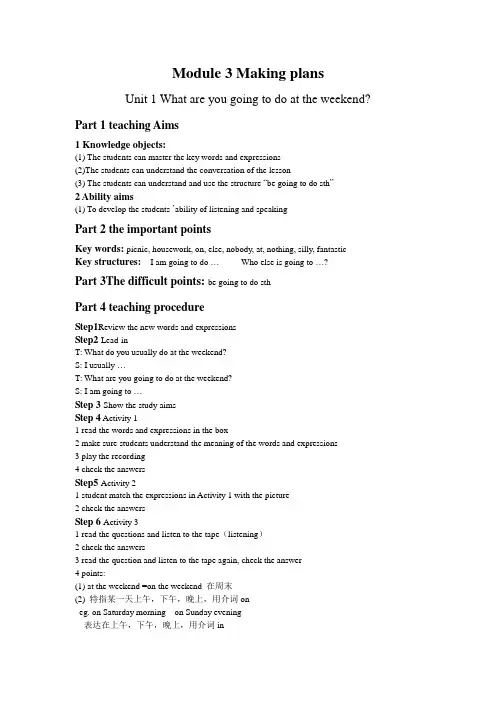
Module 3 Making plansUnit 1 What are you going to do at the weekend? Part 1 teaching Aims1 Knowledge objects:(1) The students can master the key words and expressions(2)The students can understand the conversation of the lesson(3) The students can understand and use the structure “be going to do sth”2 Ability aims(1) To develop the students ’ability of listening and speakingPart 2 the important pointsKey words: picnic, housework, on, else, nobody, at, nothing, silly, fantasticKey structures: I am going to do …Who else is going to …?Part 3The difficult points: be going to do sthPart 4 teaching procedureStep1Review the new words and expressionsStep2 Lead-inT: What do you usually do at the weekend?S: I usually …T: What are you going to do at the weekend?S: I am going to …Step 3 Show the study aimsStep 4 Activity 11 read the words and expressions in the box2 make sure students understand the meaning of the words and expressions3 play the recording4 check the answersStep5 Activity 21 student match the expressions in Activity 1 with the picture2 check the answersStep 6 Activity 31 read the questions and listen to the tape(listening)2 check the answers3 read the question and listen to the tape again, check the answer4 points:(1) at the weekend =on the weekend 在周末(2) 特指某一天上午,下午,晚上,用介词oneg. on Saturday morning on Sunday evening表达在上午,下午,晚上,用介词ineg. in the morning/ afternoon/ evening(3 )see a movie= see a film =watch a movie 看电影(4 )else “别的;其他的”用于疑问词(如what, where)或不定词(如something, anything, nothing)后(5 )plan 作名词,意为“计划;打算”是可数名词。
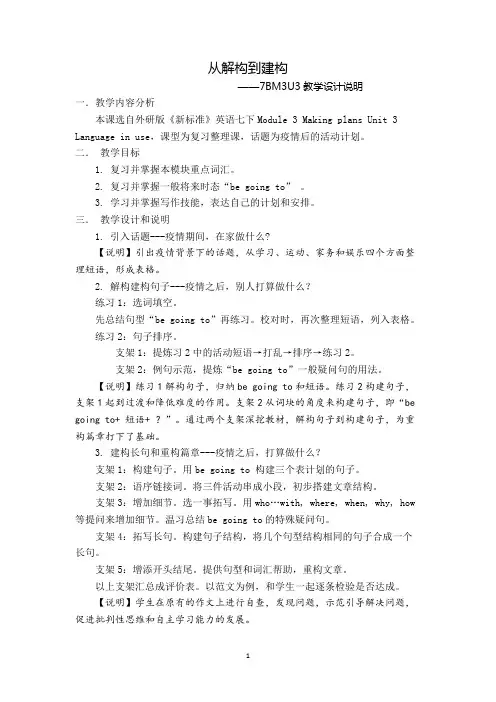
从解构到建构——7BM3U3教学设计说明一.教学内容分析本课选自外研版《新标准》英语七下Module 3 Making plans Unit 3 Language in use,课型为复习整理课,话题为疫情后的活动计划。
二.教学目标1. 复习并掌握本模块重点词汇。
2. 复习并掌握一般将来时态“be going to” 。
3. 学习并掌握写作技能,表达自己的计划和安排。
三.教学设计和说明1.引入话题---疫情期间,在家做什么?【说明】引出疫情背景下的话题,从学习、运动、家务和娱乐四个方面整理短语,形成表格。
2.解构建构句子---疫情之后,别人打算做什么?练习1:选词填空。
先总结句型“be going to”再练习。
校对时,再次整理短语,列入表格。
练习2:句子排序。
支架1:提炼习2中的活动短语→打乱→排序→练习2。
支架2:例句示范,提炼“be going to”一般疑问句的用法。
【说明】练习1解构句子,归纳be going to和短语。
练习2构建句子,支架1起到过渡和降低难度的作用。
支架2从词块的角度来构建句子,即“be going to+ 短语+ ?”。
通过两个支架深挖教材,解构句子到构建句子,为重构篇章打下了基础。
3.建构长句和重构篇章---疫情之后,打算做什么?支架1:构建句子。
用be going to 构建三个表计划的句子。
支架2:语序链接词。
将三件活动串成小段,初步搭建文章结构。
支架3:增加细节。
选一事拓写。
用who…with, where, when, why, how 等提问来增加细节。
温习总结be going to的特殊疑问句。
支架4:拓写长句。
构建句子结构,将几个句型结构相同的句子合成一个长句。
支架5:增添开头结尾。
提供句型和词汇帮助,重构文章。
以上支架汇总成评价表。
以范文为例,和学生一起逐条检验是否达成。
【说明】学生在原有的作文上进行自查,发现问题,示范引导解决问题,促进批判性思维和自主学习能力的发展。

