高中英语 Unit 2 The Olympic Games教案(1)新人教版必修2
- 格式:doc
- 大小:112.08 KB
- 文档页数:16
Unit 2 The Olympic Games Period One Warming and Reading Step
1 Leading-in
Listen to a song and guess what purpose it is used for.
Have you ever heard of this song? What is it used for?
(1) Pass the Flame.
(2) 2004—the Athens Olympic Games.
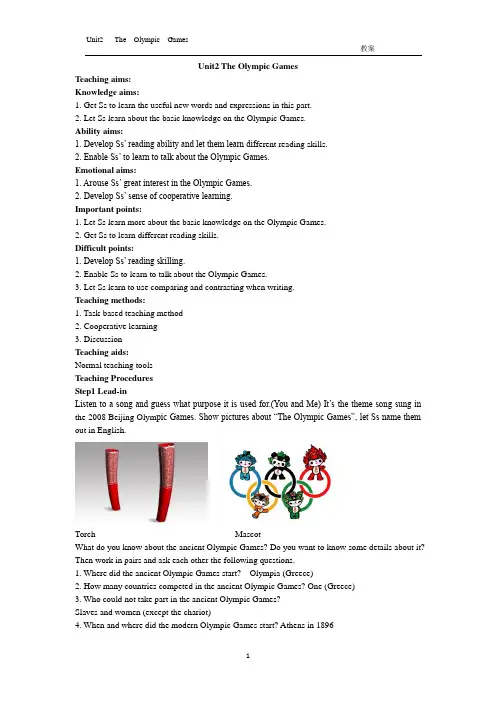
Show some pictures about “The Olympic Games”.
(Emblem (会徽) Motto (口号) Torch (火炬) Mascot(吉祥物) Stadium (体育馆)
Green Olympics The Olympic flag)
Step 2 Group work for competition
1.When did the ancient Olympic Games started?
A.1896 B. 1906 C. 776 BC
2. What was rewarded the winners in ancient Olympic Games?
A. Medals B. Money C. Olive wreath
3. How many gold medals did China get in the 2004 Athens Olympics?
A. 28 B. 32 C. 28
4. Which sport is in the Winter Olympic Games?
A. Badminton B. Basketball C. Speed skating
5. How many kinds of Olympic Games are there in the world? (Two kinds)
6. What’s the motto of the Olympic Games? (Higher, swifter and stronger)
7. What’s the motto of the Athens Olympics? (Welcome home)
8. What’s the host city of the first Olympics? (Athens, Greece)
9. What’s the host city of the 2000 Olympic Games? (Sydney, Australia)
The Events in the Olympics
Read all the words and choose the sports in the Winter Olympic Games. (P49)
badminton (羽毛球) judo (柔道) discus throw(掷铁饼) shot-put (推铅球) hang-gliding (滑翔) javelin (标枪) fencing (击剑)
ice hockey (冰球) weight-lifting (举重) pole jump (撑杆跳)
Step 3 Reading Look at the title and read the background information:
Guess: What are they going to talk about?
Task 1: skimming
1. What are they mainly talking about?
The similarities and differences about the ancient Olympics and modern Olympics.
2. When he hears that women are allowed to join in, what does he say? How about
his feeling, sad, surprised or happy? (surprised)
3.When he hears the Olympics are also about being able to run faster, jump higher
and throw further, how does he feel, sad, surprised of happy? (happy)
Task 2: scanning
Items The ancient Olympic Games The modern Olympic Games
Frequency 1.Every ______years 2. Every ______ years
Types Only Summer Olympic Games Summer and
3. ________ Olympic Games
Events Fewer 4.__________
Items The ancient Olympic Games The modern Olympic Games
Athletes Only men from 5. ________
city From 6.________ _____________
including 7. __________
Places Greece 8._____________________________
Prize 9.
_______________ 10. _____________
Step 4 Discussion
Work in pairs. What do you prepare for the 2008 Olympic Games if you
are : a teacher / university students / worker in Beijing / driver / Tianliang
/ Guo Jingjing / Liu Xiang / a coach (教练) / Zhang Yimou / the mayor of Beijing ……
Step 5 Summary of the interview
The Olympic Games are the biggest sports meeting in the world, which include two kinds, the ________and the ______ Olympics. Both of them are _____ every _____
______. All countries can take part if their athletes reached the __________ to the
games. Women are not only _______ to join in but playing a very _________ role. A
______ _______ village is built for the competitors to live in, a ________ for
competitions, a large swimming pool, a ___________ as well as seats for those
who watch the games. It’s a great _____ to host the Olympic Games.
The Olive wreath has been _________ by medals. But it’s still about being able
to run ______, jump ______ and throw _______.
Step 6 Homework
1. Review the reading text and finish Ex. 1 & 2 (P11)
2. Prepare for next period
Period Two Learning about language
Step 1 Revision
Can you tell me the similarities and differences between the ancient and the
modern Olympics? (each student says one point)
Step 2 Guessing words
1 .telling the truth— 2. take the place of—
3. take part in— 4. a group of—
5. ask someone questions to find out information—
6. something given to the winner of a competition--
7. a round piece of gold, silver or bronze given as a prize—
8. allow sb to enter--
Step 3 Language points
1. ancient: adj. old----modern
He used to drive his ancient car. 他过去常常开他的老式车.
To my surprise, the ancient custom is popular today.
让我惊奇的是, 这种古代习俗今天还流行.
in ancient times—in modern times
pete (v)—competition (n) competitor (n)—competitive (adj) I hope all of us can compete ____ race / running.
I know my English cannot compete _____________his.
game / match /contest / competition