
新概念英语第二册lesson18(第一课时)课件
- 格式:pptx
- 大小:4.53 MB
- 文档页数:54
NCE2018.txt
【New words and expressions】(3)
pub n. 小酒店landlord n. 店主bill n. 帐单
【课文讲解】
1、After I had had lunch at a village pub, I looked for my bag.Pub是public house(酒店,酒店)的缩写
2、I had left it on a chair beside the door and now it wasn't there!leave除了“离去,离开,出发”的意思,还可以表示“把(人、物)留下,遗留,丢下”等。
Have you left anything in the car?
3、'I'm very sorry,' he said. 'My dog had taken in into the garden. He often does this!'
he指店主的狗,英语国家人士常用人称代词he或she指自己喂养的宠物。
【Key structures】
have的用法
1、have作为助动词构成各种完成时和完成进行时
2、have还可以作完全动词,当作“具有、拥有”讲时,它和have got通常可以互换。have做 “有, 患病” 概念时, 可作为实义动词, 也可作为非实义动词。在英国英语中的疑问句和否定句中have(具有)的用法与be相同,即可以不用助动词do或did;在美国英语中,常用do助动词和have一起构成疑问句和否定句。
I don’t have a pen/a headache.
I haven’t a pen /a headache.
三种情况have 可以用 have got取代
have to== have got to
have作“具有,拥有”讲时是状态动词,不能用于进行时态或被动语态,通常用于一般现在时。在其它时态中,一般用have而不用have got。
新概念英语第二册课文翻译:Lesson 18 He often
does this
【New words and expressions】
pub n. 小酒店
landlord n. 店主
bill n. 帐单
【课文讲解】
1、After I had had lunch at a village pub, I looked for
my bag.
Pub是public house(酒店,酒店)的缩写
Let’s go to the pub for a drink.
2、I had left it on a chair beside the door and now it
wasn't there!
leave除了“离去,离开,出发”的意思,还能够表示“把(人、物)留下,遗留,丢下”等。
Have you left anything in the car?
3、'I'm very sorry,' he said. 'My dog had taken in into
the garden. He often does this!'
he指店主的狗,英语国家人士常用人称代词he或she指自己喂养的宠物。
【Key structures】
have的用法 1、have作为助动词构成各种完成时和完成实行时
2、have还能够作完全动词,当作“具有、拥有”讲时,它和have got通常能够互换。have做 “有, 患病” 概念时, 可作为实义动词, 也可作为非实义动词。在英国英语中的疑问句和否定句中have(具有)的用法与be相同,即能够不用助动词do或did;在美国英语中,常用do助动词和have一起构成疑问句和否定句。
I don’t have a pen/a headache.
I haven’t a pen /a headache.

1 Lesson 18 He often does this! 他经常干这种事!
After I had had lunch at a village pub, I looked for my bag. I had left it on a chair beside the door
and now it wasn't there! As I was looking for it, the landlord came in.
'Did you have a good meal?’ he asked.
'Yes, thank you,' I answered, 'but I can't pay the bill. I haven't got my bag.'
The landlord smiled and immediately went out. In a few minutes he returned with my bag
and gave it back to me.
'I'm very sorry,' he said. 'My dog had taken it into the garden. He often does this!'
New words and expressions 生词和短语
pub n. 小酒店 landlord n. 店主 bill n. 帐单
参考译文
我在一家乡村小酒店吃过午饭后,就找我的提包。我曾把它放在门边的椅子上,可这会儿不见了!当我正在寻找时,酒店老板走了进来。
“您吃得好吗?”他问。
“很好,谢谢。”我回答,“但我付不了帐,我的提包没有了。”
酒店老板笑了笑,马上走了出去。一会儿工夫他拿着我的提包回来了,把它还给了我。
“实在抱歉,”他说,“我的狗把它弄到花园里去了,他常干这种事!”
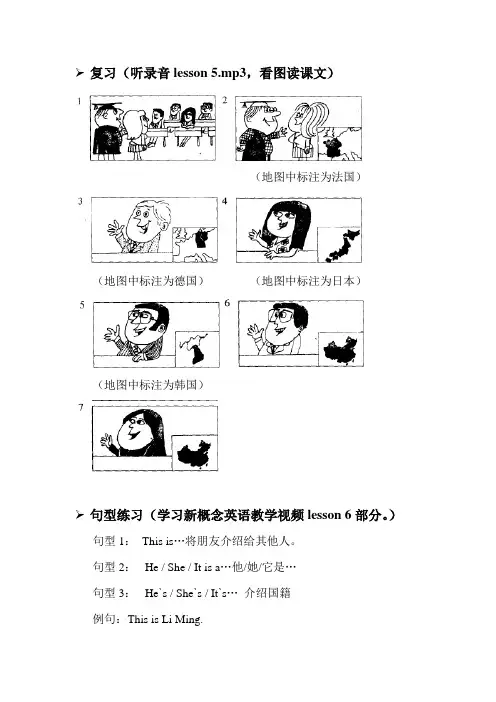
复习(听录音lesson 5.mp3,看图读课文)
(地图中标注为法国)
(地图中标注为德国) (地图中标注为日本)
(地图中标注为韩国)
句型练习(学习新概念英语教学视频lesson 6部分。)
句型1: This is…将朋友介绍给其他人。
句型2: He / She / It is a…他/她/它是…
句型3: He`s / She`s / It`s… 介绍国籍
例句:This is Li Ming. He is a new teacher.
He`s Chinese.
句型4:What make is it?它是什么牌子的?
看下图,参照示例,将对话中空白部分编读出来,记忆每幅图片中提到的国籍,对于车的牌子做了解。
Is it a French car? Is it a Swedish car?
No, it isn`t. ___________
Is it a Swedish car? Is it a French car?
Yes, it is.
___________
Is it Japanese or German? Is it Japanese or German?
It isn`t Japanese. It`s German. __________________
Is it a Korean or an English car? Is it a Korean or an English car?
(or连接的选择疑问句。
注意English前的冠词an)
It`s not an English car. It`s a Korean car. ____________________
品味Is it a Korean or an English car?和Is it Korean or English?的区别。