《英语语法》直接引语和间接引语
- 格式:doc
- 大小:47.50 KB
- 文档页数:7
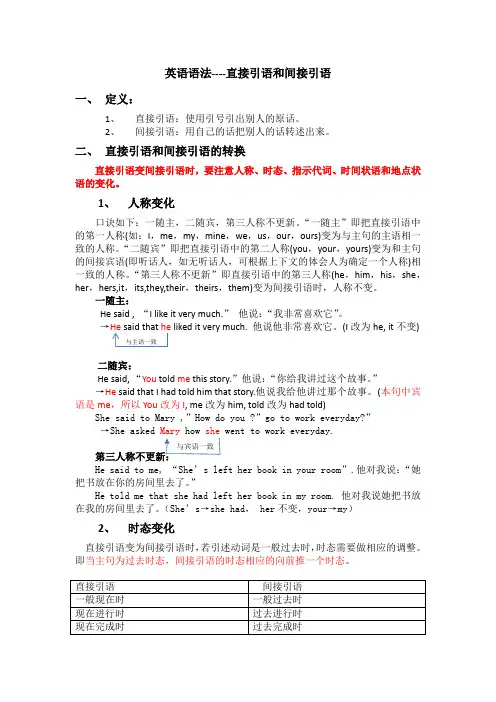
第十二章直接引语和间接引语引述某人的话一般采用两种形式:一种是直接引语(Direct Speech),即原封不动地引用原话,把它放在引号内;另一种是间接引语(Indirect Speech),即用自己的话加以转述,被转述的内容不放在引号内。
一、直接引语变间接引语A.陈述句的间接引语直接引语是陈述句,变为间接引语时,在多数情况下都构成一个that引导的宾语从句,引述动词通常是say, tell等。
与此同时,间接引语中的人称、时态和其他方面也要相应有所变化。
The foreigner aid to me, I like Beijing very much.那老外告诉我:我很喜欢北京。
→ The foreigner told me that he she liked Beijing very much. 那老外告诉我说他(她)很喜欢北京。
She said, We are very fond of sports. 她说:我们都喜欢体育运动。
→ She said that they were very fond of sports. 她说他(她)们都喜欢体运动。
I'll go over the grammar lesson once again, he said. 他说:我将把语法课再复习一遍。
→ He said he would go over the grammar lesson once again. 他说他将要把语法课再复习一遍。
(that可省略)B.疑问句的间接引语1.一般疑问句和反意疑问句一般疑问句改为间接引语时,要用陈述语序,并要加连词if 或whether,其主句动词常用ask, wonder, want to know, didn't know等。
句末不用问号。
My teacher asked me, Do you like American country music 我老师问我:你喜欢美国乡村音乐吗?→ My teacher asked me if/whether I liked American country music. 我老师问我是否喜欢美国乡村音乐。
You haven't been to Beijing, have you asked he. 他问:你没去过北,是吗?→ He asked me if/whether I had been to Beijing. 他问我是否去过北京。
2.否定的一般疑问句和选择问句如果直接引语为否定的一般问句或选择疑问句时,用whether…or 连接。
She said, Don't you know my telephone number 她说:你难道不知道我的电话号码吗?→ She asked me whether I knew her telephone number or not. 她问我是知道她的电话号码。
Do you like this one or that one Tom asked. 汤姆问:你是喜欢这个还是那个?→ Tom asked me whether I liked this one or that one. 汤姆问我是喜欢这个还是那个。
3.特殊疑问句间接引语为特殊疑问句时,间接引语前仍然用特殊疑问词作为连词引导宾语从句,注意从句必须用陈述语序,主句谓语动词常用ask。
He asked, How do you like it 他问:你觉得怎样?→ He asked me how I liked it. 他问我觉得它怎样。
She asked me, What's the matter with you 她问我:你怎么啦?→ She asked me what was the matter with me. 她问我我怎么啦。
How many books do you have she asked. 她问:你有多少本书?→ She asked me how many books I had. 她问我有多少本。
4.其它英语中有些疑问句并非提出疑问,而是表示请求、劝告、建议等。
这种疑问句变为间接引语时,往往采用其他的形式。
①.suggest doingShall we all go to the film tonight said Michael. 迈克尔说:我们今晚都去看电影,好吗?→ Michael suggested going to the film tonight. 迈克尔建议今晚都去看电影。
What about having a drink he asked. 他问:喝杯怎么样?He suggested having a drink. 他建议喝一杯。
②.advise sb to doWhy don't you go hiking asked James. 詹姆士问:你为什么不徒步旅行?James advised me to go hiking. 詹姆士建议我去徒步旅行。
③. offer to doHe said, Would you like me to post the letter 他说:你要我寄信吗?He offered to post the letter. 他主动提出寄信。
④.ask sb to doWill you please bring your reference book here tomorrow she said to me. 她对我说:劳驾你明天把你的参考书带来好吗?→ She asked me to take my reference book there the next day. 她让我第二天把我的参考书带去。
C.祈使句的间接引语1.直接引语为祈使句时,间接引语往往用复合宾来表示,其结构为主语+谓语+宾语+宾语补足语(动词不定式)。
引述动词可根据口气选用tell, ask, order, command, request等词,句中please 去掉。
She said to me, Please have a rest. 她对我说:请休息一下。
→ She asked me to have a rest. 她要求我休息一下。
Don't all answer at once, she said to the pupils. 她对学生说:大家不要齐声回答。
→ She told the pupils not to answer all at once. 她叫学生不要齐声回答。
2.带有let的祈使句(表示请求,建议或命令),可用suggest + -ing形式或suggest +that从句来表示其相应的意思。
Let's go for a walk, said the girl. 那姑娘说,让我们去散散步吧。
→ The girl suggested going for a walk. 这女孩建议去散散步。
The teacher said, Let Lily tidy the classroom. 老师说:让莉莉整理教室。
→ The teacher suggested that Lily should tidy the classroom. 老师建议让莉莉整理教室。
D.感叹句的间接引语1.直接引语是感叹句变为间接引语时,多采用宾语从句结构,既可用what或how引导,也可用that引导。
What a clever boy you are! my teacher said to him. 老师对他说,你是个聪明的孩子啊!→ My teacher told him what a cl ever boy he was. 老师对他说他是一个多聪明的孩子啊。
→ My teacher told him that he was a very clever boy. 老师说他是一个非常聪明的孩子。
He said, How well you look! 他说:你看起来气色多好啊!→ He said how well I looked. 他说我看起来是气色多好啊。
→ He said that I looked very well. 他说我看起来气色很好。
2.有些感叹句可以根据原句的意思,采用适当的动词变为陈述句,不需用间接宾语来转述。
Help! he cried. 他喊到:救命啊!→ He called for help. 他大声呼救。
What terrible weather it is! he said. 他说:多么糟糕的天气!→ He complained about the terrible weather. 他抱怨这糟糕的天气。
Happy Christmas! he said. 他说:圣诞快乐!He wished me a happy Christmas. 他祝我圣诞快乐。
二、间接引语中的词语变化直接引语变为间接引语时,间接引语中的动词时态、人称代词、物主代词、指示代词、时间和地点状语以及主谓语词序往往要作相应的变化。
A.时态的变化1.时态的变化①现在时间推移到过去时间直接引语中的时态一般现在时现在完成时现在进行时现在完成进行时间接引语中的时态一般过去时过去完成时过去进行时过去完成进行时The old man said, I have lived in this street since 1960.→The old man said that he had lived in that street since 1960. 那老人说他自从196年起就住在那条街上了。
He said, Is it raining→ He asked if it was raining. 他问是不是正在下雨。
②过去时间推移到过去的过去直接引语中的时态一般过去时过去完成时过去进行时间接引语中的时态过去完成时过去完成时(不变)过去完成进行时或不变She said to me, I wrote a letter to my parents three days ago.→She told me that she had written a letter to her parents three days before.她告诉我她三天前已给她母亲写了一封信。
What were you doing at seven p.m. yesterday he asked→ He asked me what I was doing at seven p.m. the day before. 他问我前一天晚上七点在干什么。
③将来时间推移到过去将来时间直接引语中的时态一般将来时Is/am/are going to doIs/am/are to do间接引语中的时态过去将来时Was/were going to doWas/were to doHe said, We shall get ready by eight o'clock.→He said that they could get ready by eight o'clock. 他说他们将在8点前准备好。