
Chinese language
- 格式:pptx
- 大小:2.50 MB
- 文档页数:13


chinese用法"Chinese"是一个常见的英语单词,它可以作为名词、形容词或副词使用,具体意义与语境有关。
下面分别介绍"Chinese"的几种常见用法和含义:名词用法:表示中国人或中国语言文字。
例如:Chinese people:中国人(e.g. There are over 1.4 billion Chinese people in the world.)Chinese language:汉语、中文(e.g. I'm learning Chinese language at school.)Chinese character:汉字、中文字符(e.g. Chinese characters are a unique feature of Chinese language.)形容词用法:表示与中国有关的、来自中国的、或符合中国风格的。
例如:Chinese culture:中国文化(e.g. Chinese culture has a long and rich history.)Chinese cuisine:中国菜、中餐(e.g. I love eating Chinese cuisine, especially dumplings.)Chinese medicine:中医(e.g. Chinese medicine has been used to treat illnesses for thousands of years.)副词用法:表示按照中国方式、中国风格、或用中文等。
例如:Chinese-style:中国式的(e.g. The restaurant serves Chinese-style hotpot.)Chinese-speaking:说中文的、用中文的(e.g. The tour guide is Chinese-speaking and can help us communicate with locals.)。

语文课程的英语作文English:Chinese language class is essential for students to develop their language skills, cultural awareness, and communication abilities. Through studying Chinese literature, grammar, and vocabulary, students can improve their reading, writing, listening, and speaking skills. Additionally, learning Chinese characters and calligraphy helps students appreciate the beauty and intricacy of the language. Moreover, studying classical Chinese texts allows students to understand the rich history and traditions of China. Through language immersion programs and language learning apps, students have the opportunity to practice their language skills and engage with native speakers. Overall, the Chinese language course not only equips students with practical language skills but also fosters a deeper understanding and appreciation of Chinese culture and history.中文翻译:中文课程对学生发展语言能力、文化意识和沟通能力至关重要。

汉语的魅力英语作文关于汉语的魅力英语作文(通用21篇)在日常生活或是工作学习中,大家都跟作文打过交道吧,借助作文人们可以反映客观事物、表达思想感情、传递知识信息。
作文的注意事项有许多,你确定会写吗?下面是小编整理的汉语的魅力英语作文,仅供参考,大家一起来看看吧。
汉语的魅力英语作文篇1Chinese Language faces some challenges. As compared with English and other Latin based languages, Chinese is less popular and more difficult for computer word processing. Some college students, wondering whether it is still one of the best languages in the world, neglect Chinese study.Extensive research has revealed that Chinese possesses many advantages over other languages. Written Chinese is based on a set of ideogram characters. From a simple word one may obtain a wealth of information about its hidden meaning, evolution history and related phrases. Historians can decipher the damaged ancient characters carved on ox hones but no such achievement could be obtained with Latin-based languages. To express a given idea, the Chinese version is always the shortest, most accurate and most effective.Moreover, Chinese kids learn Chinese by memorizing patterns or funny pictures which stimulate curiosity and imagination. It is well recognized that human brains work well with patterns and pattern recognition in turn promotes brain development. What's more, Chinese is also easy to learn. Many foreigners speak Chinese fluently after a few years of learning. Recently, several word processing programs have been successfully developed for Chinese language and turned out tobe better than those designed for English.Chinese is the crystallization of the splendid culture developed continuously for over 5,000 years. Many treasures remain to be explored. As China grows stronger, more and more foreigners will learn Chinese and share the invaluable treasure. 汉语的魅力英语作文篇2都德的《最后一课》一直以来就深深地震撼我的内心。
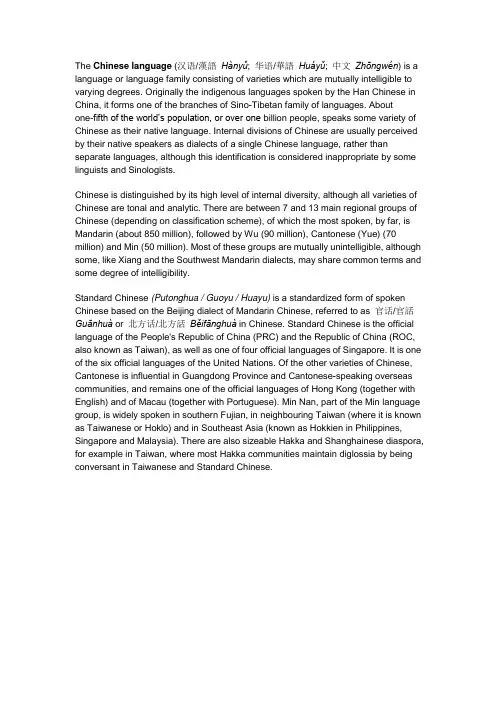
The Chinese language (汉语/漢語Hànyǔ; 华语/華語Huáyǔ; 中文Zhōngwén) is a language or language family consisting of varieties which are mutually intelligible to varying degrees. Originally the indigenous languages spoken by the Han Chinese in China, it forms one of the branches of Sino-Tibetan family of languages. Aboutone-fifth of the world’s population, or over one billion people, speaks some variety of Chinese as their native language. Internal divisions of Chinese are usually perceived by their native speakers as dialects of a single Chinese language, rather than separate languages, although this identification is considered inappropriate by some linguists and Sinologists.Chinese is distinguished by its high level of internal diversity, although all varieties of Chinese are tonal and analytic. There are between 7 and 13 main regional groups of Chinese (depending on classification scheme), of which the most spoken, by far, is Mandarin (about 850 million), followed by Wu (90 million), Cantonese (Yue) (70 million) and Min (50 million). Most of these groups are mutually unintelligible, although some, like Xiang and the Southwest Mandarin dialects, may share common terms and some degree of intelligibility.Standard Chinese (Putonghua / Guoyu / Huayu) is a standardized form of spoken Chinese based on the Beijing dialect of Mandarin Chinese, referred to as 官话/官話Guānhuà or 北方话/北方話Běifānghuà in Chinese. Standard Chinese is the official language of the People's Republic of China (PRC) and the Republic of China (ROC, also known as Taiwan), as well as one of four official languages of Singapore. It is one of the six official languages of the United Nations. Of the other varieties of Chinese, Cantonese is influential in Guangdong Province and Cantonese-speaking overseas communities, and remains one of the official languages of Hong Kong (together with English) and of Macau (together with Portuguese). Min Nan, part of the Min language group, is widely spoken in southern Fujian, in neighbouring Taiwan (where it is known as Taiwanese or Hoklo) and in Southeast Asia (known as Hokkien in Philippines, Singapore and Malaysia). There are also sizeable Hakka and Shanghainese diaspora, for example in Taiwan, where most Hakka communities maintain diglossia by being conversant in Taiwanese and Standard Chinese.。