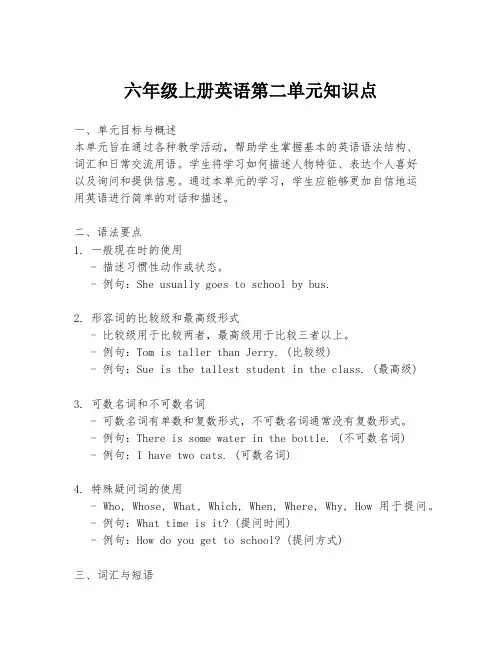
六年级英语知识点二单元
- 格式:docx
- 大小:37.44 KB
- 文档页数:4
六年级英语知识点二单元
Unit 2: English Language Points for Sixth Grade
In the second unit of sixth-grade English, students are introduced to
several key language points that will enhance their understanding and
communication skills. This unit focuses on various aspects of grammar,
vocabulary, and language usage. Let's delve into these topics in detail
below.
1. Verb Tenses
Understanding verb tenses is crucial for effective communication.
The three main verb tenses covered in this unit are present, past, and
future. Students should learn to use these tenses correctly in sentences
and understand the differences between simple, continuous, and perfect
forms.
2. Present Tense
The present tense is used to describe actions happening currently or
regularly. It is important to understand the different forms of the
present tense, such as simple present, present continuous, and present
perfect. These forms indicate different aspects of time and duration.
3. Past Tense
The past tense is used to talk about actions that have already
happened. Students should learn the regular and irregular forms of past
tense verbs and understand how to use them correctly in sentences.
Additionally, they should be aware of common time indicators like
yesterday, last week, or in 2005 that accompany past tense sentences.
4. Future Tense
The future tense is used to discuss actions that will happen in the
future. Common ways to express the future include using the modal
verb "will" or present continuous form with future intentions. Students
should practice constructing sentences using future tense structures
accurately.
5. Parts of Speech
This section focuses on the different parts of speech, such as nouns,
pronouns, verbs, adjectives, and adverbs. Students should understand
the roles these words play in sentences and how they can modify or
describe other words. Identifying and categorizing words correctly will
enhance their overall language skills.
6. Vocabulary Expansion Expanding vocabulary is crucial for effective communication. In
this unit, students will learn new words and phrases related to various
topics, including daily routines, hobbies, and sports. They should
practice using these words in context to improve their speaking and
writing skills.
7. Sentence Structure
Understanding sentence structure helps students form
grammatically correct and meaningful sentences. They should learn
about subject-verb agreement, word order, and sentence types
(declarative, interrogative, imperative, and exclamatory) to express
their thoughts accurately.
8. Reading Comprehension
Students will engage in reading activities to improve their
comprehension skills. They will read texts, answer questions, and
develop strategies to extract information from the given passages. This
improves their overall understanding of English and enhances their
critical thinking abilities.
9. Listening and Speaking Listening and speaking exercises are crucial for developing fluency.
Students will participate in dialogues, group discussions, and oral
presentations to enhance their communication skills. These activities
will focus on developing clear pronunciation, appropriate intonation,
and accurate usage of language points covered in this unit.
In conclusion, the second unit of sixth-grade English covers various
language points essential for effective communication. Students should
pay attention to verb tenses, parts of speech, vocabulary expansion,
sentence structure, and reading comprehension. Engaging in listening
and speaking activities will also enhance their overall language
proficiency. This unit serves as a solid foundation for further language
development.