
2013年美赛集训微分方程建模问题
- 格式:ppt
- 大小:3.33 MB
- 文档页数:100

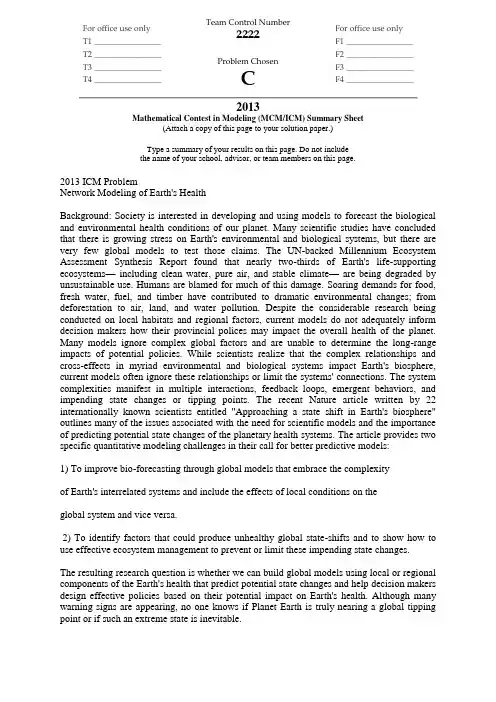
For office use onlyT1________________ T2________________ T3________________ T4________________ Team Control Number2222Problem ChosenCFor office use onlyF1________________F2________________F3________________F4________________ 2013Mathematical Contest in Modeling (MCM/ICM) Summary Sheet(Attach a copy of this page to your solution paper.)Type a summary of your results on this page. Do not includethe name of your school, advisor, or team members on this page.2013 ICM ProblemNetwork Modeling of Earth's HealthBackground: Society is interested in developing and using models to forecast the biological and environmental health conditions of our planet. Many scientific studies have concluded that there is growing stress on Earth's environmental and biological systems, but there are very few global models to test those claims. The UN-backed Millennium Ecosystem Assessment Synthesis Report found that nearly two-thirds of Earth's life-supporting ecosystems—including clean water, pure air, and stable climate—are being degraded by unsustainable use. Humans are blamed for much of this damage. Soaring demands for food, fresh water, fuel, and timber have contributed to dramatic environmental changes; from deforestation to air, land, and water pollution. Despite the considerable research being conducted on local habitats and regional factors, current models do not adequately inform decision makers how their provincial polices may impact the overall health of the planet. Many models ignore complex global factors and are unable to determine the long-range impacts of potential policies. While scientists realize that the complex relationships and cross-effects in myriad environmental and biological systems impact Earth's biosphere, current models often ignore these relationships or limit the systems' connections. The system complexities manifest in multiple interactions, feedback loops, emergent behaviors, and impending state changes or tipping points. The recent Nature article written by 22 internationally known scientists entitled "Approaching a state shift in Earth's biosphere" outlines many of the issues associated with the need for scientific models and the importance of predicting potential state changes of the planetary health systems. The article provides two specific quantitative modeling challenges in their call for better predictive models:1) To improve bio-forecasting through global models that embrace the complexityof Earth's interrelated systems and include the effects of local conditions on theglobal system and vice versa.2) To identify factors that could produce unhealthy global state-shifts and to show how to use effective ecosystem management to prevent or limit these impending state changes.The resulting research question is whether we can build global models using local or regional components of the Earth's health that predict potential state changes and help decision makers design effective policies based on their potential impact on Earth's health. Although many warning signs are appearing, no one knows if Planet Earth is truly nearing a global tipping point or if such an extreme state is inevitable.The Nature article and many others point out that there are several important elements at work in the Earth's ecosystem (e.g., local factors, global impacts, multi-dimensional factors and relationships, varying time and spatial scales). There are also many other factors that can be included in a predictive model — human population, resource and habitat stress, habitat transformation, energy consumption, climate change, land use patterns, pollution, atmospheric chemistry, ocean chemistry, bio diversity, and political patterns such as social unrest and economic instability. Paleontologists have studied and modeled ecosystem behavior and response during previous cataclysmic state shifts and thus historic-based qualitative and quantitative information can provide background for future predictive models. However, it should be noted that human effects have increased significantly in our current biosphere situation.Requirements:You are members of the International Coalition of Modelers (ICM) which will soon be hosting a workshop entitled "Networks and Health of Planet Earth" and your research leader has asked you to perform modeling and analysis in advance of the workshop. He requires your team to do the following:Requirement 1:Build a dynamic global network model of some aspect of Earth's health (you develop the measure) by identifying local elements of this condition (network nodes) and appropriately connecting them (network links) to track relationship and attribute effects. Since the dynamic nature of these effects is important, this network model must include a dynamic time element that allows the model to predict future states of this health measure. For example, your nodes could be nations, continents, oceans, habitats, or any combination of these or other elements which together constitute a global model. Your links could represent nodal or environmental influences, or the flow or propagation of physical elements (such as pollution) over time. Your health measure could be any element of Earth's condition to include demographic, biological, environmental, social, political, physical, and/or chemical conditions. Be sure to define all the elements of your model and explain the scientific bases for your modeling decisions about network measures, nodal entities, and link properties. Determine a methodology to set any parameters and explain how you could test your model if sufficient data were available. What kinds of data could be used to validate or verify the efficacy of your model? (Note: If you do not have the necessary data to determine parameters or perform verification, do not throw out the model. Your supervisor realizes that, at this stage, good creative ideas and theories are as important as verified data-based models.) Make sure you include the human element in your model and explain where human behavior and government policies could affect the results of your model.Requirement 2: Run your model to see how it predicts future Earth health. You may need to estimate parameters that you would normally determine from data. (Remember, this is just to test and understand the elements of your model, not to use it for prediction or decision making.) What kinds of factors will your model produce? Could it predict state change or tipping points in Earth's condition? Could it provide warning about global consequences of changing local conditions? Could it inform decision makers on important policies? Do you take into account the human elements in your measures and network properties?Requirement 3: One of the powerful elements of using network modeling is the ability to analyze the network structure. Can network properties help identify critical nodes or relationships in your model? If so, perform such analysis. How sensitive is your model to missing links or changing relationships? Does your model use feedback loops or take into account uncertainties? What are the data collection issues? Does your model react to various government policies and could it thus help inform planning? Requirement 4: Write a 20-page report (summary sheet does not count in the 20 pages) that explains your model and its potential. Be sure to detail the strengths and weaknesses of the model. Your supervisor will use your report as a major theme in the upcoming workshop and, if it is appropriate and insightful to planetary health modeling, will ask you to present at the upcoming workshop. Good luck in your network modeling work!Potentially helpful references include:Anthony D. Barnosky, Elizabeth A. Hadly, Jordi Bascompte, Eric L. Berlow, James H. Brown,Mikael Fortelius, Wayne M. Getz, John Harte, Alan Hastings, Pablo A. Marquet, Neo D.Martinez, Arne Mooers, Peter Roopnarine, Geerat Vermeij, John W. Williams, Rosemary Gillespie, Justin Kitzes, Charles Marshall, Nicholas Matzke, David P. Mindell, Eloy Revilla, Adam B. Smith. "Approaching a state shift in Earth's biosphere,". Nature, 2012; 486 (7401): 52 DOI: 10.1038/nature11018Donella Meadows, Jorgen Randers, and Dennis Meadows. Limits to Growth: The 30-year update, 2004.Robert Watson and A.Hamid Zakri. UN Millennium Ecosystem Assessment Synthesis Report, United Nations Report, 2005.University of California - Berkeley. "Evidence of impending tipping point for Earth." ScienceDaily, 6 Jun. 2012. Web. 22 Oct. 2012.。
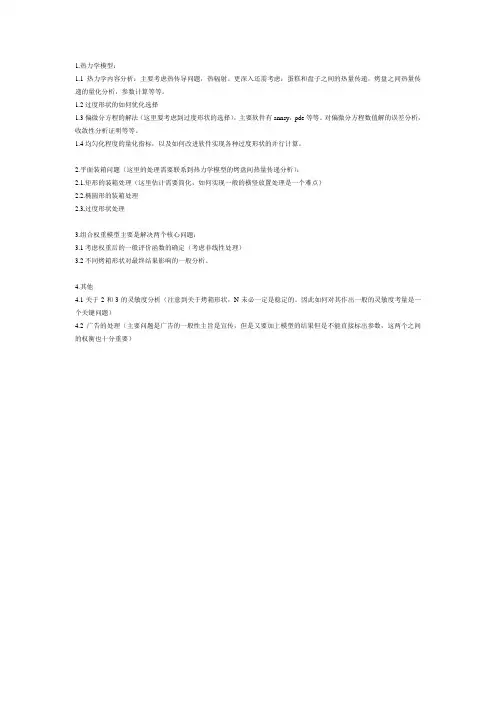
1.热力学模型:
1.1热力学内容分析:主要考虑热传导问题,热辐射。
更深入还需考虑:蛋糕和盘子之间的热量传递,烤盘之间热量传递的量化分析,参数计算等等。
1.2过度形状的如何优化选择
1.3偏微分方程的解法(这里要考虑到过度形状的选择),主要软件有annsy,pde等等。
对偏微分方程数值解的误差分析,收敛性分析证明等等。
1.4均匀化程度的量化指标,以及如何改进软件实现各种过度形状的并行计算。
2.平面装箱问题(这里的处理需要联系到热力学模型的烤盘间热量传递分析):
2.1.矩形的装箱处理(这里估计需要简化,如何实现一般的横竖放置处理是一个难点)
2.2.椭圆形的装箱处理
2.3,过度形状处理
3.组合权重模型主要是解决两个核心问题:
3.1考虑权重后的一般评价函数的确定(考虑非线性处理)
3.2不同烤箱形状对最终结果影响的一般分析。
4.其他
4.1关于2和3的灵敏度分析(注意到关于烤箱形状,N未必一定是稳定的。
因此如何对其作出一般的灵敏度考量是一个关键问题)
4.2广告的处理(主要问题是广告的一般性主旨是宣传,但是又要加上模型的结果但是不能直接标出参数,这两个之间的权衡也十分重要)。

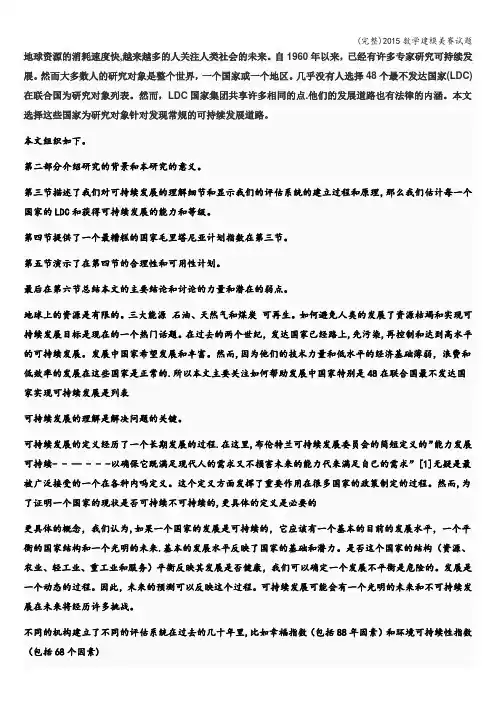
地球资源的消耗速度快,越来越多的人关注人类社会的未来。
自1960年以来,已经有许多专家研究可持续发展。
然而大多数人的研究对象是整个世界,一个国家或一个地区。
几乎没有人选择48个最不发达国家(LDC)在联合国为研究对象列表。
然而,LDC国家集团共享许多相同的点.他们的发展道路也有法律的内涵。
本文选择这些国家为研究对象针对发现常规的可持续发展道路。
本文组织如下。
第二部分介绍研究的背景和本研究的意义。
第三节描述了我们对可持续发展的理解细节和显示我们的评估系统的建立过程和原理,那么我们估计每一个国家的LDC和获得可持续发展的能力和等级。
第四节提供了一个最糟糕的国家毛里塔尼亚计划指数在第三节。
第五节演示了在第四节的合理性和可用性计划。
最后在第六节总结本文的主要结论和讨论的力量和潜在的弱点。
地球上的资源是有限的。
三大能源石油、天然气和煤炭可再生。
如何避免人类的发展了资源枯竭和实现可持续发展目标是现在的一个热门话题。
在过去的两个世纪,发达国家已经路上,先污染,再控制和达到高水平的可持续发展。
发展中国家希望发展和丰富。
然而,因为他们的技术力量和低水平的经济基础薄弱,浪费和低效率的发展在这些国家是正常的.所以本文主要关注如何帮助发展中国家特别是48在联合国最不发达国家实现可持续发展是列表可持续发展的理解是解决问题的关键。
可持续发展的定义经历了一个长期发展的过程.在这里,布伦特兰可持续发展委员会的简短定义的”能力发展可持续- - — - - -以确保它既满足现代人的需求又不损害未来的能力代来满足自己的需求”[1]无疑是最被广泛接受的一个在各种内吗定义。
这个定义方面发挥了重要作用在很多国家的政策制定的过程。
然而,为了证明一个国家的现状是否可持续不可持续的,更具体的定义是必要的更具体的概念,我们认为,如果一个国家的发展是可持续的,它应该有一个基本的目前的发展水平,一个平衡的国家结构和一个光明的未来.基本的发展水平反映了国家的基础和潜力。