一般将来时知识点
- 格式:pdf
- 大小:91.57 KB
- 文档页数:3
一般将来时
一、知识梳理
(一)基本用法
1.概念
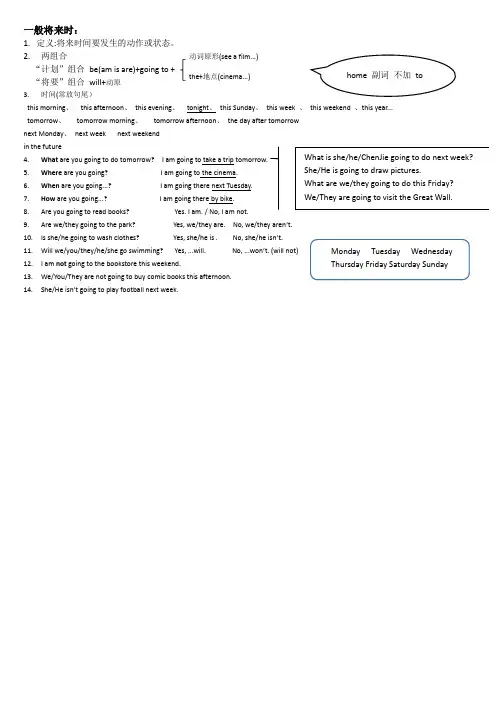
一般将来时表示将来某一时刻的动作或状态,或将来某一段时间内经常的动作或状态。
2.构成
基本构成句型例句
am/is/are going to
do
肯定句I am going to go fishing next weekend.
否定句I am not going to go fishing next weekend.一般疑问句Are you going to go fishing next weekend?特殊疑问句What are you going to do next weekend?
will/shall do
肯定句I shall/will visit my grandmother on Sunday.
否定句
I shall/will not(won’t)visit my grandmother
on Sunday.
一般疑问句
---Will you visit my grandmother on Sunday?
---Yes,I will./No,I won’t.
特殊疑问句What will you do on Sunday?
3.常用时间状语
明天下个XX后
明天:tomorrow,后面可以加morning,afternoon,evening
下个:next,后面可以加week,month,year等
XX后:after和in,后面可以加three weeks/months/years
这里要注意一下,after后加时间点才表示将来,如after3o’clock。
加时间段表示过去,如after2hours表示过去。
in后加时间段表将来,如in two years。
(二)考点
1.will和shall的区别
will可用于所有人称,但shall仅表示单纯将来时,用于第一人称I和we,
作为will的一种替代形式。
以You and I为主语时通常避免用shall。
如:He will be back soon.他很快就会回来。
I shall/will be free on Sunday.星期天我有空。
You and I will work in the same factory.你和我将在同一工厂工作。
★shall的特殊用法
shall用于第一人称的疑问句中,表示征求对方意见Shall we go there together? What shall we do?
shall用于第二、第三人称,表示说话人给对方的许诺、命令、警告、威胁等。
You shall fail if you don’t work hard.(警告)
2.be going to和will的区别
1).be going to表示根据主观判断将来肯定发生的事情,will表示客观上将来势必发生的事情。
如:
He is seriously ill.He is going to die.他病得很严重。
他将要死了。
He will be twenty years old.他明年将要二十岁了。
2).be going to表示说话人根据现在已有的迹象,判断将要或即将发生某种情况。
will则无迹象可言。
如:
Look at those black clouds!It’s going to rain.看看那些乌云!天快要下雨了。
He will be here in half an hour.他将在半小时之内到这儿。
3).be going to表示事先经过考虑的打算、计划,而will表示未经过考虑的打算、计划,只是临时之意。
如:
—What are you going to do next Sunday?下星期天你打算干什么?
—I’m going to go fishing.我打算去钓鱼。
—Where is the telephone book?电话号码簿在哪儿?
—I’ll go and get it for you.我去给你拿。
3.现在进行时表将来
表示位置转移的动词(如go,come,leave,start,arrive等)和其它几个动作动词(如begin,finish,die等)常与现在进行时和表示将来的时间状语连用,表示在最近将要发生某事。
这些事是事先安排好的。
如:
The Browns are coming to dinner tomorrow.明天布朗夫妇要来吃晚饭。
What are you doing tomorrow?明天你做什么?
The train is arriving at nine o’clock.火车将在九点钟到。
4.主将从现
在英语中,“主将、从现”原则通常是指在主、从复合句中,当主句的谓语动词用一般将来时态时,从句的谓语动词用一般现在时态表示将要发生的动作或存在的状态。
(1)if引导的条件状语从句,如:
If giant pandas have no food,they will die.如果大熊猫没有食物,就会死亡。
(2)一些时间状语从句,如:
I will go to the bookshop as soon as school is over this afternoon.下午一放学我就去书店。