
中山大学吴柏林教授研究生课程“营销管理”绝密资料CH01
- 格式:pptx
- 大小:738.12 KB
- 文档页数:32
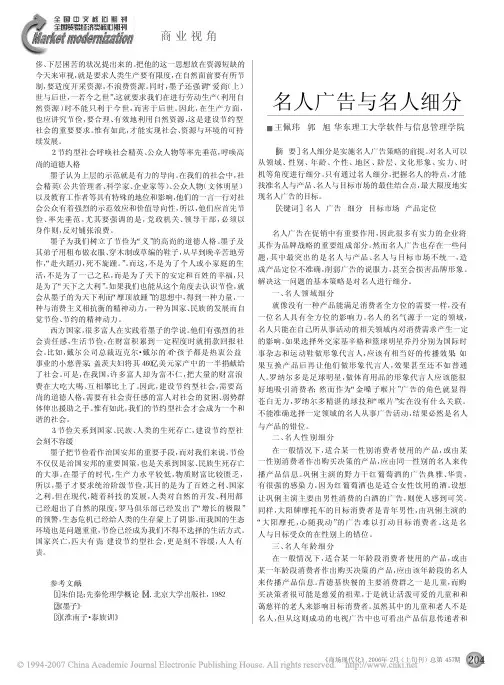
204《商场现代化》2006年2月(上旬刊)总第457期名人广告在促销中有重要作用,因此很多有实力的企业将其作为品牌战略的重要组成部分。
然而名人广告也存在一些问题,其中最突出的是名人与产品、名人与目标市场不统一,造成产品定位不准确,削弱广告的说服力,甚至会损害品牌形象。
解决这一问题的基本策略是对名人进行细分。
一、名人领域细分就像没有一种产品能满足消费者全方位的需要一样,没有一位名人具有全方位的影响力。
名人的名气源于一定的领域,名人只能在自己所从事活动的相关领域内对消费需求产生一定的影响。
如果选择外交家基辛格和篮球明星乔丹分别为国际时事杂志和运动鞋做形象代言人,应该有相当好的传播效果;如果互换产品后再让他们做形象代言人,效果甚至还不如普通人。
罗纳尔多是足球明星,做体育用品的形象代言人应该能很好地吸引消费者;然而作为“金嗓子喉片”广告的角色就显得苍白无力,罗纳尔多精湛的球技和“喉片”实在没有什么关联。
不能准确选择一定领域的名人从事广告活动,结果必然是名人与产品的错位。
二、名人性别细分在一般情况下,适合某一性别消费者使用的产品,或由某一性别消费者作出购买决策的产品,应由同一性别的名人来传播产品信息。
巩俐主演的野力干红葡萄酒的广告典雅、华贵,有很强的感染力,因为红葡萄酒也是适合女性饮用的酒。
设想让巩俐主演主要由男性消费的白酒的广告,则使人感到可笑。
同样,大阳牌摩托车的目标消费者是青年男性,由巩俐主演的“大阳摩托,心随我动”的广告难以打动目标消费者。
这是名人与目标受众的在性别上的错位。
三、名人年龄细分在一般情况下,适合某一年龄段消费者使用的产品,或由某一年龄段消费者作出购买决策的产品,应由该年龄段的名人来传播产品信息。
肯德基快餐的主要消费群之一是儿童,而购买决策者很可能是慈爱的祖辈,于是就让活泼可爱的儿童和和蔼慈祥的老人来影响目标消费者。
虽然其中的儿童和老人不是名人,但从这则成功的电视广告中也可看出产品信息传递者和名人广告与名人细分王佩玮 郭 旭 华东理工大学软件与信息管理学院[摘 要] 名人细分是实施名人广告策略的前提。

Case Research50市场观察・广告主/2007.10案例研究2007年8月1日,联想集团(Lenovo)首款在上盖带有Lenovo标志的ThinkPad皮壳版笔记本电脑正式发售,中国国内售价高达5万元;与此形成鲜明对比的是,8月2日,联想在北京推出的“天福”系列电脑,价格最低的一款只有1499元。
同出一门,价格天地差异,可以看出联想在Lenovo和Think上不同的品牌诉求。
但为了淡化IBM和产品品牌Think之间的联系,联想不断促进企业品牌Lenovo和Think之间的融合,而这最终有可能导致双品牌危机的爆发。
企业并购导致双品牌现象频频出现企业之间的大规模并购,促使双(多)品牌现象频频出现。
世界经济稳步增长、产业加速整合等多种因素促使企业并购、大宗并购案正逐渐增多。
通过并购,大型企业之间可以迅速的形成强强联合体,短时间内迅速做大。
2002年,惠普(HP)斥资240亿美元收购康柏(Compaq);经过3年的整合期之后,惠普2006财年收入达到了917亿美元,首次超过IBM成为全球最大的IT公司。
跨国并购也成为中国内资企业实现技术跨越式发展,以及全球市场的重要途径。
2007年8月7日,联想集团宣布正在就收购欧洲PC厂商Packard Bell进行磋商。
联想主要目的就是得到其品牌的基础上,利用其在欧洲的渠道与售后服务网点。
2007年8月24日,全球最大的硬盘供应商希捷(Seagate)公司首席执行官Will-iam Watkins表示,一家中国科技公司近日表达了收购该公司的意愿。
在大型企业的并购发生之后,在同一企业之下双产品品牌共存现象普遍,双品牌战略重要性凸显。
企业通过收购得到被收购方的品牌之后,利用该品牌的知名度,可以进军新市场。
联想通过收购IBM的PC业务以及Packard Bell不仅可以进入北美和欧洲市场,更可以在一定程度上利用其渠道使Lenovo品牌走向世界。
双品牌运作规则企业的品牌策略有两个层次:一个是企业品牌层次;一个是产品品牌层次。

C HAPTER 20--M ANAGING THE S ALES F ORCEOVERVIEWMost companies use sales representatives, and many companies assign them the pivotal role in the marketing mix. Salespeople are very effective in achieving certain marketingobjectives. At the same time they are very costly. Management must give careful thought to designing and managing its personal-selling resources.Sales force design calls for decisions on objectives, strategy, structure, size and compensation. Sales force objectives include prospecting, communicating, selling and servicing, information gathering, and allocating. Sales force strategy is a question of what types and mix and selling approaches are most effective (solo selling, team selling, and so on). Sales force structure is a choice between organizing by territory, product, customer, or a hybrid combination and developing the right territory size and shape. Sales force size involves estimating the total workload and how many sales hours-and hence salespeople-would be needed. Sales force compensation involves deter-mining pay level and components such as salary, commission, bonus, expenses, and fringe benefits.Managing the sales force involves recruiting and selecting sales representatives and training, directing, motivating, and evaluating them. Sales representatives must be recruited and selected carefully to hold down the high costs of hiring the wrong persons. Sales-training programs familiarize new salespeople with the company's history, its products and policies, the characteristics of the market and competitors, and the art of selling. Salespeople need direction on such matters as developing customer and prospect targets and call norms and using their time efficiency through computer-aided information, planning and selling systems and inside support salespeople. Salespeople also need encouragement through economic and personal rewards and recognition because they must make tough decisions and are subject to many frustrations. The key idea is that appropriate sales force motivation will lead to more effort, better performance, higher rewards, higher satisfaction, and therefore still more motivation. The last management step calls for periodically evaluating each salesperson's performance to help him or her do a better job. The purpose of the sales force is to produce sales, and this involves the art of personal selling. One aspect is salesmanship, which involves a seven-step process: prospecting and qualifying, preapproach, approach, presentation and demonstration, overcoming objections, closing, and fol-low-up and maintenance. Another aspect is negotiation, the art of arriving at transaction terms that satisfy both parties. The third aspect is relationship management, the art of creating a closer working relationship and interdependence between the people in two organizations.In summary, the primary variables for the sales force / management effort include the following: (1) Setting Objectives - Objectives can be general rules for guiding salespeople or more specific expectations for behavior. Regardless, the sales objectives should address the relationship between sales, customer satisfaction, and company profit; (2) Designing Strategy- Strategy requires decisions on salesforce structure, size, and compensation. Variations inthis mixture are appropriate for differing industries, markets and sales objectives; (3) Recruiting and Selecting - Knowing in advance what characteristics will always produce good salespeople is very difficult. Selection procedures should attempt to screen candidates forboth ability and retention-related issues; (4) Training Salespeople - Issues in training center onskills such as order taking and order getting, seeing customers as people who require problem solutions; (5) Supervising Salespeople - Supervision addresses problems in directing and coordinating salespeople's organization, time management, motivation, and customer relationships; (6) Evaluating Salespeople - Evaluation requires both qualitative and quantitative measures of salesforce performance.LEARNING OBJECTIVES:After reading the chapter the student should understand:∙The key factors in designing a sales force∙How one manages a sales force successfully∙The fundamental principles of personal sellingOUTLINEI.Introduction - various classifications of sales positions ranging from least to most creativetypes of selling (deliverer, order taker, missionary, technician, demand creator, solutionvendor)II.Designing the Sales ForceA.Sales Force Objectives (tasks to perform include: prospecting, targeting,communicating, selling, servicing, information gathering, and allocating)B.Sales Force Strategy - approach can be: sales rep to buyer, sales rep to buyergroup, sales team to buyer group, conference selling or seminar selling. Acompany can utilize a direct (company) or contractual (outside) sales force.C.Sales Force StructureD.Force Size and Compensation - level and appropriate combination of components(fixed, variable, expense allowances, and benefits).III.Managing the Sales ForceA.Recruiting and Selecting Sales Representative1.What Makes a Good Sales Representative?2.Recruitment Procedures3.Applicant-Rating ProceduresB.Training Sales Representatives - several goals: to know and identify with thecompany, to know the company’s products, to know the customers’ andcompetitors’ characteristics, to know how to make effective sales presentations,and to understand field procedures and responsibilitiesC.Supervising Sales Representatives1.Developing Norms for Customer Calls2.Developing Norms for Prospect Callsing Sales Time EfficientlyD.Motivating Sales Representatives - the higher the salesperson’s motivation, thegreater his or her effort.1.Sales quotas2.Supplementary Motivators (meetings, contests, etc.)E.Evaluating Sales Representatives1.Sources of Information - sales reports including activity plans and write-ups of activity reports2.Formal Evaluation of Performance (current-to-past sales comparisons,customer-satisfaction evaluation, qualitative evaluation)IV.Principles of Personal SellingA.Professionalism - major steps involved in any sales presentationB.Prospecting and Qualifying - identify and screen out leads1.Pre-approach - learning about the prospect2.Approach - greeting the prospect3.Presentation and Demonstration - tell the product “story”4.Overcoming Objections - psychological and logical resistance5.Closing - asking for the sale6.Follow-Up and Maintenance - ensure satisfactionC.Negotiation1.Negotiation Defined - in negotiated exchange, price and other terms areset via bargaining behavior, in which two or more parties negotiate long-term binding agreements.2.When to Negotiate - appropriate whenever a zone of agreement exists3.Formulating a Negotiation StrategyD.Relationship Marketing - based on the premise that important accounts needfocused and continuous attention. Main steps in establishing a relationshipmarketing program include:1.Identify the key customers meriting relationship marketing,2.Assign a skilled relationship manager to each key customer,3.Develop a clear job description for relationship managers,4.Appoint an overall manager to supervise the relationship managers,5.Have relationship managers develop long-range goals and annualcustomer-relationship plans.V.SummaryMarketing and Advertising1. Ford uses ads such as this, which appeared in Latina magazine, to bring prospects into its dealers' showrooms. Then sales representatives take over, asking about prospects' needs and discussing features and benefits of various Ford models. What kind of training do you think dealers' sales representatives n eed? How can they qualify prospects? Why are good follow-up and maintenance skills important for dealers' sales representatives?Answer: Dealers' sales representatives need training in the features and benefits of each Ford model, as well as training in customers' and competitors' characteristics, effective sales presentation methods, and appropriate field procedures. They can qualify prospects by asking about their preferences (to see whether these match with Ford models being sold), schedule for buying, and price requirements. Good follow-up and maintenance skills keep customers coming back for service at the dealership and encourage customers to buy the next vehicle from the same dealer.2. The Xerox ad shown in Figure 2 is geared toward businesses that produce marketing materials such as brochures in color. This ad directs interested readers to call a toll-free number and ask for a "Xerox Color Specialist." Which of the six types of sales representatives is this specialist likely to be? Which of the specific sales tasks is this sales rep likely to perform?Answer: The Xerox color specialist is likely to be a solution vendor who can devise a system to solve the customer's problems. This sales rep will not do prospecting, targeting, or allocating, but wil l respond to calls from customers by communicating, selling, servicing, and information gathering.Focus on TechnologyAutomated sales management software helps companies boost the productivity of their sales representatives and better integrate sales activities with overall marketing and corporate strategies. Among the leaders in this technology is Trilogy, whose Selling Chain software includes modules for managing sales compensation, contracts, pricing, proposals, and other aspects of the sales proces s.Visit Trilogy's Web site to read about its Selling Chain software(/products/selling_chain.asp). Also click on the "SC Commission" button (in the column of products at left) to read about the sales compensation portion of this program, used by sales managers at Hewlett-Packard and many other companies. With this program, what criteria might sales managers want to use to evaluate the performance of their representatives? Why would sales managers want to track the profitability as well as the volume of sales produced by a sales representative?Answer: Using the Trilogy software, sales managers might want to evaluate their sales reps on the basis of activity (including the number of sales calls made and the number of resulting proposals, contracts, and quotes generated) as well as performance in meeting sales quotas and revenue and profit goals. Customer satisfaction is not tracked directly by the Trilogy software, but should also be included in any sales performance evaluation. Profitability as well as sales should be tracked because reps who build sales volume by discounting prices can significantly hurt the company's overall profitability.Marketing for the MillenniumMany companies are using their Web sites as tool s for building long-term relationships between sales representatives and their customers. A case in point is Texas Instruments, which has created a sophisticated Web site to support its sales of multiple product lines, including calculators and semiconductors.Visit the Texas Instruments Web site (/). Click on the privacy policy (at bottom of page) to learn why information is collected from visitors. Then return to the home page and click on the TI&ME button (at top right) to see how visitors can customize what they view on this site. What does Texas Instruments do with the information it collects from visitors? Why would a customer want to customize the Web page? Why would Texas Instruments want its customers to set up customized Web pages? What effect is this likely to have on the relationship between customers and their sales representatives? Answer: Texas Instruments' privacy policy states that the company will not provide any visitor's personally identifying information to other companies or individuals without getting the visitor's consent. The company tracks the sites from which people go to the Texas Instrument site; it also retains cookies to track specific information requested by the vi sitor, such as personalized Web pages, registrations, and so on. Customers who do not want to waste time wading through mountains of irrelevant data would find customized Web pages useful and time-saving. Knowing what interests a customer can help a sales reptailor the offer of goods and services to better meet that customer's needs; thi s strengthens the relationship between the customer and the sales rep.YOU'RE THE MARKETER: SONIC MARKETING PLANMany marketers—including nonprofit and for-profit organizations—include personal selling in their marketing plans. However, because of the high cost of maintaining a sales force, many marketers are substituting mail and telephone sales for some personal sales calls.At Sonic, you are helping Jane Melody plan sales strategy for the company's line of shelf stereos. Take a few minutes to review Sonic's current situation and the marketing strategies you have already recommended. Then answer the following questions about Sonic's use of personal selling:∙Who should Sonic's sales force be calling on? How can the sales force support Sonic's marketing plan and goals? Would Sonic benefit from major account management?∙What sales objectives and quotas should Sonic set for its sales force?∙What kind of compensation would be most appropriate for the sales force?∙What training should Sonic be providing for new and existing sales representatives?Once you have answered these questions, consider the implications for Sonic's overall marketing goals and its marketing mix. Depending on your instructor's directions, type your answers and recommendations into a written marketing plan or enter them into the Marketing Strategy/Sales Force section and the Sales Forecast section of the Marketing Plan Pro software.Answer: Sonic's sales force should be calling on wholesalers and retailers as part of the distribution strategy. The goals set for the sales force should directly link with Sonic's marketing plan and goals and with the company's overall goals. Sonic would probably benefit from major account management. This would allow for the development and nurturing of longer-term relationships with retailers and other channel members who sell large quantities of Sonic stereos. Sales objectives and quotas for Sonic's sales force should include: quotas that are higher than the sales forecast presented in the marketing plan, to encourage higher performance; objectives for unit sales, revenues, and profitability; and objectives for customer satisfaction. Sonic can structure its sales compensation in several ways. If straight salary is provided, the company should add special incentives to motivate and reward sales reps for extraordinary effort or results. If straight commission is provided, the company only pays when reps perform, which encourages sales reps to meetor exceed their quotas. However, Sonic would probably do best with a combination of salary and commission, which would pay reps for handling necessary nonsales functions while rewarding them for making or exceeding their quotas. Sonic needs to train its sales reps about the company and its goals; the products and their features and benefits; customers and competitors' characteristics; sales presentation methods; and sales procedures and responsibilities.。

自从上个世纪90年代以来,越来越多的企业经营者逐渐认识到:在经营战略问题上,企业经营的最高境界是品牌经营。
要想在21世纪日益激烈的市场竞争中获得竞争优势和主导地位,必须重视实施强有力的品牌经营战略,努力提高企业的品牌价值和声誉,以高质量的品牌作为参与市场竞争的利器。
在品牌经营过程中,衍生出许多新的操作技术和方法,其中,联合品牌或称为品牌联合,作为一种新型的品牌经营方法在实际运用中显示出其强大的市场竞争力。
联合品牌如火如荼所谓联合品牌(Co-Branding),就是指两种或两种以上的企业品牌,通过相互联合,相互借助而形成的一种独特的品牌。
其中一种品牌可以借助于其他一些品牌来丰富自己品牌的内涵,以实现“1+1>2”的效应。
品牌联合的萌芽可以追溯到上个世纪90年代的美国。
为了抵御竞争对手在计算机芯片市场上的大举进攻,电脑业巨头英特尔公司制定了每年耗资1亿美元的促销计划,鼓励计算机制造商在其产品上使用“IntelInside”标识,并对参与这项计划的计算机制造商给予3%—5%的折扣。
此举一出,效果极为明显。
1992年英特尔公司的销售额比上年增加了63%,并且迫于消费者和小制造商的压力,几乎所有的主要计算机制造商都参与了这项计划。
在参与这项计划的计算机产品上都出现了两种品牌:一种是计算机制造商自己的品牌,另一种则是其机芯的品牌即“Intel Inside”。
这种联合品牌与我们将要探讨的联合品牌还有一定的差别。
但英特尔公司的这种品牌经营策略为以后的品牌经营方式开创了一个新思路。
时至今日,联合品牌的运营已深入到许多行业,并且运营主体的实力也越来越强。
仅以2002年为例,就可以看出这种品牌运营方式的应用是如此之广:2002年3月15日,长城与韩松电子进行战略联盟,共同推出面向高端用户群的“金长城-HANSOL”联合品牌显示器;5月18日,被称为2001年网络黑马的TCL网络公司,突然宣布与亚洲最大的网络设备供应商台湾智邦科技建立战略联盟,以“TCL-Accton”联合品牌全面进军中高端设备市场;7月18日,联想集团与D-Link公司苦心缔造的“联想-D-Link”联合品牌网络产品开始上路;10月12日,海尔与万达集团联姻,组建联合战舰,共同进军房地产行业,推出其联合品牌产品“万达・海尔房”;11月19日,世界第三大移动电话制造商爱立信公司在日本与索尼首次推出了“索尼-爱立信”这一联合品牌的高端彩屏CDMA移动电话。