
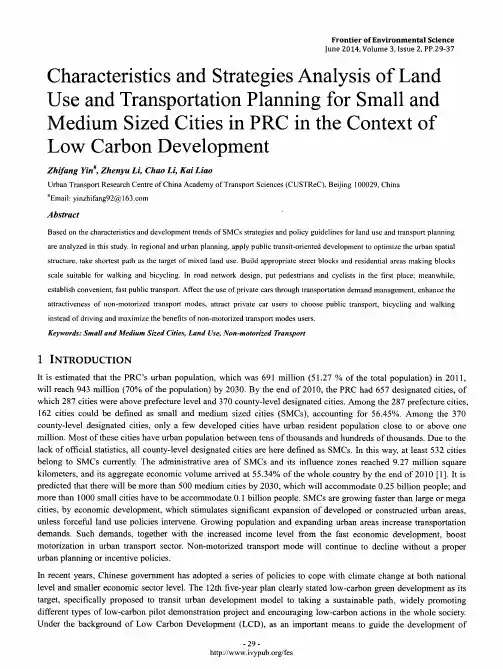
Characteristics and Strategies Analysis of Land Use and Transportation Planning for Small
- 格式:pdf
- 大小:503.21 KB
- 文档页数:9

工业设计中市场调研用到的方法1.我们可以通过问卷调查来了解消费者对产品的需求和偏好。
We can use questionnaires to understand consumers' needs and preferences for products.2.进行竞品分析,比较其他类似产品的功能和设计特点。
Conduct competitive analysis to compare the features and design of similar products.3.通过用户访谈,了解他们对现有产品的意见和建议。
Conduct user interviews to understand their opinions and suggestions for existing products.4.可以进行观察研究,观察用户在使用产品时的行为和反应。
Observational research can be conducted to observe users' behaviors and reactions when using the product.5.可以使用焦点小组讨论的方式,深入了解消费者的想法和想法。
We can use focus group discussions to gain deeperinsights into consumers' thoughts and ideas.6.通过社交媒体分析用户的评论和反馈,了解他们对产品的看法。
Analyze user comments and feedback on social media to understand their views on the product.7.进行用户测试,让用户亲自体验产品并提供反馈。
Conduct user testing, allowing users to experience the product firsthand and provide feedback.8.进行市场调查,了解目标市场的规模和需求。

为如何成为一个好的领导者提供意见英语作文Leadership is a quality that is highly sought after in today's fast-paced and competitive world. Effective leadership is essential for the success of any organization, whether it is a business, a government, or a non-profit. A good leader possesses a unique set of skills and traits that enable them to inspire and motivate others to achieve their goals. In this essay, we will explore some of the key characteristics and strategies that can help individuals become effective leaders.One of the most important qualities of a good leader is the ability to communicate effectively. A leader must be able to articulate their vision and goals clearly and concisely, and to inspire their team to work towards a common purpose. This requires excellent verbal and written communication skills, as well as the ability to listen actively and respond to the needs and concerns of their team members.Another crucial aspect of effective leadership is the ability to makesound decisions. Leaders must be able to analyze complex situations, weigh the pros and cons of different courses of action, and make informed decisions that will have a positive impact on their organization. This requires a combination of critical thinking skills, strategic planning, and the willingness to take calculated risks.In addition to decision-making skills, a good leader must also possess strong problem-solving abilities. Leaders are often faced with a variety of challenges and obstacles that they must overcome in order to achieve their goals. Effective leaders are able to identify the root causes of problems, generate creative solutions, and implement them in a timely and efficient manner.Another key characteristic of a good leader is the ability to inspire and motivate their team. Leaders must be able to create a positive and supportive work environment that encourages team members to work together towards a common goal. This requires the ability to recognize and acknowledge the contributions of team members, to provide constructive feedback and guidance, and to foster a sense of ownership and accountability among team members.Closely related to the ability to inspire and motivate is the quality of emotional intelligence. Effective leaders must be able to understand and manage their own emotions, as well as the emotions of their team members. This includes the ability to empathize with others, tomanage conflict, and to maintain a positive and optimistic attitude even in the face of adversity.Another important characteristic of a good leader is the ability to adapt to changing circumstances. The business world is constantly evolving, and leaders must be able to anticipate and respond to these changes in order to maintain a competitive edge. This requires the ability to think creatively, to be open to new ideas and perspectives, and to be willing to embrace change and innovation.Finally, a good leader must possess a strong sense of integrity and ethical behavior. Leaders must be able to set a positive example for their team members and to uphold the values and principles of their organization. This includes being honest and transparent, treating team members with respect and fairness, and making decisions that are in the best interest of the organization and its stakeholders.In conclusion, becoming a good leader requires a combination of skills, traits, and strategies that can be developed and honed over time. Effective leaders must be able to communicate effectively, make sound decisions, solve problems, inspire and motivate their team, demonstrate emotional intelligence, adapt to changing circumstances, and uphold a strong sense of integrity and ethical behavior. By cultivating these qualities, individuals can become effective leaders who can guide their organizations to success.。

商务英语专业毕业论文题目文化对比类1.中西方餐饮文化对比2.跨文化交际与中西文化冲突3.中西方餐桌礼仪差异4.了解中西方不同礼仪在外贸业务中的意义4.中英文在生活中的差异5.文化差异与英汉习语的翻译6.论语境在翻译中的重要性7.英语听说读写四种技能的关系9.英语词汇中的外来语单词10.美国英语的特色11.中外文学作品比较12.报刊英语中标点、缩略语的应用13.背诵在英语中的作用14.英语与美语的差异15.中西饮食文化的比较16.中西文化中礼仪在外贸业务中的比较17.中美商务谈判中恭维语及恭维应答的比较分析18.商务英语信函中词汇特征的分析其他2.商务英语函电在对外贸易中的作用3.商务合同中英语词汇的作用4.商务英语在中国加入 WTO 后的新发展和新趋势、5.商务英语函电写作和作用6.商务谈判的成功因素7.中美商务谈判中恭维语及恭维应答的比较分析8.商务英语信函的词汇特征分析9.英汉习语中的明喻、暗喻和借代10.英汉习语对比及反映的东西方文化异同11.英语商标的文化内涵与汉译12.商务谈判中英语的重要性14.还盘信中的写作技巧15.商务谈判中成功的要素16.商务函电的写作及用词特点17.入世商务英语写作的措施研究18.外贸单证在出口业务中的地位和作用19.对背信用证和可转让信用证的对比分析20.外贸单证在缮制过程中的要点中英题目1)The Influence of Cultural Elements on the Translation of the idioms in Commercial English 试论文化因素对经贸领域中习语翻译的影响2)Commercial English: its characteristics and translation 经贸英语的特点与翻译3)The Characteristics of Business Contract Wording in English & its Translation 英语经贸契约4)On the Usage and Translation of Prepositions and Prepositional Phrases in Business Contracts in English 英语经贸契约介词和介词短语的用法及翻译5)Understanding and Translation of the Divisional Phenomena in English Economic Contracts 英语经贸契约分隔现象的理解与翻译6)Lexical Features of Business Contract English and Its Translation 经贸合同英语词法特征及其翻译7)Characteristics and Distinctive English Translation of Words in Business Contracts 商务合同英语用词特点及翻译的特色标记8)The Characteristics and the Present Situation of Foreign trade English Translation 对外经贸翻译的特点与现状9)On the Translation of Commercial Advertisement 谈商业广告的翻译10)On the Role of Social Context in Business English Translation 浅议经贸英语翻译中语境因素的作用11)On the Criteria of Translating English in to Foreign- oriented Economy and Trade Affairs 试论经贸英语翻译的标准12)Translation Characteristics of Economy and Trade English 经贸英语的翻译特点13)Understanding and Translation of the Divisional Phenomena in English Economic Contracts 英语经贸契约分隔现象的理解与翻译14)On Abbreviations in Business English 谈经贸英语中的缩略语现象15)On the Strategies of the Mistranslation in Business English 论经贸英语误译的对策16)Multi-angle Views On Business English Translation 经贸翻译的多视角17)A Classification & Translation of Words Denoting Major Positions in Business English 经贸英语中主要职务用词的分类与翻译18)The Classification and Translation of the Business English T erms with the Reference of "Money"经贸英语中含有"钱款"意义词汇的分类及翻译19)A Brief analysis on the Characteristics of Business English Vocabulary浅议经贸英语词汇的特点10) Word Diction in Economy and Trade Translation 经贸翻译的词义选择21)On the Multi-discipline of the Economic English Vocabulary 论经济英语语汇的多学科性22)On the Features of Business English Letters 浅谈外经贸英语信函的写作特点23)Adjusting the T one in International Business English 经贸英语缓和口吻表达方法探究24)The Stylistic Features of the Contract English 协议、合同英语的文体特点25)On Translation of English Advertisement 广告英语的翻译26)Advertisement English Translation in Cross-cultural Background 跨文化背景中的广告英语翻译27)On Modifiers of Nouns in English for Foreign Economy & Trade 略谈外经贸英语中的名词修饰语28)On Translation of the Dates, Amount and Numbers (Figures) in the Economic & Trade Contracts 经贸契约中日期、金额和数字的翻译29)Translating Strategy of Modern Business English 现代商务英语翻译策略30)The New Trend of Economy & Trade English after China's Entry into WTO 经贸英语在中国加入WTO 后的新趋势31)Knowledge of Formulaic Expressions in Foreign Economic and Trade Contracts for the Study of Legal English 了解涉外经贸合同套语扫除法律英语学习障碍32)The Principle of Faithfulness in C-E Business Translation 关于英汉经贸翻译的"信"33)Methods and Principles of Trade Mark Translation 商标翻译的方法及应遵循的基本原则34)The Language Characteristics and Translation Strategy of English Advertisements 广告英语语言特点及其翻译策略35)A Study of the Characteristics of Sentences in International Economic Trade Contracts in English 试谈英文国际经济贸易合同的句法特点36)How to Correctly Understand & Translate the Compound WordsFormed from Here-, There- and Where- in Economic & Trade Contracts如何正确理解和翻译经贸契约中 Here, There-和 Where 构成的复合词37)he Life of the Translation of the Literature of Economy and Trade——Accuracy in the Translation 经贸文体翻译之生命——准确性38)On the Rhetoric Character and Translating Method of Advertising English 浅析广告英语的修辞特点和翻译方法39)On Metaphors in Business English and Translation 商务英语中的隐喻及其翻译40)On "Faithfulness" and "Innovation" in Foreign Trade English Translation 外贸英语翻译的"忠实"与"变通"41)The Strategies of Domestication and Dissimilation on Advertising English Translation 广告英语翻译的"归化"和""异化"策略42)Cross-cultural and Cross-linguistic Factors in English Advertisement Translation 英语广告翻译中的跨文化、跨语言因素43)Nominalization application in business English letter writing and its translation 名词化结构在商务英语信函中的应用和翻译44)On the Art of Rhetoric and Translation Approaches in Advertising English 论广告英语的修辞艺术和翻译方法45)The Negative and Active Function of Fuzzy Language in Business Writing 论模糊语言在经贸英语写作中的作用46)The Application of PP (Polite Principle) in Business English Communication47)CP(Cooperative Principle)and Business English Interpretation48)On the Cliché Expressions in Business English 商务英语中陈词腐语探析49)Hypotaxis and Parataxis in the Context of English to Chinese Translation of Business Literature 商务英语翻译中形合义合分析50)On the Preciseness of Business English Contracts 论商务英文合同语言严谨性51)How to Achieve Consideration in Business Correspondence 实现商务函电中“consideration”的手段52)A Research into the Legalese in Applied Business Literature 商务英语应用文中的法制性语言研究53)On the Balance between Conversational English and Old-fashioned English “conversational English”与“old-fashioned English”的恰当使用54)Features of Foreign Trade English and its Translation Model 外贸英语的特点与翻译模式55)An Analysis of the Rhetorical Devices used in English Business Advertisements 商务英语广告语言修辞探析56)On the Translation of Trademarks 商务英语商标翻译技巧57)Business English Abbreviations and their Functions 商务英文缩略语构成及功能58)On the Application of the Politeness Principle in Foreign Trade Correspondence“礼貌”在函电中的恰当使用59)Principles of Translating Economic Literature of Enterprises from Chinese to English 企业外宣资料汉英翻译原则60)English-Chinese Translation of Trademarks: Its Principles and Strategies 英语商标的汉译原则及策略61)The Puns in English and Chinese Advertisements and the Translation of Them 英汉广告中的双关语及其英汉互译62)The Pragmatic Analysis and Translation Strategies of Long Sentences in English Business Contracts 英语商务合同长句的语用分析及翻译策略63)Influence of Cultural differences on the Chinese-English Translation of Business Writing 文化差异对商务汉英翻译的影响64)On Equivalence of Cultural Message in the International Business English Translation 国际商务英语翻译中的文化信息等值研究。
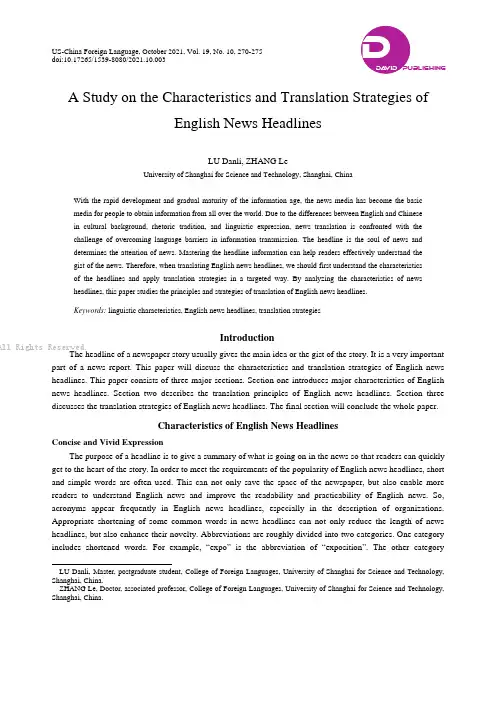
US-China Foreign Language, October 2021, Vol. 19, No. 10, 270-275doi:10.17265/1539-8080/2021.10.003A Study on the Characteristics and Translation Strategies ofEnglish News HeadlinesLU Danli, ZHANG LeUniversity of Shanghai for Science and Technology, Shanghai, ChinaWith the rapid development and gradual maturity of the information age, the news media has become the basicmedia for people to obtain information from all over the world. Due to the differences between English and Chinesein cultural background, rhetoric tradition, and linguistic expression, news translation is confronted with thechallenge of overcoming language barriers in information transmission. The headline is the soul of news anddetermines the attention of news. Mastering the headline information can help readers effectively understand thegist of the news. Therefore, when translating English news headlines, we should first understand the characteristicsof the headlines and apply translation strategies in a targeted way. By analyzing the characteristics of newsheadlines, this paper studies the principles and strategies of translation of English news headlines.Keywords: linguistic characteristics, English news headlines, translation strategiesIntroductionThe headline of a newspaper story usually gives the main idea or the gist of the story. It is a very importantpart of a news report. This paper will discuss the characteristics and translation strategies of English news headlines. This paper consists of three major sections. Section one introduces major characteristics of English news headlines. Section two describes the translation principles of English news headlines. Section three discusses the translation strategies of English news headlines. The final section will conclude the whole paper. Characteristics of English News HeadlinesConcise and Vivid ExpressionThe purpose of a headline is to give a summary of what is going on in the news so that readers can quickly get to the heart of the story. In order to meet the requirements of the popularity of English news headlines, short and simple words are often used. This can not only save the space of the newspaper, but also enable more readers to understand English news and improve the readability and practicability of English news. So, acronyms appear frequently in English news headlines, especially in the description of organizations. Appropriate shortening of some common words in news headlines can not only reduce the length of news headlines, but also enhance their novelty. Abbreviations are roughly divided into two categories. One category includes shortened words. For example, “expo” is the abbreviation of “exposition”. The other categoryLU Danli, Master, postgraduate student, College of Foreign Languages, University of Shanghai for Science and Technology, Shanghai, China.ZHANG Le, Doctor, associated professor, College of Foreign Languages, University of Shanghai for Science and Technology,Shanghai, China.All Rights Reserved.CHARACTERISTICS & TRANSLATION STRATEGIES OF ENGLISH NEWS HEADLINES 271combines the capital letters of each word in a phrase into one word, such as AQ (Adversity Quotient), EST(Eastern Standard Time). No matter readers are familiar with them or not, they can find the full names ordefinitions of them in news chapters.“Newness” is the life of news language, which is determined by the content of news reports. In order to keep close to social life and grasp the pulse of the times, news reports need to create a large number of newwords to spread new ideas and fashions, so as to attract public attention. Therefore, frequent use of new wordsis a prominent feature of English news, which usually includes two types of situation (Xu, 2018). In onesituation, a new meaning is derived from an old word, such as “clone”, which means “copy” now. In the othersituation, a new word is purely created, such as “computernik”, which means someone addicted to computers.News reports have a high requirement for information dissemination and effectiveness, so words often change their part of speech (such as from a noun to a verb, or vice versa). For example, the headline“Cooperative Operation Profits Farmers” has changed “Profit” from noun to verb, making the headline moreconcise and clear. In addition, English news has wide audience, so a large number of easy-to-understand wordsare used to enhance the overall accessibility of the headlines. Among them, using proper nouns and specialnames to refer to specific meanings is one of the ways to improve the popularity of the headlines. For instance,it is common to use the name of a building or place to refer to a country, such as “the White House” for theUnited States and “the Louvre” for France.Distinct Grammatical FeaturesThe grammar of English news headlines is different from that of normal use and has its unique characteristics. The news story that appears in the newspaper has already happened; so according to the basicrules of grammar, it needs to be expressed in the past tense. But the use of past tense deviates from the essentialcharacteristic of news. In order to enhance readers’ experience of news events, editors should abide by thespecial principle of “news present tense”, and use the simple present tense to formulate news headlines (Zhu,2008).A news headline should be a complete sentence, but in order to be concise and highlight importantinformation, function words such as articles, auxiliary words, link verbs, conjunctions, and pronouns are oftenomitted from the headline on the premise of not affecting the expression of the main theme of the news. In thisway, the length of the headline is shortened to a large extent, so as to avoid procrastination and redundancy. Forexample, the headline “It’s Time to Organize Your Book” could be shortened to “Time to Organize YourBook” and the headline “Japan Is in Danger of Reform” could be shortened to “Japan in Danger of Reform”.Punctuation marks are auxiliary recording symbols of the written system, which can divide meaning groups, substitute words, emphasize information, and highlight the sense of reality (Zhang, 2020). Punctuationmarks can make news headlines simple and lively, leaving people with thinking space. Headlines focus onstructural clarity and often use three types of punctuation. The first is comma, which is used to replace theconjunction “and” to save space, such as in the headline “US, Japan Meet in Women’s World Cup”. Thesecond is dash, which is often used to quote a statement to make the headline more intuitive and clear. Forinstance, the headline “Next iPhone Update Will Let You Disable Intentional Slow Down—Tim Cook” meansthat Tim Cook says that next iPhone update will let you disable intentional slowdown. The third is colon, whichis used to mean “to say” or “to think” or to replace the related verb “to be”, so as to make the headline moredirect.All Rights Reserved.CHARACTERISTICS & TRANSLATION STRATEGIES OF ENGLISH NEWS HEADLINES272 Abundant Rhetorical FeaturesIn order to highlight the novelty of English news headlines, rhetorical devices are often used in order to achieve humorous, vivid, or ironic effects. The first type is pun. In a specific context, homophone or polysemy can be used to generate double meaning. In English, there are a lot of words with the same spelling but different meanings. Applying this kind of puns in news headlines can increase their connotation and arouse readers’ interest. For example, the headline “Champagne Economy or Bubble Economy?” highlights the difficulty of maintaining production in France in the economic decline caused by champagne losses. And when headlines are created, champagne can be used to both illustrate economic losses and allude to the bubble economy. Pun can not only induce readers’ associations, but also add humor or irony to headlines.The second type is exaggeration, which can quickly attract the attention of readers and enhance the influence of the headline, causing readers’ imagination of news content. However, editors should highlight the essence of the matter when applying exaggeration so as to avoid overreaching. For example, “A Vow to Zip His Lips” not only rhetorically indicates the action of “sew up the lips”, but also can be translated as “keep a secret”.The third type is euphemism. For taboo contents in a specific culture, the direct expression is not elegant, so obscure and polite words can be used to express them, which makes the language more appropriate and generally accepted by the public. For example, after Watergate, people often use the word “Watergate” to describe similar political events, followed by “Monica Scandal” and “Korea Scandal”.The fourth type is alliteration and end rhyme. “Soldiers Salary Soars”, for example, is a headline with each word starting with an “S”. From the perspective of lexical meaning, “Rises” or “Goes High” can replace “Soars”, but the beauty of rhythm in the original headline will be lost. It can be seen that alliteration could more easily attract readers’ attention and leave a deep impression on readers. In the headline “After the Boom Everything Is Gloom”, “Boom” is similar to “Gloom” in the form of final rhyme. End rhyme can not only enhance readers’ audio-visual pleasure, but also stimulate readers’ interest in this news content. In addition, the double rhyming rhetoric of “alliteration + end rhyme” makes English news headlines more orderly, which has a strong sense of rhythm. In the headline “From Monster to Martyr?”, “Monster” and “Martyr” have completely opposite meanings but with the same pronunciation of the first and the last sound. The simultaneous appearance of alliteration and end rhyme, which concentrates on a single person in a news headline, is highly ironic and highlights the excellent writing skills of news editors.Translation Principles of English News HeadlinesAccuracyIn the translation of English news headlines, the first principle is to ensure the accuracy of the headlines, which is not to go against the original author’s idea and which is to grasp the important content of the news. Once the key content of the news is not grasped in the translation, the translator may not be able to feel the error of the translation, trapped in the dilemma of catching the meaning of words literally. The accuracy of the news headline directly determines the quality of the whole report, so it should be regarded as the primary standard in the translation and the theme content of the news should not deviate. As Chinese and foreigners have different ways of thinking, it is necessary to take into account cultural differences and accurately express the connotation and mood of the news headlines.All Rights Reserved.CHARACTERISTICS & TRANSLATION STRATEGIES OF ENGLISH NEWS HEADLINES 273RefinementWhen the requirement of accuracy is met, another important point of translation of English news headlines is refinement. Due to the differences between languages, it is difficult to find the corresponding words inChinese for some words in English, which leads to procrastination in translation. Therefore, it is necessary toensure the refinement of translation. In order to ensure that the headlines achieve the effect of refinement,translators need to analyze the headlines of English news. Abbreviations are often used to make English newsheadlines more concise, so abbreviated words can also be used in translation, which is also a common methodfor translating English news headlines.VitalityWith the special nature, English news headlines have a unique way of presentation. In most cases, news headlines are often made vivid by rhetorical devices. A good news headline can not only make readersunderstand the important content of the news, but also stimulate readers’ interest and deepen readingimpression. However, due to cultural differences, translators must have a deep understanding of the culture ofrelevant English-speaking countries, and fully consider the Chinese language and culture to translate withappropriate words. In addition to ensuring the similarity in form, it is more important to ensure the mutualcommunication of connotation, so as to express the original charm of language.Translation Strategies of English News HeadlinesLiteral TranslationWhen English news headlines are clear and easy to understand, literal translation can be used. The greatest advantage of literal translation is that it retains the language features, expression forms, and content meaning ofthe original text. Although there are some differences between Chinese and Western cultures, people have a lotin common in terms of feelings and thinking patterns. Therefore, literal translation is the most commontranslation method and also the preferred strategy of translators.Free TranslationIf literal translation cannot accurately express the content of the original headline, or its readability cannot be accepted by the reader of the target language, free translation can be considered. In general, free translationdoes not need to strictly maintain the original structure, but only needs to clearly and completely express itscorresponding meaning, without paying attention to too many details in grammar. But this does not mean thatthe translator can freely adjust the patterns and structure; instead, the translator must translate on the basis ofthe original meaning. It allows readers to capture the true content of news from hidden information. Forexample, the headline “Believing the Believers” can be translated into “人类的信仰” and “Looking Back toLook Ahead” can be translated into “回首往昔,展望未来”. Free translation can not only accurately expressthe meaning of the original headline, but also better reflect the rich and profound connotation of Chinese.Amplification Method in TranslationIf the readers of target language lack the relevant background knowledge, the addition of annotations or related information becomes necessary. For instance, the translation of “Tyson’s Trade Treatment” is “美国女贸易经济学家泰森的贸易对策”. For the readers familiar with the content of the original text, “Tyson” in theheadline is easy to understand. Accurately grasping the main point, however, can be difficult for the targetreaders, who will mistake “Tyson” for a champion boxer. Therefore, it is necessary for the translator to add All Rights Reserved.CHARACTERISTICS & TRANSLATION STRATEGIES OF ENGLISH NEWS HEADLINES274 some information about Tyson as an economist, so that the target audience can accurately receive the information. As another example, the translation of “Jack Ma: Don’t Use Trade as a Weapon” is “马云出席达沃斯:不要把贸易当作武器”. The original headline only tells what Ma said, but the translator added specific conference details to help the target readers better know the news information. The translated version gives the readers background information on Ma’s stance on the trade war. Such translation is helpful to improve the accuracy of expression and shorten the distance between events and readers. More importantly, it can stimulate the reader’s interest to continue reading.Method of Using Rhetorical DevicesAlthough news needs to be concise and accurate, distinctive headlines are a magic weapon to attract readers. The use of various rhetorical devices can make a news report sparkling. If the headline contains some rhetorical devices, such as puns, metaphors, and rhymes, the translation should also use the corresponding rhetorical devices, in order to achieve the same rhetorical characteristics as the original as much as possible. For instance, the headline “After the Booms, Everything Is Gloom” is translated by “一别繁荣,一片愁容”. “Boom” and “Gloom” form the end rhyme and the Chinese translation perfectly shows the rhyme feature of the original through “Rong” and “Rong” with the same pronunciation to form the end rhyme. Also, the two “yi” achieve the effect of alliteration, fully showing the rhetorical effect with a feeling of unity. As another example, the headline “A Bowl of Soup a Day Could Keep the Pounds at Bay” applies the pattern of an old saying “An Apple a Day Keeps Doctor Away”, achieving the rhyme effect. So, it can be translated by “一天一碗汤,脂肪减光光” by imitating the format of this proverb. This translating method not only accurately conveys the intended meaning of the original headline, but also makes the news headlines more interesting.Conversion Between Positive and Negative Words In the process of translation, we should also pay attention to the different nature of words between countries and understand the context of the original news. For example, in the headline “The Chinese Market, a Bottomless Pit”, the phrase “A Bottomless Pit” in Chinese has a negative meaning. If we literally translate it into Chinese, the Chinese market will be described as derogatory. Through reading the content of the news, the phrase “A Bottomless Pit” comes from the mouth of the president of the famous sports brand Nike, which happened when he inspected Shanghai. After analyzing the context, it can be found that what he wants to express is that the market potential of China is great. In this headline, if the relevant context and expression of the words are not analyzed, it is easy to cause negative understanding and even affect the relationship between the two countries. Therefore, in the process of translation, we should focus on the meaning of each word in different countries to make it fit with the original context, so that we can translate and express it accurately and play a positive role in communication.ConclusionNews headlines, whether in Chinese or English, reflect their own language and cultural characteristics. So, the translation of news headlines is not only the conversion between different languages, but also a cultural communication which must be carried out on the basis of the characteristics of English news headlines. In the process of translation, translators will be affected by many cultural differences, such as different cultural backgrounds, thinking patterns, and historical allusions. Therefore, it is particularly important to adopt different translation strategies according to the specific situation.All Rights Reserved.CHARACTERISTICS & TRANSLATION STRATEGIES OF ENGLISH NEWS HEADLINES 275The purpose of news headline translation is to enable the readers of the target language to accurately obtain the information in the source language. Readers tend to pay more attention to the content of the originalnews headline, but less to its form. In order to ensure the readability of the news headlines, translators shouldnot only accurately convey the information of the original headline, but also make the target language conformto the reading habit and thinking mode of the readers. Only in this way can the cultural information hidden inthe original news headlines be excavated and transmitted accurately and effectively, which helps readers of thetarget language better understand the news content.ReferencesDuanmu, Y. W. (2011). Functions and language features of English newspaper headlines. Foreign Languages Research, (2), 43-45.Dou, H. L. (2016). Lexical features and translation strategies of news English. News Junkie, (2), 66-68.Xu, M. W. (2018). News English and translation. Beijing: China International Translation Press.Zhu, Y. G. (2008). Linguistic features & translation. Shanghai: Shanghai Jiaotong University Press.Zhang, X. (2020). English news headline translation based on functional theory. Journalistic Research Guide, (1), 225-226.All Rights Reserved.。