
Quartus时序约束与时序分析
- 格式:ppt
- 大小:1.85 MB
- 文档页数:34

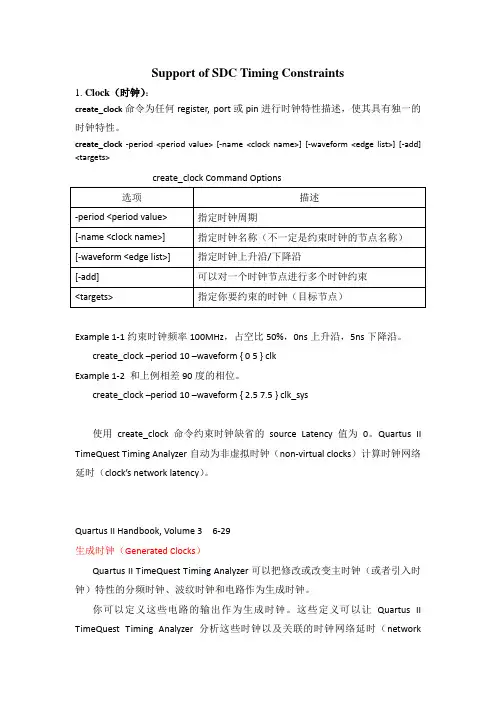
Support of SDC Timing Constraints1. Clock(时钟):create_clock命令为任何register, port或pin进行时钟特性描述,使其具有独一的时钟特性。
create_clock-period <period value> [-name <clock name>] [-waveform <edge list>] [-add] <targets>create_clock Command OptionsExample 1-1约束时钟频率100MHz,占空比50%,0ns上升沿,5ns下降沿。
create_clock –period 10 –waveform { 0 5 } clkExample 1-2 和上例相差90度的相位。
create_clock –period 10 –waveform { 2.5 7.5 } clk_sys使用create_clock命令约束时钟缺省的source Latency值为0。
Quartus IITimeQuest Timing Analyzer自动为非虚拟时钟(non-virtual clocks)计算时钟网络延时(clock’s network latency)。
Quartus II Handbook, Volume 3 6-29生成时钟(Generated Clocks)Quartus II TimeQuest Timing Analyzer可以把修改或改变主时钟(或者引入时钟)特性的分频时钟、波纹时钟和电路作为生成时钟。
你可以定义这些电路的输出作为生成时钟。
这些定义可以让Quartus II TimeQuest Timing Analyzer分析这些时钟以及关联的时钟网络延时(networklatency)。
使用create_generated_clock命令定义生成时钟。


quaruts 时序约束English Answer:Quarts Timing Constraints.Quartus Prime timing constraints drive the Quartus Prime timing analyzer engine to achieve fast and accurate timing analysis results. Timing constraints specify the timing relationships and requirements between different parts of the design. These constraints can be applied to clocks, registers, I/O ports, and other design components.Quartus Prime supports two main types of timing constraints:Static timing constraints (STCs) specify absolute timing relationships between two points in the design. For example, you can use STCs to specify the maximum or minimum time between a clock edge and a register setup time.Dynamic timing constraints (DTCs) specify timing relationships between two points in the design that may change over time. For example, you can use DTCs to specify the maximum or minimum time between a clock edge and a register setup time when the clock frequency is changing.Quartus Prime Timing Constraints Syntax.The syntax for timing constraints in Quartus Prime isas follows:<constraint_type> <constraint_name> <constraint_value>。
