
CLAW6026_Taxation Law_2010 Semester Summer_6-CGT
- 格式:ppt
- 大小:201.50 KB
- 文档页数:61


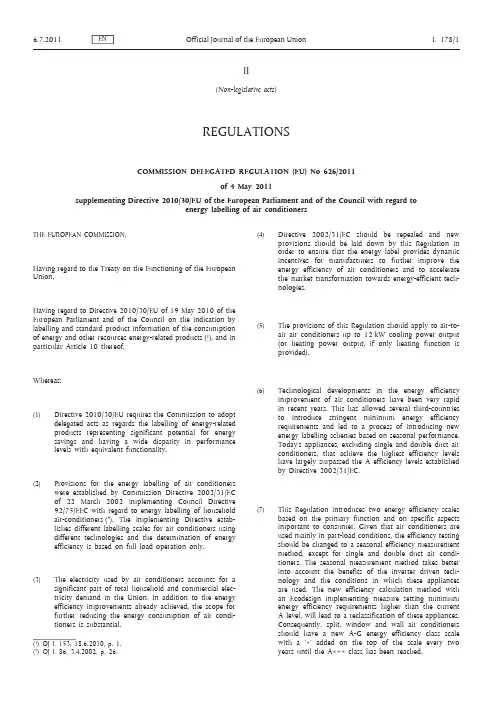
II(Non-legislative acts)REGULATIONSCOMMISSION DELEGATED REGULATION (EU) No 626/2011of 4 May 2011supplementing Directive 2010/30/EU of the European Parliament and of the Council with regard toenergy labelling of air conditionersTHE EUROPEAN COMMISSION,Having regard to the Treaty on the Functioning of the EuropeanUnion,Having regard to Directive 2010/30/EU of 19 May 2010 of the European Parliament and of the Council on the indication by labelling and standard product information of the consumption of energy and other resources energy-related products ( 1 ), and in particular Article 10 thereof,Whereas:(1) Directive2010/30/EU requires the Commission to adopt delegated acts as regards the labelling of energy-relatedproducts representing significant potential for energy savings and having a wide disparity in performance levels with equivalent functionality.(2) Provisionsfor the energy labelling of air conditioners were established by Commission Directive 2002/31/ECof 22 March 2002 implementing Council Directive 92/75/EEC with regard to energy labelling of household air-conditioners ( 2 ). The implementing Directive estab lishes different labelling scales for air conditioners using different technologies and the determination of energy efficiency is based on full load operation only.(3) Theelectricity used by air conditioners accounts for a significant part of total household and commercial elec tricity demand in the Union. In addition to the energy efficiency improvements already achieved, the scope for further reducing the energy consumption of air condi tioners is substantial.(4) Directive 2002/31/EC should be repealed and newprovisions should be laid down by this Regulation in order to ensure that the energy label provides dynamic incentives for manufacturers to further improve the energy efficiency of air conditioners and to accelerate the market transformation towards energy-efficient tech nologies.(5) The provisions of this Regulation should apply to air-to-air air conditioners up to 12 kW cooling power output(or heating power output, if only heating function is provided).(6) Technological developments in the energy efficiencyimprovement of air conditioners have been very rapid in recent years. This has allowed several third-countries to introduce stringent minimum energy efficiency requirements and led to a process of introducing new energy labelling schemes based on seasonal performance. Today's appliances, excluding single and double duct air conditioners, that achieve the highest efficiency levels have largely surpassed the A efficiency levels established by Directive 2002/31/EC.(7) This Regulation introduces two energy efficiency scalesbased on the primary function and on specific aspects important to consumer. Given that air conditioners are used mainly in part-load conditions, the efficiency testing should be changed to a seasonal efficiency measurement method, except for single and double duct air condi tioners. The seasonal measurement method takes better into account the benefits of the inverter driven tech nology and the conditions in which these appliances are used. The new efficiency calculation method with an Ecodesign implementing measure setting minimum energy efficiency requirements higher than the current A level, will lead to a reclassification of these appliances. Consequently, split, window and wall air conditioners should have a new A-G energy efficiency class scale with a ‘+’ added on the top of the scale every two years until the A+++ class has been reached.( 1 ) OJ L 153, 18.6.2010, p. 1. ( 2 ) OJ L 86, 3.4.2002, p. 26.(8)For double duct and single duct air conditioners, steady-state energy efficiency performance indicators should continue to be applied, as there are currently no inverter units on the market. As no reclassification of these appliances is appropriate, single and double duct air conditioners should have an A+++-D scale. While these, inherently less efficient than split appliances, can go only up to an A+ energy efficiency class in a scale of A+++-D, the more efficient split appliances can reach up to the A+++ energy efficiency class.(9) This Regulation should ensure that consumers get moreaccurate comparative information about the performanceof air conditioners.(10) Thecombined effect of energy labeling set out in this Regulation and of Regulation implementing Directive 2009/125/EC of the European Parliament and of the Council with regard to ecodesign requirements for airconditioners ( 1 ) is expected to result in annual electricitysavings of 11 TWh by 2020, compared to the situation if no measures are taken.(11) The noise level of an air conditioner could be animportant aspect for end-users. In order to enable them to make an informed decision, information on noise emissions should be included on the label of air condi tioners.(12) Theinformation provided on the label should be obtained through reliable, accurate and reproducible measurement procedures, which take into account the recognised state of the art measurement methods including, where available, harmonised standards adopted by the European standardisation bodies, as listed in Annex I to Directive 98/34/EC of the European Parliament and of the Council of 22 June 1998 laying down a procedure for the provision of information in the field of technical standards and regu lations ( 2 ).(13) ThisRegulation should specify a uniform design and requirements as to the content of labels for air condi tioners.(14) Inaddition, this Regulation should specify requirements as to the technical documentation and the fiche for air conditioners.(15) Moreover, this Regulation should specify requirements asto the information to be provided for any form ofdistance selling, advertisements and technical promo tional material of air conditioners.(16) Itis appropriate to provide for a review of the provisions of this Regulation taking into account technological progress.(17) In order to facilitate the transition from Directive2002/31/EC to this Regulation, air conditioners labelledin accordance with this Regulation should be considered compliant with Directive 2002/31/EC.(18)Suppliers wishing to place on the market air conditioners that can meet the requirements for higher energy effi ciency classes should be allowed to provide labels showing those classes in advance of the date for mandatory display of such classes.(19) Directive 2002/31/EC should therefore be repealed, HAS ADOPTED THIS REGULATION:Article 1Subject matter and scope1. This Regulation establishes requirements for the labelling and the provision of supplementary product information for electric mains-operated air conditioners with a rated capacity of ≤ 12 kW for cooling, or heating, if the product has no cooling function.2. This Regulation shall not apply to:a) appliances that use non-electric energy sources;b) air conditioners of which the condensor- or evaporator-side, or both, do not use air for heat transfer medium.Article 2 DefinitionsIn addition to the definitions set out in Article 2 of Directive 2010/30/EU of the European Parliament and of the Council ( 3 ), the following definitions shall apply:(1) ‘air conditioner ’ means a device capable of cooling or heating,or both, indoor air, using a vapour compression cycle driven by an electric compressor, including air conditioners that provide additional functionalities such as dehumidifi cation, air-purification, ventilation or supplemental air- heating by means of electric resistance heating and appliances that may use water (either condensate water that is formed on the evaporator side or externally added water) for evaporation on the condensor, provided that the device is also able to function without the use of additional water, using air only; (2) ‘double duct air conditioner ’ means an air conditioner inwhich, during cooling or heating, the condensor or evap orator intake air is introduced from the outdoor environment to the unit by a duct and rejected to the outdoor environment by a second duct, and which is placed wholly inside the space to be conditioned, near a wall; (3) ‘single duct air conditioner ’ means an air conditioner in which,during cooling or heating, the condensor or evaporator intake air is introduced from the space containing the unit and discharged outside this space;( 1 ) Not yet adopted.( 2 ) OJ L 204, 21.7.1998, p. 37.( 3 ) OJ L 153, 18.06.2010, p. 1.(4) ‘rated capacity’ (P rated) means the cooling or heating capacityof the vapour compression cycle of the unit at standard rating conditions;(5) ‘end-user’ means a consumer buying or expected to buy anair conditioner;(6) ‘point of sale’ means a location where air conditioners aredisplayed or offered for sale, hire or hire-purchase.Additional definitions for the purpose of Annexes II to VIII are set out in Annex I.Article 3Responsibilities of suppliers1. Suppliersshall take action as described in points (a) to (g):(a) a printed label is provided for each air conditionerrespecting energy efficiency classes as set out in Annex II.The label shall comply with the format and content of information as set out in Annex III. For air conditioners, except single and double duct air conditioners, a printed label must be provided, at least in the packaging of the outdoor unit, for at least one combination of indoor and outdoor units at capacity ratio 1. For other combinations, the information can be alternatively provided on a free access web site;(b) a product fiche, as set out in Annex IV, is made available.For air conditioners, except single and double duct air conditioners, a product fiche must be provided at least in the packaging of the out door unit, for at least one combination of indoor and outdoor units at capacity ratio 1. For other combinations, the information can be alternatively provided on a free access web site;(c) technical documentation as set out in Annex V is madeavailable electronically on request to the authorities of the Member States and to the Commission;(d) any advertisement for a specific model of an air conditionershall contain the energy efficiency class, if the advertisement discloses energy-related or price information. Where more than one efficiency class is possible, the supplier or the manufacturer, as appropriate, shall declare the energy efficiency class for heating at least in ‘Average’ heating season.Information in the cases where end-users cannot be expected to see the product displayed is to be provided as set out in Annex VI;(e) any technical promotional material concerning a specificmodel of an air conditioner which describes its specific technical parameters shall include the energy efficiency class of that model as set out Annex II; (f) instructions for use are made available;(g) single ducts shall be named ‘local air conditioners’ inpackaging, product documentation and in any advertisement material, whether electronic or in paper.2. The energy efficiency class shall be determined as set out in Annex VII.3. The format of the label for air conditioners except for single and double duct air conditioners shall be as set out in Annex III.4. For the air conditioners, except for single and double duct air conditioners, the format of the label set out in Annex III shall be applied according to the following timetable:(a) as regards air conditioners, except single duct and doubleduct air conditioners, placed on the market from 1 January 2013, labels with energy efficiency classes A, B, C, D, E, F,G shall be in accordance with point 1.1 of Annex III forreversible air conditioners, with point 2.1 of Annex III for cooling-only air conditioners and with point 3.1 of Annex III for heating-only air conditioners;(b) as regards air conditioners, except single duct and doubleduct air conditioners, placed on the market from 1 January 2015, labels with energy efficiency classes A+, A, B, C, D, E,F, shall be in accordance with point 1.2 of Annex III for reversible air conditioners, with point 2.2 of Annex III for cooling-only air conditioners and with point 3.2 of Annex III for heating-only air conditioners;(c) as regards air conditioners, except single duct and doubleduct air conditioners, placed on the market from 1 January 2017, labels with energy efficiency classes A++, A+, A, B, C,D, E, shall be in accordance with point 1.3 of Annex III for reversible air conditioners, with point 2.3 of Annex III for cooling-only air conditioners and with point 3.3 of Annex III for heating-only air conditioners;(d) as regards air conditioners, except single duct and doubleduct air conditioners, placed on the market from 1 January 2019, labels with energy efficiency classes A+++, A++, A+, A, B, C, D shall be in accordance with point 1.4 of Annex III for reversible air conditioners, with point 2.4 of Annex III for cooling-only air conditioners and with point 3.4 of Annex III for heating-only air conditioners.5. The format of the label for double duct air conditioners placed on the market from 1 January 2013 with energy efficiency classes A+++, A++, A+, A, B, C, D shall be in accordance with point 4.1 of Annex III for reversible double duct air conditioners, with point 4.3 of Annex III for cooling-only double duct air conditioners and with point 4.5 of Annex III for heating-only double duct air conditioners.6. The format of the label for single duct air conditioners placed on the market from 1 January 2013 with energy efficiency classes A+++, A++, A+, A, B, C, D shall be in accordance with point 5.1 of Annex III for reversible single duct air conditioners, with point 5.3 of Annex III for cooling-only single ducts air conditioners and with point 5.5 of Annex III heating-only single duct air conditioners.Article 4Responsibilities of dealersDealers shall ensure that:(a) air conditioners, at the point of sale, bear the label providedby suppliers in accordance with Article 3(1) on the outside of the front or top of the appliance, in such a way as to be clearly visible;(b) air conditioners offered for sale, hire or hire purchase wherethe end-user cannot be expected to see the product displayed, are marketed with the information provided by suppliers in accordance with Annexes V and VI;(c) any advertisement for a specific model of air conditionercontains a reference to the energy efficiency class, if the advertisement discloses energy-related or price information.Where more than one efficiency class is possible, the supplier/manufacturer will declare the energy efficiency class at least in ‘Average’ season zone;(d) any technical promotional material concerning a specificmodel which describes the technical parameters of an air conditioner includes a reference to the energy efficiency class(es) of the model and the instructions for use provided by the supplier. Where more than one efficiency class is possible, the supplier/manufacturer will declare the energy efficiency class at least in ‘Average’ season zone;(e) single ducts shall be named ‘local air conditioners’ inpackaging, product documentation and in any promotional or advertisement material, whether electronic or in paper.Article 5Measurement methodsThe information to be provided under Article 3 shall be obtained by reliable, accurate and reproducible measurement procedures, which take into account the recognised state of the art calculation and measurement methods, as set out in Annex VII.Article 6Verification procedure for market surveillance purposes When Member States assess the conformity of the declared energy efficiency class, the annual or hourly energy consumption, as appropriate, and the noise emissions, they shall apply the procedure laid down in Annex VIII.Article 7RevisionThe Commission shall review this Regulation in the light of technological progress no later than five years after its entry into force. In particular, attention will be paid to any significant changes in market shares of various types of appliances.Article 8RepealDirective 2002/31/EC is repealed from 1 January 2013.Article 9Transitional provision1. Air conditioners placed on the market before 1 January 2013 shall comply with the provisions set out in Directive 2002/31/EC.Article 10Entry into force and application1. ThisRegulationshallenter into forceon the twentiethday following that of its publication in the Official Journal of the European Union.2. It shall apply from 1 January 2013.This Regulation shall be binding in its entirety and directly applicable in all Member States. Done at Brussels, 4 May 2011.For the CommissionThe PresidentJosé Manuel BARROSOANNEX IDefinitions applicable for the purposes of Annexes II to VIIFor the purposes of Annexes II to VII, the following definitions shall apply:(1) ‘Reversible air conditioner’ means an air conditioner capable of both cooling and heating;(2) ‘Standard rating conditions’ means the combination of indoor (Tin) and outdoor temperatures (Tj) that describe theoperating conditions while establishing the sound power level, rated capacity, rated air flow rate, rated energy efficiency ratio (EER rated) and/or rated coefficient of performance (COP rated), as set out in Annex VII, table 2;(3) ‘Indoor temperature’ (Tin) means the dry bulb indoor air temperature [°C] (with the relative humidity indicated by thecorresponding wet bulb temperature);(4) ‘Outdoor temperature’ (Tj) means the dry bulb outdoor air temperature [°C] (with the relative humidity indicated by thecorresponding wet bulb temperature);(5) ‘Rated energy efficiency ratio’ (EER rated) means the declared capacity for cooling [kW] divided by the rated power input forcooling [kW] of a unit when providing cooling at standard rating conditions;(6) ‘Rated coefficient of performance’ (COP rated) means the declared capacity for heating [kW] divided by the rated power inputfor heating [kW] of a unit when providing heating at standard rating conditions;(7) ‘Global warming potential’ (GWP) means the measure of how much 1 kg of the refrigerant applied in the vapourcompression cycle is estimated to contribute to global warming, expressed in kg CO2equivalents over a 100 year time horizon;GWP values considered will be those set out in Annex I of Regulation (EC) No 842/2006 of the European Parliament and of the Council (1);for fluorinated refrigerants, the GWP values shall be those published in the Third Assessment Report (TAR), adopted by the Intergovernmental Panel on Climate Change (2) (2001 IPCC GWP values for a 100 year period);for non-fluorinated gases, the GWP values are those published in the first IPCC assessment (3) over a 100 year period;total GWP values for mixtures of refrigerants shall be based on the formula stated in Annex I of the Regulation (EC) No 842/2006;for refrigerants not included in the above references, the IPCC UNEP 2010 report on Refrigeration, Air Conditioning and Heat Pumps, dated February 2011, or newer, shall be used as a reference;(8) ‘Off mode’ is a condition in which the air conditioner or comfort fan is connected to the mains power source and isnot providing any function. As off mode also are considered conditions providing only an indication of off mode condition, as well as conditions providing only functionalities intended to ensure electromagnetic compatibility pursuant to Directive 2004/108/EC of the European Parliament and of the Council (4);(9) ‘Standby mode’ means a condition where the equipment is connected to the mains power source, depends on energyinput from the mains power source to work as intended and provides only the following functions, which may persist for an indefinite time: reactivation function, or reactivation function and only an indication of enabled reactivation function, and/or information or status display;(10) ‘Reactivation function’ means a function facilitating the activation of other modes, including active mode, by remoteswitch including remote control, internal sensor, timer to a condition providing additional functions, including the main function;(1) OJ L 161, 14.6.2006, p. 1.(2) IPCC Third Assessment Climate Change 2001. A Report of the Intergovernmental Panel on Climate Change: http://www.ipcc.ch/publications_and_data/publications_and_data_reports.shtml(3) Climate Change, The IPCC Scientific Assessment, J.T Houghton, G.J.Jenkins, J.J. Ephraums (ed.) Cambridge University Press, Cambridge(UK) 1990.(4) OJ L 390, 31.12.2004, p. 24.(11) ‘Information or status display’ is a continuous function providing information or indicating the status of the equipmenton a display, including clocks;(12) ‘Sound power level’ means the A-weighted sound power level [dB(A)] indoors and/or outdoors measured at standardrating conditions for cooling (or heating, if the product has no cooling function);(13) ‘Reference design conditions’ means the combination of requirements for the reference design temperature, the maximumbivalent temperature and the maximum operation limit temperature, as set out in Annex VII, Table 3;(14) ‘Reference design temperature’ means the outdoor temperature[°C] for either cooling (Tdesignc) or heating (Tdesignh) asdescribed in Annex VII, Table 3, at which the part load ratio shall be equal to 1, and which varies according the designated cooling or heating season;(15) ‘Part load ratio’ (pl(Tj)) means the outdoor temperature minus 16°C, divided by the reference design temperature minus16°C, for either cooling or heating;(16) ‘Season’ means one of the four sets of operating conditions (available for four seasons: one cooling season, threeheating seasons: average / colder / warmer) describing per bin the combination of outdoor temperatures and the number of hours these temperatures occur per season for which the unit is declared fit for purpose;(17) ‘Bin’ (with index ‘j’) means a combination of an outdoor temperature(Tj) and bin hours (hj), as set out in Annex VII,Table 1;(18) ‘Bin hours’ means the hours per season (hj) the outdoor temperature occurs for each bin, as set out in Annex VII,Table 1;(19) ‘Seasonal energy efficiency ratio’ (SEER) is the overall energy efficiency ratio of the unit, representative for the wholecooling season, calculated as the reference annual cooling demand divided by the annual electricity consumption for cooling;(20) ‘Reference annual cooling demand’ (QC) means the reference cooling demand [kWh/a] to be used as basis for calculationof SEER and calculated as the product of the design load for cooling(Pdesignc) and the equivalent active mode hours for cooling (HCE);(21) ‘Equivalent active mode hours for cooling’ (HCE) means the assumed annual number of hours [h/a] the unit must providethe design load for cooling(Pdesignc) in order to satisfy the reference annual cooling demand, as set out in Annex VII, Table 4;(22) ‘Annual electricity consumption for cooling’ (QCE) means the electricity consumption [kWh/a] required to meet thereference annual cooling demand and is calculated as the reference annual cooling demand divided by the active mode seasonal energy efficiency ratio (SEERon), and the electricity consumption of the unit for thermostat off-, standby-, off- and crankcase heater-mode during the cooling season;(23) ‘Active seasonal mode energy efficiency ratio’ (SEERon) means the average energy efficiency ratio of the unit in activemode for the cooling function, constructed from part load and bin-specific energy efficiency ratio's (EERbin(Tj)) and weighted by the bin hours the bin condition occurs;(24) ‘Part load’ means the cooling load (Pc(Tj)) or the heating load (Ph(Tj)) [kW] at a specific outdoor temperature Tj,calculated as the design load multiplied by the part load ratio;(25) ‘Bin-specific energy efficiency ratio’ (EERbin(Tj)) means the energy efficiency ratio specific for every bin j with outdoortemperature Tj in a season, derived from the part load, declared capacity and declared energy efficiency ratio(EERd(Tj)) for specified bins (j) and calculated for other bin s through inter/extrapolation, when necessary corrected by the degradation coefficient;(26) ‘Seasonal coefficient of performance’ (SCOP) is the overall coefficient of performance of the unit, representative for thewhole designated heating season (the value of SCOP pertains to a designated heating season), calculated as the reference annual heating demand divided by the annual electricity consumption for heating;(27) ‘Reference annual heating demand’ (QH) means the reference heating demand [kWh/a], pertaining to a designatedheating season, to be used as basis for calculation of SCOP and calculated as the product of the design load for heating (Pdesignh) and the seasonal equivalent active mode hours for heating (H HE);(28) ‘Equivalent active mode hours for heating’ (H HE) means the assumed annual number of hours [h/a] the unit must providethe design load for heating(Pdesignh) in order to satisfy the reference annual heating demand, as set out in Annex VII, Table 4;(29) ‘Annual electricity consumption for heating’ (Q HE) means the electricity consumption [kWh/a] required to meet theindicated reference annual heating demand and which pertains to a designated heating season; and is calculated as the reference annual heating demand divided by the active mode seasonal coefficient of performance (SCOPo n), and the electricity consumption of the unit for thermostat off-, standby-, off- and crankcase heater-mode during the heating season;(30) ‘Active mode seasonal coefficient of performance’ (SCOPo n) means the average coefficient of performance of the unit inactive mode for the designated heating season, constructed from the part load, electric back up heating capacity (where required) and bin-specific coefficients of performance(COPbin(Tj)) and weighted by the bin hours the bin condition occurs;(31) ‘Electric back-up heater capacity’ (elbu(Tj)) is the heating capacity [kW] of a real or assumed electric back-up heater withCOP of 1 that supplements the declared capacity for heating (Pdh(Tj)) in order to meet the part load for heating (Ph(Tj)) in case Pdh(Tj) is less than Ph(Tj), for the outdoor temperature (Tj);(32) ‘Bin-specific coefficient of performance’ (COPbin(Tj)) means the coefficient of performance specific for every bin j withoutdoor temperature Tj in a season, derived from the part load, declared capacity and declared coefficient of performance (COPd(Tj)) for specified bins (j) and calculated for other bins through inter/extrapolation, when necessary corrected by the degradation coefficient;(33) ‘Declared capacity’ [kW] is the capacity of the vapour compression cycle of the unit for cooling (Pdc(Tj)) or heating(Pdh(Tj)), pertaining to an outdoor temperature Tj and indoor temperature (Tin), as declared by the manufacturer;(34) ‘Function’ means the indication of whether the unit is capable of indoor air cooling, indoor air heating or both;(35) ‘Design load’ means the declared cooling load (Pdesignc) and/or declared heating load (Pdesignh) [kW] at the referencedesign temperature, whereby(a) for cooling mode, Pdesignc is equal to the declared capacity for cooling at Tj equal to Tdesignc;(b) for heating mode, Pdesignh is equal to the part load at Tj equal to Tdesignh;(36) ‘Declared energy efficiency ratio’ (EERd(Tj)) means the energy efficiency ratio at a limited number of specified bins(j)with outdoor temperature (Tj), as declared by the manufacturer;(37) ‘Declared coefficient of performance’ (COPd(Tj)) means the coefficient of performance at a limited number of specified bins (j)with outdoor temperature(Tj), as declared by the manufacturer;(38) ‘Bivalent temperature’ (Tbi v) means the outdoor temperature(Tj) [°C] declared by the manufacturer for heating at whichthe declared capacity equals the part load and below which the declared capacity must be supplemented with electric back up heater capacity in order to meet the part load for heating;(39) ‘Operation limit temperature’ (Tol) means the outdoor temperature [°C] declared by the manufacturer for heating, belowwhich air conditioner will not be able to deliver any heating capacity. Below this temperature, the declared capacity is equal to zero;(40) ‘Active mode’ means the mode corresponding to the hours with a cooling or heating load of the building andwhereby the cooling or heating function of the unit is activated. This condition may involve on/off-cycling of the unit in order to reach or maintain a required indoor air temperature;(41) ‘Thermostat-off mode’ means a mode corresponding to the hours with no cooling or heating load whereby the coolingor heating function of the unit is switched on but the unit is not operational as there is no cooling or heating load.This condition is therefore related to outdoor temperatures and not to indoor loads. Cycling on / off in active mode is not considered as thermostat off;。

