
联想 SystemX X6 服务器介绍与方案
- 格式:pptx
- 大小:11.32 MB
- 文档页数:51

IBM System x系列手册IntroductionIBM System x is a series of server products that are designed to meet the needs of various industries, including banking, healthcare, transportation, and retail. The System x series is characterized by its reliability, scalability, and efficiency, making it an ideal choice for businesses of all sizes. This manual will provide an overview of the IBM System x series and its specifications.System x Series OverviewThe IBM System x series consists of a range of server products that are built on various platforms, including Intel, AMD, and IBM's own Power architecture. These servers are available in a range of form factors, including rack-mountable, tower, and blade configurations. The System x servers are designed to operate on several operating systems, including Windows Server, Linux, and IBM's AIX and IBM i.The System x servers offer a range of features to meet the needs of various applications. These features include multiple Ethernet ports, support for multiple GPUs, integrated RAID and hot-swappable hard drives, and support for high-speed memory technologies like DDR4.The servers also support a range of virtualization technologies, including VMware and Hyper-V.System x Server ModelsThe System x series includes a range of servers, each designed to meet specific needs. The System x3250 M6 is a compact, single-socket server that is ideal for small businesses. It features Intel Xeon processors and up to 64GB of RAM. The server supports up to six hot-swap 2.5-inch hard drives or solid-state drives (SSDs), and it includes a 550W power supply.The System x3550 M5 is a two-socket server that is ideal for virtualization and cloud computing applications. It features Intel Xeon processors, up to 1.5TB of RAM, and up to 24 hot-swap 2.5-inch hard drives or SSDs. The server includes multiple Ethernet ports and two high-speed PCI Express 3.0 slots.The System x3650 M5 is a versatile four-socket server that can be configured for a range of applications. It features Intel Xeon processors, up to 3TB of RAM, and up to 32 hot-swap 2.5-inch hard drives or SSDs. The server includes multiple Ethernet ports, multiple high-speed PCI Express 3.0 slots, and support for up to four GPUs.System x Management and SecurityIBM offers a range of management and security tools for the System x series. The servers include Integrated Management Module (IMM) technology, which provides remote management capabilities, including remote control, power management, and monitoring. The servers also include Trusted Platform Module (TPM) technology, which provides hardware-based security features, including secure boot and key management.IBM also offers a range of software tools for managing System x servers. These tools include IBM Systems Director, which provides a centralized management console for configuring and monitoring servers, and IBM ServerGuide, which provides automated server setup and configuration.ConclusionThe IBM System x series is a versatile and reliable server platform that is ideal for businesses of all sizes. The series includes a range of servers that can be configured for specific applications, and the servers offer a range of features to meet the needs of various industries. IBM also offers a range of management and security tools to help businesses manage their System x servers effectively.。

IBM System x3550 M4IBM System x3550 M3 IBM System x3530 M4 1 U 机架机架/1U 1 U 机架多达 2 个八核 Intel Xeon E5-2600 系列处理器最多 2 个 3.46 GHz 六核(3.60 GHz 四核)英特尔至强 5600 系列处理器,采用QuickPath Interconnect 技术多达 2 个八核 Intel Xeon E5-2400 系列处理器1/2每个处理器 20 MB高达 12 MB 三级缓存每颗处理器 20 MB利用 24 个插槽高达 768 GB (UDIMM/RDIMM/LRDIMM)利用 18 个 DIMM 插槽 288GB DDR-3 RDIMM,或利用12 个 DIMM 插槽 48 GBDDR-3 UDIMM利用 12 个插槽高达 384 GB(UDIMM/RDIMM/LRDIMM)2 个 PCIe 3.0 插槽、1 个可选PCI-X 22 个 PCIe 3.0 插槽1 个适用于 2.5 英寸型号的可选 ODD 托架1 个适用于 2.5 型号的可选DVD 托架8 个 2.5 英寸或 3 个 3.5 英寸硬盘驱动器(HDD)多达 8 个 2.5 英寸热插拔SAS/SATA 硬盘驱动器或固态驱动器8 个 2.5 或 4 个 3.5 硬盘驱动器(HDD)多达 8 TB(2.5 英寸型号)或9 TB(3.5 英寸型号)SAS/SATA 高达 8.0 TB(热插拔SAS/SATA)多达 8 TB SAS/SATA(2.5型号)或 12 TB SAS4 个 1 GbE(标配),2 个 10 GbE 嵌入式适配器(无插槽选件)/可信平台模块2 个集成端口,外加 2 个可选千兆以太网端口板载英特尔以太网控制器I350,双 1 Gb + 适用于 IBMSystem x (FoD)的英特尔I-350 嵌入式双端口 GbE 激活1/2 冗余 550 W AC、750 W AC 或 750 W DC(因型号而异)1/2;460 W、675 W、675 W高效电源或 675 W DC(因型号而异)1 个固定式 460 W,或者多达2 个 460 W 或 67电源、风扇模块和硬盘驱动器电源、风扇模块、磁盘电源、风扇模块和硬盘驱动器集成式 6 Gbps 硬件 RAID-0、-1、-10,可选 RAID-5、-50或 -6、-606 Gbps RAID -0、-1、-10 或6 Gbps RAID -0、-1、-10、-5、-50,带 256 MB 或 512 MB缓存以及其他可选电池备份(因型号而异)集成式 3 Gbps 软件 RAID-0、-1、-10;可选的硬件RAID-0、-1、-10,或者RAID-5、-50 或 -6, -60带可选 FoD 远程在线支持的IBM IMM2、预测性故障分析、诊断 LED、光通路诊断面板、服务器自动重启、IBM Systems Director 和 Active Energy Manager™IBM IMM 带有虚拟介质密钥用于可选的远程在线支持、预测性故障分析、诊断 LED、光通路诊断面板、AutomaticServer Restart、IBM SystemsDirector 和 IBM SystemsDirector Active EnergyManager™带至远程在线的可选升级 FoD的 IBM IMM2、预测性故障分析、诊断 LED、带可选高级套件的标配光通路、IBMSystems Director 和 ActiveEnergy Manager™(因型号而异)前端 2 个(3.5 英寸型号有 3个)/后端 4 个/内部 1 个7(2 个前端、4 个后端、1 个内部)前端 1/后端 1 1 个前端(3.5 硬盘驱动器型号可选,因型号而异)/1 个后Microsoft Windows Server、Red Hat Enterprise Linux、SUSE Linux Enterprise Server 、VMware vSphere Microsoft Windows Server2008 R2 与 2008、Red HatEnterprise Linux、SUSELinux Enterprise Server 以及VMware ESXi、Oracle Solaris10(因型号而异)Microsoft Windows Server、Red Hat Enterprise Linux、SUSE Linux EnterpriseServer、VMware vSphere3 年客户更换元件和现场服务,下一工作日 9×5,服务可升级3 年客户更换元件和现场有限保修3 年客户更换元件和现场服务,下一工作日 9×5,服务可升级IBM System x3250 M3机架式/1U英特尔® 至强® 3400 系列(四核)(最高 3.06 GHz/8 MB/1333 MHz)/英特尔赛扬®、奔腾®或酷睿 i3(双核)处理器(最高 3.2 GHz/1333 MHz-4 MB)1/18MB 三级缓存最高 32GB DDR-3 ECC 内存,高达 1333MHz;1GB、2GB 和 4GB UDIMM2;1GB 、2GB、4GB 和 8GB2个 PCIe x8 第二代,专用RDIMM2PCIe x4 用于 RAID-0、-1,可选 PCI-X(CTO 或仅限特殊报价)2个 3.5英寸易插拔 SATA 或3.5英寸热插拔 SAS/SATA,或者 4个 2.5英寸热插拔 SAS 硬盘驱动器4.0TB SATA 或 2.4TB SAS可选的光盘驱动器设备。
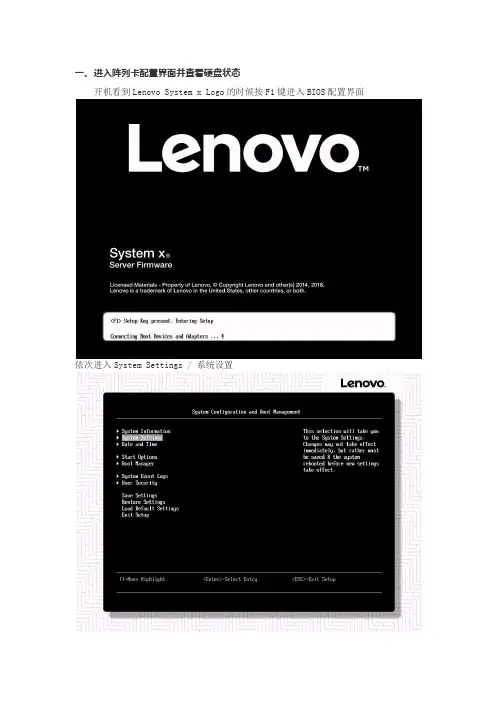
一、进入阵列卡配置界面并查看硬盘状态开机看到Lenovo System x Logo的时候按F1键进入BIOS配置界面依次进入System Settings / 系统设置Storage / 存储然后进入阵列卡,一般配备的是ServeRAID M5210或者M1215阵列卡进入Main Menu / 主菜单此界面即阵列卡配置主界面,然后进入Drive Management / 磁盘管理查看硬盘状态注意硬盘的状态,只有Unconfigured Good状态的硬盘才能配置RAID,Online状态表示该盘已在某个阵列中,JBOD状态表示该盘为单盘直通模式,Unconfigured Good状态与JBOD状态的相互转换请看下文“设置JBOD模式”二、创建RAID 0/1/5阵列进入阵列卡配置主界面,进入Configuration Management / 配置管理再进入Create Virtual Drive,创建一个阵列RAID Level / RAID级别选择RAID 0、RAID 1或者RAID 5。
本节只介绍创建RAID 5阵列的操作步骤,创建RAID 0或者RAID 1阵列参照本节操作执行注意:RAID 5等RAID级别需要阵列卡硬件支持或者激活相应功能,亦需要可配置硬盘数量满足最低要求,否则不会出现相应RAID级别或者该RAID级别为灰色不可选(如本机虽然已激活RAID 5/50功能,但不满足创建RAID 50硬盘数量最低要求:6块,所以RAID 50选项未出现)选择好RAID级别后进入Select Drives / 选取硬盘在将要加入阵列的硬盘上按空格或者回车键,然后Apply Changes / 应用更改。
注意:1、不同RAID级别有不同的硬盘数量要求,如RAID 5至少需要3块硬盘,RAID 1只能有2块硬盘,RAID 0无限制。
2、如果使用SSD / 固态硬盘配置阵列,需要将Select Media Type选项改为SSD。