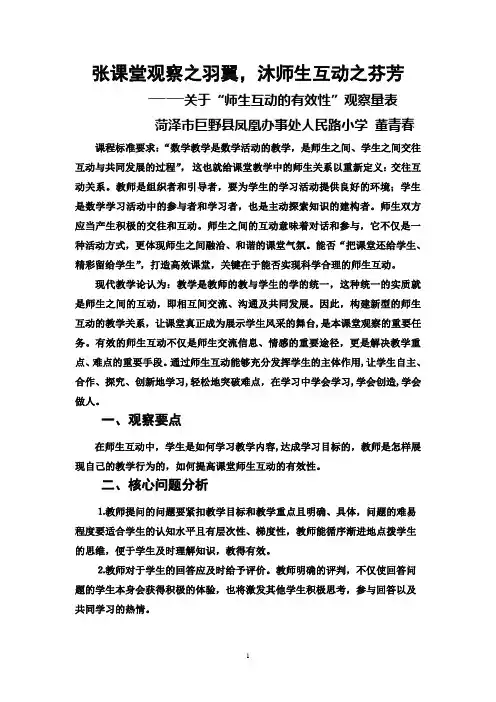
课堂观察量表(教师行为等级量表)
- 格式:docx
- 大小:37.25 KB
- 文档页数:9
课堂观察量表(教师行为等级量表)
n Checklist for Classroom (Teacher r Level Checklist)
Observer:
n Point:
1.Can the teacher effectively regulate the learning atmosphere?
2.Can the teacher effectively stimulate students' interest in
learning?
Observer's View:
3.Is the teacher's language easy to understand。and is the n
effective (clear/structured/relevant to the
theme/concise/appropriate pace/volume/rhythm)?
4.Are nonverbal rs (facial ns/movements/body language)
appropriate and effective?
5.Does the teacher guide students in learning (self-directed。cooperative。exploratory learning)。and is it effective?
6.Does the teacher listen to students' comments and provide
timely feedback?
7.Can appropriate ns (such as n) guide students to think
deeply about the learning theme?
8.Is the n of media (blackboard。courseware。etc.)
reasonable and helpful to student learning?
9.Is the teacher's demeanor natural。calm。and pleasant?
10.How is the teacher's performance in terms of teaching wit?
11.Is the teacher able to handle unexpected ns in the
classroom in a timely manner?
12.Is the language of n easy to understand and the n clear?
Observer n:
Name:
Unit:
Class:
n Center:
n Data:
1.Is the student's interest in learning strong?
2.Is the learning n high?
3.Can students actively participate in teaching activities?
4.Attitude towards the teacher.
5.Can students usly choose and anize n from the resources
mended by the teacher (ork。n bag)。can they "discover" rules。form their own ns。and effectively express their views?
6.Active thinking and in-depth inquiry.
7.In cooperative learning。can students effectively cooperate
with their classmates and take care of the learning needs of other
students?
8.In learning。can students boldly n the ns of teachers and
classmates and raise different ns?
9.In learning。can students apply the knowledge and skills
they have mastered to solve new problems?
n Topic:
Enter the Fairy Tale World"
n Time and n:
Grade 4.Class 2
Observer's Name: Wang
Unit:
Under the background of the new curriculum。the n of
students' learning methods-self-directed learning。exploratory
learning。cooperative learning
Rating:
Yes/No
1.Can the teacher effectively regulate the learning atmosphere?
2.Can the teacher effectively stimulate students' interest in
learning?
3.Is the teacher's language easy to understand。and is the n
effective (clear/structured/relevant to the
theme/concise/appropriate pace/volume/rhythm)?
4.Are nonverbal rs (facial ns/movements/body language)
appropriate and effective?
5.Does the teacher guide students in learning (self-directed。cooperative。exploratory learning)。and is it effective?
6.Does the teacher listen to students' comments and provide
timely feedback?
7.Can appropriate ns (such as n) guide students to think
deeply about the learning theme?
8.Is the n of media (blackboard。courseware。etc.)
reasonable and helpful to student learning?
9.Is the teacher's demeanor natural。calm。and pleasant?
10.How is the teacher's performance in terms of teaching wit?
11.Is the teacher able to handle unexpected ns in the
classroom in a timely manner?
12.Is the language of n easy to understand and the n clear。
n Record:
Students showed strong interest in learning.
The learning n was high.
Students actively participated in teaching activities. Attitude towards the teacher was good.
Students were able to choose and anize n from the resources
mended by the teacher。and were able to "discover" rules。form
their own ns。and effectively express their views.
Students showed active thinking and in-depth inquiry.
In cooperative learning。students were able to effectively
cooperate with their classmates and take care of the learning needs
of other students.
Students were able to boldly n the ns of teachers and
classmates and raise different ns.
Students were able to apply the knowledge and skills they
have mastered to solve new problems。
Overall。the teacher's performance was effective in
regulating the learning atmosphere。stimulating students' interest
in learning。using language that was easy to understand。guiding
students in learning。listening to students' comments。and
providing timely feedback。The teacher's use of nonverbal rs was
appropriate and effective。and appropriate ns were used to guide
students to think deeply about the learning theme。The teacher's