
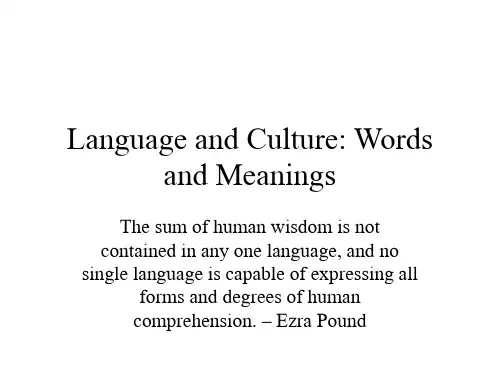
Language and Culture
- 格式:ppt
- 大小:63.50 KB
- 文档页数:29

语言与文化英文作文英文:Language and culture are closely intertwined. One's language reflects their culture and vice versa. For example, in Chinese culture, the concept of "face" is very important, and this is reflected in the language with phrases such as "giving face" and "losing face." Similarly, in English,there are many idioms and expressions that reflect the culture, such as "raining cats and dogs" and "barking upthe wrong tree."Language can also affect one's perception of the world. For example, in some languages, there are multiple wordsfor different types of snow, reflecting the importance of snow in those cultures. In English, there is only one word for snow, which may reflect the lesser importance of snowin the culture.Culture can also affect language learning. For example,in some cultures, it is considered impolite to correct someone's language mistakes, while in others it is seen as helpful. This can affect how easily someone learns a new language and how comfortable they feel making mistakes.Overall, language and culture are deeply intertwined and cannot be separated. Understanding both is important for effective communication and cultural understanding.中文:语言和文化密不可分。

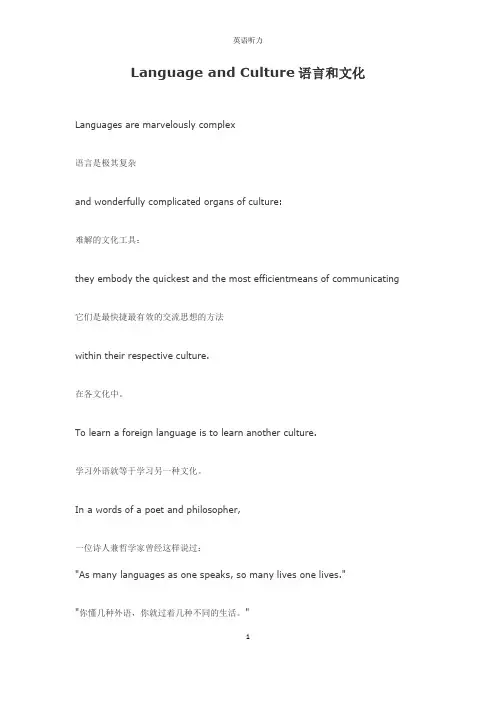
Language and Culture语言和文化Languages are marvelously complex语言是极其复杂and wonderfully complicated organs of culture:难解的文化工具:they embody the quickest and the most efficientmeans of communicating 它们是最快捷最有效的交流思想的方法within their respective culture.在各文化中。
To learn a foreign language is to learn another culture.学习外语就等于学习另一种文化。
In a words of a poet and philosopher,一位诗人兼哲学家曾经这样说过:"As many languages as one speaks, so many lives one lives.""你懂几种外语,你就过着几种不同的生活。
"A culture and its language are as inseparable as brain and body;文化及其语言正像人脑与人体一样不可分割。
while one is a part of the other,neither can function without the other. 虽然其中一个是另一个的部分,但是失去一部分,另一部分就不能运作。
In learning a foreign language, the best beginning学习外语最好的开始是is with the non- verbal linguistic elements of the language,从这种语言的非语言的语言成分开始,its gestures,its body language.即从手势,体语开始。

nida, e. a. (2001). language and culture的主要内容1. 引言1.1 概述本文将探讨Nida, E.A. (2001)的著作《Language and Culture》中关于语言和文化之间相互影响的观点和理论。
语言和文化是人类社会中不可分割的两个要素,它们相互交织、相互影响,并共同塑造着我们的社会生活和认知方式。
通过深入研究Nida的论述,本文将展示语言如何塑造文化,以及文化又如何影响着语言使用。
1.2 文章结构本文主要分为四个部分:引言、Nida, E.A. (2001). Language and Culture背景介绍、语言与文化的关系以及Nida的观点和理论、正文(包括语言对文化的影响、文化对语言的影响以及跨文化交流中的挑战和解决途径)和结论。
每一部分都将详细阐述相关内容,并根据作者的观点进行阐释和探讨。
1.3 目的本文旨在通过研究Nida, E.A. (2001)所提出的有关语言和文化之间相互关系的理论,增进我们对这一领域认识的理解。
通过实证研究和案例分析,本文将探索语言如何塑造文化,以及文化对语言的影响,并讨论跨文化交流中的挑战以及可能的解决途径。
通过深入理解语言和文化之间的互动关系,我们可以更好地理解多样性、发展跨文化教育方法并促进更有效的跨文化交流。
综上所述,本篇文章旨在探讨语言与文化之间的紧密联系并阐述Nida, E.A. (2001)在此领域的观点和理论。
以下部分将详细介绍Nida, E.A. (2001). Language and Culture的背景、语言与文化之间的关系以及相关问题。
2. Nida, E.A. (2001). Language and Culture:2.1 背景介绍:Nida, E.A.是一位著名的语言学家和翻译家,他对多种语言及其文化之间的关系进行了深入研究。
在他的著作《Language and Culture》中,他探讨了语言与文化之间的紧密联系,并提出了一些重要观点和理论。