
2008年06月大学英语六级真题(含答案)
- 格式:pdf
- 大小:7.77 MB
- 文档页数:39

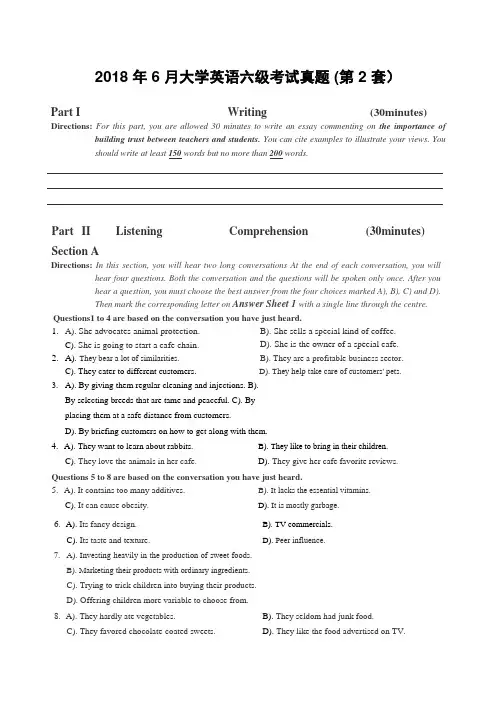
2018 年 6 月大学英语六级考试真题 (第 2 套)Part I Writing(30minutes) Directions: For this part, you are allowed 30 minutes to write an essay commenting on the importance of building trust between teachers and students. You can cite examples to illustrate your views. Youshould write at least 150 words but no more than 200 words.Part II Listening Comprehension(30minutes) Section ADirections: In this section, you will hear two long conversations At the end of each conversation, you will hear four questions. Both the conversation and the questions will be spoken only once. After youhear a question, you must choose the best answer from the four choices marked A), B), C) and D).Then mark the corresponding letter on Answer Sheet 1 with a single line through the centre. Questions1 to 4 are based on the conversation you have just heard.1.A). She advocates animal protection.C). She is going to start a cafe chain.2.A). They bear a lot of similarities.C). They cater to different customers.B). She sells a special kind of coffee.D). She is the owner of a special cafe.B). They are a profitable business sector.D). They help take care of customers' pets.3.A). By giving them regular cleaning and injections. B).By selecting breeds that are tame and peaceful. C). Byplacing them at a safe distance from customers.D). By briefing customers on how to get along with them.4.A). They want to learn about rabbits.B). They like to bring in their children.C). They love the animals in her cafe.D). They give her cafe favorite reviews. Questions 5 to 8 are based on the conversation you have just heard.5.A). It contains too many additives.B). It lacks the essential vitamins.C). It can cause obesity.D). It is mostly garbage.6.A). Its fancy design.B). TV commercials.C). Its taste and texture.D). Peer influence.7.A). Investing heavily in the production of sweet foods.B). Marketing their products with ordinary ingredients.C). Trying to trick children into buying their products.D). Offering children more variable to choose from.8.A). They hardly ate vegetables.B). They seldom had junk food.C). They favored chocolate-coated sweets.D). They like the food advertised on TV.Section BDirections: In this section, you will hear two passages. At the end of each passage, you will hear three or four questions. Both the passage and the questions will be spoken only once. After you hear a question, you must choose the best answer from the four choices marked A), B), C)and D). Then mark the corresponding letter on Answer Sheet 1 with a single line through the centre.Questions 9 to 11 are based on the passage you have just heard.9.A). Stretches of farmland. C).Tombs of ancient rulers.10.A). It provides habitats for more primitive tribes. B).It is hardly associated with great civilizations. C). Ithas not yet been fully explored and exploited.D). Itgathers water from many tropical rain forests.11.A). It carries about one fifth of the word' fresh water. B).It has numerous human settlements along its banks. C). It is second only to the Mississippi River in width. D). It is as long as the Nile and the Yangtze combined. B). Typical Egyptian animal farms.D). Ruins left by devastating floods.Questions 12 to 15 are based on the passage you have just heard.12.A). Living a life in the fast lane leads to success.B). We are always in a rush to do various things.C). The search for tranquility has become a trend. D).All of us actually yearn for a slow and calm life.13.A). She had trouble balancing family and work.C). She was accustomed to tight schedules.14.A). The possibility of ruining her family.C). The fatigue from living a fast-paced life.15.A). She started to follow the cultural norms.C). She learn to use more polite expressions.B). She enjoyed the various social events. D). She spent all her leisure time writing books.B). Becoming aware of her declining health. D). Reading a book about slowing down. B). She came to enjoy doing everyday tasks. D). She stopped using to-do lists and calendars.Section CDirections: In this section, you will hear three recordings of lectures or talks followed by three or four questions. The recordings will be played only once. After you hear a question, you must choose the best answer from the four choices marked A), B), C)and D).Then mark the corresponding letter on Answer Sheet 1 with a single line through the centre.Questions 16 to 18 are based on the recording you have just heard.16.A). They will root out native species altogether.C). They pose a threat to the local ecosystem.17.A). Their classifications are meaningful.C). Their definitions are changeable.18.A). Only a few of them cause problems to native B).They may turn to benefit the local environment C).Few of them can survive in their new habitats.B). They contribute to a region's biodiversity.D). They will crossbreed with native species.B). Their interactions are hard to define. D). Their distinctions are artificial.D). Only 10 percent of them can be naturalized.Questions 19 to 21 are based on the recording you have just heard.19.A). Respect their traditional culture.C). Research their specific demands.20.A). Showing them your palm.B). Giving them gifts of great value.C). Drinking alcohol on certain days of a month. D).Clicking your fingers loudly in their presence.21.A). They are very easy to satisfy.C). They trend to friendly and enthusiastic.B). Attend their business seminars. D). Adopt the right business strategies.B). They have a strong sense of worth. D). They have a break from 2:00 to 5:30 p.m.Questions 22 to 25 are based on the recording you have just heard.22. A). He completely changed the company's culture.B). He collected paintings by world-famous artists.C). He took over the sales department of Reader's Digest.D). He had the company’s boardroom extensively renovated.23.A). It should be sold at a reasonable price.B). Its articles should be short and inspiring.C). It should be published in the world's leading languages.D). Its articles should entertain blue-and pink-collar workers.24.A). He knew how to make the magazine profitable.B). He served as a church minster for many years.C). He suffered many setbacks and misfortunes in his life.D). He treated the employees like members of his family.25.A). It carried many more advertisements.B). George Grune joined it as an ad salesman.C). Several hundred of its employees got fired.D). Its subscriptions increased considerably.Part III Reading Comprehension(40minutes) Section ADirections: In this section, there is a passage with ten blanks. You are required to select one word for each blank from a list of choices given in a word bank following the passage. Read the passage through carefully before making your choices. Each choice in the bank is identified by a letter. Please mark the corresponding letter for each item on Answer Sheet 2 with a single line through the centre. You may not use any of the words in the bank more than once.Questions 26 to 35 are based on the following passage.Did Sarah Josepha Hale write “Mary 's Little Lamb,” the eternal nursery rhyme (儿歌) about a girl named Mary with a stubborn lamb? This is still dispute , but it’s clear that the woman 26 for writing it was one of America 's most fascinating 27 _. In honor of the poem 's publication on May 24,1830,here’s more about the28author 's life.Hale wasn’t just a writer, she was also a 29 social advocate, and she was particularly 30_ with an ideal New England, which she associated with abundant Thanksgiving meals that she claimed had “a deep moral influence.” she began a nationwide 31 to have a national holiday declared that would bring families together whilecelebrating the 32 festivals. In 1863, after 17 years of advocacy including letters to five presidents, Hale got it.President Abraham Lincoln, during the Civil War, issued a 33 setting aside the last Thursday in November for the holiday.The true authorship of “Mary’s Little Lamb” is disputed.. According to New England Historical Society, Hale wrote only one part of the poem, but claimed authorship. Regardless of the author, it seems that the poem was34by a real event. When young Mary Sawyer was followed to school by a lamb in 1816, it caused some problems. A bystander named John Roulstone wrote a poem about the event, then, at some point, Hale herself seems to have helped write it. However, if a 1916 piece by her great-niece is to be trusted, Hale claimed for the35 of her life that “Some other people pretended that someone else wrote the poem”.A). campaign B). careerC). characters D). featuresE). fierce F). inspiredG). latter H). obsessedI). proclamation J). rectifiedK). reputed L). restM). supposed N). traditionalO). versatileSection BDirections: In this section, you are going to read a passage with ten statements attached to it. Each statement contains information given in one of the paragraphs. Identify the paragraph from which the information is derived. You may choose a paragraph more than once. Each paragraph is marked with a letter. Answer thequestions by marking the corresponding letter onGrow Plants Without Water[A].Ever since humanity began to farm our own food, we've faced the unpredictable rain that is bothfriend and enemy. It comes and goes without much warning, and a field of lush ( 茂盛的 ) leafy greens one year can dry up and blow away the next. Food security and fortunes depend on sufficient rain, and nowhere more so than in Africa, where 96% of farmland depends on rain instead of the irrigationcommon in more developed places. It has consequences : South Africa's ongoing drought—the worst in three decades— will cost at least a quarter of its com crop this year.[B].Biologist Jill Farrant of the University of Cape Town in South Africa says that nature has plenty ofanswers for people who want to grow crops in places with unpredictable rainfall. She is hard at work finding a way to take traits from rare wild plants that adapt to extreme dry weather and use them in food crops. As the earth's climate changes and rainfall becomes even less predictable in some places, those answers will grow even more valuable."The type of farming I'm aiming for isliterally so that people can survive as it's going to get more and more dry,"Farrant says.[C].Extreme conditions produce extremely tough plants. In the rusty red deserts of South Africa, steep-sidedrocky hills called inselbergs rear up from the plains like the bones of the earth. The hills are remnants of an earlier geological era, scraped bare of most soil and exposed to the elements. Yet on these and similar formations in deserts around the world, a few fierce plants have adapted to endure under ever-changing conditions.[D].Farrant calls them resurrection plants (复苏植物) . During months without water under a harsh sun.They wither, shrink and contract until they look like a pile of dead gray leaves. But rainfall can revive them in a matter of hours. Her time-lapse ( 间歇性拍摄的 ) videos of the revivals look like someone playing a tape of the plant's death in reverse.[E].The big difference between "drought-tolerant" plants and these tough plants: metabolism. Many differentkinds of plants have developed tactics to weather dry spells. Some plants store reserves of water to see them through a drought ; others send roots deep down to subsurface water supplies. But once these plants use up their stored reserve or tap out the underground supply, they cease growing and start to die. They may be able to handle a drought of some length, and many people use the term "drought tolerant" todescribe such plants, but they never actually stop needing to consume water, so Farrant prefers to call them drought resistant.[F].Resurrection plants, defined as those capable of recovering from holding less than 0.1 grams of water pergram of dry mass, are different. They lack water-storing structures, and their existence on rock faces prevents them from tapping groundwater, so they have instead developed the ability to change their metabolism .When they detect an extended dry period, they divert their metabolisms, producing sugars and certain stress-associated proteins and other materials in their tissues. As the plant dries, these resources take on first the properties of honey, then rubber, and finally enter a glass-like state that is "the most stable state that the plant can maintain," Farrant says. That slows the plant's metabolism and protects its dried-out tissues. The plants also change shape, shrinking to minimize the surface area through which their remaining water might evaporate. They can recover from months and years without water, depending on the species.[G].What else can do this dry-out-and-revive trick? Seeds-almost all of them. At the start of her career,Farrant studied . recalcitrant seeds (执拗性种子) ," such as avocados, coffee and lychee. While tasty, such seeds are delicate--they cannot bud and grow if they dry out (as you may know if you've evertried to grow a tree from an avocado pit). In the seed world, that makes them rare, because most seeds from flowering plants are quite robust. Most seeds can wait out the dry, unwelcoming seasons untilconditions are right and they sprout (发芽 ). Yet once they start growing, such plants seem not to retain the ability to hit the pause button on metabolism in their stems or leaves.[H].After completing her Ph. D. on seeds, Farrant began investigating whether it might be possible to isolate theproperties that make most seeds so resilient ( 迅速恢复活力的) and transfer them to other plant tissues.What Farrant and others have found over the past two decades is that there are many genes involved in resurrection plants' response to dryness. Many of them are the same that regulatehow seeds become dryness-tolerant while still attached to their parent plants. Now they are trying to figure out what molecular signaling processes activate those seed-building genes in resurrection plants—and how to reproduce them in crops."Most genes are regulated by a master set of genes,"Farrant says."We're looking at gene promoters and what would be their master switch."[I].Once Farrant and her colleagues feel they have a better sense of which switches to throw, they will haveto find the best way to do so in useful crops."I'm trying three methods of breeding,"Farrant says :conventional, genetic modification arid gene editing. She says she is aware that plenty of people do not want to eat genetically modified crops, but she is pushing ahead with every available tool until one works.Farmers and consumers alike can choose whether or not to use whichever version prevails :"I'm giving people an option. "[J].Farrant and others in the resurrection business got together last year to discuss the best species of resurrection plant to use as a lab model. Just like medical researchers use rats to test ideas for human medical treatments, botanists use plants that are relatively easy to grow in a lab or greenhouse setting to test their ideas for related species. The Queensland rock violet is one of the best studied resurrection plants so far, with a draft genome ( 基因图谱) published last year by a Chinese team. Also last year, Farrant and colleagues published a detailed molecular study of another candidate, Xerophyta viscosa, a tough-as-nail south African plant with lily-like flowers, and she says that a genome is on the way. one or both of these models will help researchers test their ideas — so far mostly done in the lab— on test plots.[K].Understanding the basic science first is key. There are good reasons why crop plants do not use dryness defenses already. For instance, there's a high energy cost in switching from a regular metabolism to an almost-no-water metabolism. It will also be necessary to understand what sort of yield farmers might expect and to establish the plant's safety."The yield is never going to be high,"Farrant says, so these plants will be targeted not at Iowa farmers trying to squeeze more cashout of high-yield fields, but subsistence farmers who need help to survive a drought like the present one in South Africa."My vision is for the subsistence farmer," Farrant says."I'm targeting crops that are of African value. ".36.There are a couple of plants tough and adaptable enough to survive on bare rocky hills and in deserts.37.Farrant is trying to isolate genes in resurrection plants and reproduce them in crops.38.Farmers in South Africa are more at the mercy of nature, especially inconsistent rainfall.39.Resurrection crops are most likely to be the choice of subsistence farmers.40.E ven though many plants have developed various tactics to cope with dry weather, they cannot survive aprolonged drought.41.Despite consumer resistance, researchers are pushing ahead with genetic modification of crops.42.Most seeds can pull through dry spells and begin growing when conditions are ripe, but once thisprocess starts, it cannot be held back.43.Farrant is working hard to cultivate food crops that call survive extreme dryness by studying thetraits of rare wild plants.44.By adjusting their metabolism, resurrection plants can recover from an extended period of drought.45.Resurrection plants can come back to life in a short time after a rainfall.Section CDirections:There are 2 passages in this section. Each passage is followed by some questions or unfinished statements. For each of them there are four choices marked A), B), C) and D). You should decide on the best choice and mark the corresponding letter on Answer Sheet 2 with asingle line through the centrepassage oneQuestions 46 to 50 are based on the following passage.Human memory is notoriously unreliable. Even people with the sharpest facial-recognition skills can only remember so much.It's tough to quantify how good a person is at remembering. No one really knows how many different faces someone can recall, for example, but various estimates tend to hover in the thousands-based on the number of acquaintances a person might have.Machines aren't limited this way, Give the right computer a massive database of faces, and it can process what it sees-then recognize a face it's told to find-with remarkable speed and precision.This skill is what supports the enormous promise of facial-recognition software in the 2lst century.It's also what makes contemporary surveillance systems so scary.The thing is, machines still have limitations when it comes to facial recognition. And scientists are only just beginning to understand what those constraints are. To begin to figure out how computers are struggling, researchers at the University of Washington created a massive databaseof faces- they call it MegaFace- and tested a variety of facial-recognition algorithms (算法) as they scaled up in complexity. The idea was to test the machines on a database that included up to 1 million different images of nearly 700,000 different people-and not just a large database featuring a relatively small number of different faces, more consistent with what's been used in other research.As the databases grew, machine accuracy dipped across the board. Algorithms that were right95% of the time when they were dealing with a 13, 000-image database, for example, were accurateabout 70% of the time when confronted with 1 million images. That's still pretty good, says one of the researchers, Ira Kemelmacher-Shlizerman."Much better than we expected, "she said.Machines also had difficulty adjusting for people who look a lot alike-either doppelgangers(长相极相似的人),whom the machine would have trouble identifying as two separate people, or the same person who appeared in different photos at different ages or in different lighting, whom themachine would incorrectly view as separate people."Once we scale up, algorithms must be sensitive to tiny changes in identities and at the same time invariant to lighting, pose, age, "Kemelmacher-Shlizerman said.The trouble is, for many of the researchers who'd like to design systems to address these challenges, massive datasets for experimentation just don't exist--at least, not in formats that are accessible to academic researchers.Training sets like the ones Google and Facebook have are private. There are no public databases that contain millions of faces. MegaFace's creators say it's the largest publicly available facial-recognition dataset out there.“An ultimate face recognition algorithm should perform with billions of people in adataset, ”the researchers wrote.46. Compared with human memory, machines can.A)identify human faces more efficientlyB)tell a friend from a mere acquaintanceC)store an unlimited number of human facesD)perceive images invisible to the human eye47.Why did researchers create MegaFace?A)To enlarge the volume of the facial-recognition databaseB)To increase the variety of facial-recognition softwareC)To understand computers' problems with facial recognitionD)To reduce the complexity of facial-recognition algorithms48.What does the passage say about machine accuracy?A)It falls short of researchers' expectations.B)It improves with added computing power.C)It varies greatly with different algorithms.D)It decreases as the database size increases.49.What is said to be a shortcoming of facial-recognition machines?A)They cannot easily tell apart people with near-identical appearances.B)They have difficulty identifying changes in facial expressionsC)They are not sensitive to minute changes in people's moodD)They have problems distinguishing people of the same age50.What is the difficulty confronting researchers of facial-recognition machines?A)No computer is yet able to handle huge datasets of human facesB)There do not exist public databases with sufficient face samplerC)There are no appropriate algorithms to process the face samplesD) They have trouble converting face datasets into the right format.Passage TwoQuestions 51 to 55 are based on the following passage.There’re currently 21.5 million students in America, and many will be funding their college on borrowed money. Given that there's now over $1.3 trillion in student loans on the books, it's prettyapproaches $40, 000, and as college becomes ever more expensive, calls to make it "free" are multiplying. Even Hillary Clinton says that when it comes to college, "Costs won't be a barrier. "But the only way college could be free is if the faculty and staff donated their time, the buildings required no maintenance, and campuses required no utilities. As long as it's impossibleto produce something from nothing costs are absolutely a barrier.The actual question we debate is who should pay for people to go to college. If taxpayers are to bear the cost of forgiving student loans, shouldn't they have a say in how their money is used?At least taxpayers should be able to decide what students will study on the public dime. If we're going to force taxpayers to foot the bill for college degrees, students should only study those subjects that’re of greatest benefit to taxpayers. After all, students making their own choices in this respect is what caused the problem in the first place. We simply don't need more poetry, gender studies, or sociology majors. How do we know which subjects benefit society? Easy.Average starting salaries give a clear indication of what type of training society needs its new workers to have. Certainly, there're benefits to a college major beyond the job a student can perform. But if we're talking about the benefits to society, the only thing that matters is what the major enables the student to produce for society. And the value of what the student can produce is reflected in the wage employers are willing to pay the student to produce it.A low wage for elementary school teachers, however, doesn't mean elementary education isn’t important. It simply means there're too many elementary school teachers already.Meanwhile, there're few who're willing and able to perform jobs requiring a petroleum engineering major, so the value of one more of those people is very highSo we can have taxpayers pick up students' tuition in exchange for dictating what those students will study. Or we can allow students both to choose their majors and pay for their education themselves. But in the end ,one of two things is true:Either a college major is worth its cost or it isn't. If yes, taxpayer financing isn't needed If not taxpayer financing isn't desirable. Either way, taxpayers have no business paying for students' college education.51. What does the author think of college students funding their education through loans?A)They only expect to get huge returns.C)They benefit at taxpayers expense.B)They are acting in an irrational way.D)They will regret doing so someday.52. In the author's opinion, free college education is.A) impractical B)unsustainableC)a goal to strive for D) a way to social equality53.What should students do if taxpayers are to bear their college costs?A)Work even harder to repay society.B)Choose their subjects more carefully.C)Choose majors that will serve society's practical need.D)Allow taxpayers to participate in college administration.54.What does the author say about the value of a student's college education?A)It is underestimated by profit-seeking employers.B)It is to be proved by what they can do on the job.C)It is well reflected in their average starting salary.55.What message does the author want to convey in the passage?A)Students should think care fully whether to go to collegeB)Taxpayers should only finance the most gifted students.C)The worth of a college education is open to debate.D)College students should fund their own education..Part I Translation(30minutes) Directions:For this part, you are allowed 30 minutes to translate a passage from Chinese into English. You should write your answer on Answer Sheet 2.中国目前拥有世界上最大最快的高速铁路网。

2008年6月21日大学英语六级真题及答案Part IV Reading Comprehension (Reading in Depth) (25 minutes)Passage OneQuestions 52 to 56 are based on the following passage.Imagine waking up and finding the value of your assets has been halved. No, you’re not an investor in o ne of those hedge funds that failed completely. With the dollar slumping to a 26-year low against the pound, already-expensive London has become quite unaffordable. A coffee at Starbucks, just as unavoidable in England as it is in the United States, runs about $8.The once all-powerful dollar isn’t doing a Titanic against just the pound. It is sitting at a record low against the euro and at a 30-year low against the Canadian dollar. Even the Argentine peso and Brazilian real are thriving against the dollar.The weak dollar is a source of humiliation, for a nation’s self-esteem rests in part on the strength of its currency. It’s also a potential economic problem, since a declining dollar makes imported food more expensive and exerts upward pressure on interest rates. And yet there are substantial sectors of the vast U.S. economy-from giant companies like Coca-Cola to mom-and-pop restaurant operators in Miami-for which the weak dollar is most excellent news.Many Europeans may view the U.S. as an arrogant superpower that has become hostile to foreigners. But nothing makes people think more warmly of the U.S. than a weak dollar. Through April, the total number of visitors from abroad was up 6.8 percent from last year. Should the trend continue, the number of tourists this year will finally top the 2000 peak? Many Europeans now apparently view the U.S. the way many Americans view Mexico-as a cheap place to vacation, shop and party, all while ignoring the fact that the poorer locals can’t afford to join the merrymaking.The money tourists spend helps decrease our chronic trade deficit. So do exports, which thanks in part to the weak dollar, soared 11 percent between May 2006 and May 2007. For first five months of 2007, the trade deficit actually fell 7 percent from 2006.If you own shares in large American corporations, you’re a winner in the weak-dollar gamble. Last week Coca-Cola’s stick bubbled to a five-year high after it reported a fantastic quarter. Foreign sales accounted for 65 percent of Coke’s beverage business. Other American companies profiting from this trend include McDonald’s and IBM.American tourists, however, shouldn’t expect any relief soon. The dollar lost strength the way many marriages break up- slowly, and then all at once. And currencies don’t turn on a dime. So if you want to avoid the pain inflicted by the increasingly pathetic dollar, cancel that summer vacation to England and look to New England. There, the dollar is still treated with a little respect.注意:此部分试题请在答题卡2上作答。
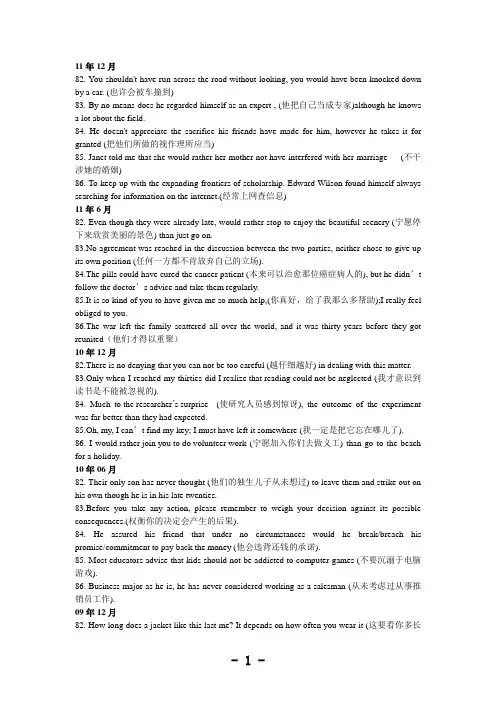
82. Y ou shouldn't have run across the road without looking, you would have been knocked down by a car. (也许会被车撞到)83. By no means does he regarded himself as an expert , (他把自己当成专家)although he knowsa lot about the field.84. He doesn't appreciate the sacrifice his friends have made for him, however he takes it for granted (把他们所做的视作理所应当)85. Janet told me that she would rather her mother not have interfered with her marriage (不干涉她的婚姻)86. To keep up with the expanding frontiers of scholarship. Edward Wilson found himself always searching for information on the internet.(经常上网查信息)11年6月82. Even though they were already late, would rather stop to enjoy the beautiful scenery (宁愿停下来欣赏美丽的景色) than just go on.83.No agreement was reached in the discussion between the two parties, neither chose to give up its own position (任何一方都不肯放弃自己的立场).84.The pills could have cured the cancer patient (本来可以治愈那位癌症病人的), but he didn’t follow the doctor’s advice and take them regularly.85.It is so kind of you to have given me so much help,(你真好,给了我那么多帮助);I really feel obliged to you.86.The war left the family scattered all over the world, and it was thirty years before they got reunited(他们才得以重聚)10年12月82.There is no denying that you can not be too careful (越仔细越好) in dealing with this matter.83.Only when I reached my thirties did I realize that reading could not be neglected (我才意识到读书是不能被忽视的).84. Much to the researcher’s surprise _(使研究人员感到惊讶), the outcome of the experiment was far better than they had expected.85.Oh, my, I can’t find my key; I must have left it somewhere (我一定是把它忘在哪儿了).86. I would rather join you to do volunteer work (宁愿加入你们去做义工) than go to the beach for a holiday.10年06月82. Their only son has never thought (他们的独生儿子从未想过) to leave them and strike out on his own though he is in his late twenties.83.Before you take any action, please remember to weigh your decision against its possible consequences.(权衡你的决定会产生的后果).84. He assured his friend that under no circumstances would he break/breach his promise/commitment to pay back the money (他会违背还钱的承诺).85. Most educators advise that kids should not be addicted to computer games (不要沉溺于电脑游戏).86. Business major as he is, he has never considered working as a salesman (从未考虑过从事推销员工作).09年12月82. How long does a jacket like this last me? It depends on how often you wear it (这要看你多长83. The theory he advanced has proved a challenge to many traditional concepts (对许多传统概念的一种挑战)84. The manager could have attended the meeting in person (by himself) (本可以亲自参加会议), but he was called away for some urgent business abroad.85. Both research and practical experience have shown that a balance diet is essential to health (均衡的饮食对健康是必不可少的).86. Much regretted as I felt (我感到遗憾), I was unable to finish the work on time.09年06月82.With the oil prices ever rising, she tried to talk over him not to buy a car (说服他不买车)83. Keeping sense of humor is contributive to (保持幽默有助于) reduce stress and promote creative thinking in today’s competitive society.84.When confronted with the evidence, he had no choice but to confess his guilt (他不得不坦白自己的罪行)85.When people say, “I can feel my ears burning,”it means they think some one must are speaking ill of them (一定有人在说他们坏话).86.She has decided to go on a diet, but finds it difficult to resist the temptation of ice cream (很难抵制冰淇淋的诱惑).08年12月82.He designed the first suspension bridge, which combined beauty and function perfectly(把美观与功能完美地结合起来)。

2008年12月大学英语六级考试真题Part I Writing (30 minutes)Directions: For this part, you are allowed 30 minutes to write a short essay entitled How To Improve Student's Mental Health?.You should write at least 150 words following the outline given below.1.大学生的心理健康十分重要2.因此,学校可以……3.我们自己应当……How To Improve Student's Mental Health?________________________________________________________________________________ ________________________________________________________________________________ ________________________________________________________________________________ Part II Reading Comprehension (Skimming and Scanning) (15 minutes) Directions:In this part, you will have 15 minutes to go over the passage quickly and answer the questions on Answer Sheet 1.For questions 1-7, choose the best answer from the four choices marked [A], [B], [C] and [D].For questions 8 -10, complete the sentences with the information given in the passage.Supersize SurpriseAsk anyone why there is an obesity epidemic and they will tell you that it’s al down to eating too much and burning too few calories. That explanation appeals to common sense and has dominated efforts to get to the root of the obesity epidemic and reverse it. Yet obesity researchers are increasingly dissatisfied with it. Many now believe that something else must have changed in our environment to precipitate(促成) such dramatic rises in obesity over the past 40 years or so. Nobody is saying that the “big two” – reduced physical activity and increased availability of food – are not important contributors to the epidemic, but they cannot explain it all.Earlier this year a review paper by 20obesity experts set out the 7 most plausible alternative explanations for the epidemic. Here they are.1.Not enough sleepIt is widely believed that sleep is for the brain, not the body. Could a shortage of shut-eye also be helping to make us fat?Several large-scale studies suggest there may be a link. People who sleep less than 7 hours a night tend to have a higher body mass index than people who sleep more, according to data gathered by the US National Health and Nutrition Ex amination Survey. Similarly, the US Nurses’ Health Study, which tracked 68,000 women for 16 years, found that those who slept an average of 5 hours a night gained more weight during the study period than women who slept 6 hours, who in turn gained more than whose who slept 7.It’s well known that obesity impairs sleep, so perhaps people get fat first and sleep less afterwards. But the nurses’ study suggests that it can work in the other direction too: sleep loss may precipitate weight gain.Although getting figures is difficult, it appears that we really are sleeping less. In 1960 people in the US slept an average of 8.5 hours per night. A 2002 poll by the National Sleep Foundation suggests that the average has fallen to under 7 hours, and the decline is mirrored by the increase in obesity.2.Climate controlWe humans, like all warm-blooded animals, can keep our core body temperatures pretty much constant regardless of what’s going on in the world around us. We do this by altering our metabolic(新陈代谢的) rate, shivering or sweating. Keeping warm and staying cool take energy unless we are in the “thermo-neutral zone”,which is increasingly where we choose to live and work.There is no denying that ambient temperatures(环境温度) have changed in the past few decades. Between 1970 and 2000, the average British home warmed from a chilly 13C to 18C. In the US, the changes have been at the other end of the thermometer as the proportion of homes with air conditioning rose from 23% to 47% between 1978 and 1997. In the southern states – where obesity rates tend to be highest – the number of houses with air conditioning has shot up to 71% from 37% in 1978.Could air conditioning in summer and heating in winter really make a difference to our weight?Sadly,there is some evidence that it does-at least with regard to heating. Studies show that in comfortable temperatures we use less energy.3.Less smokingBad news: smokers really do tend to be thinner than the rest of us, and quitting really does pack on the pounds, though no one is sure why. It probably has something to do with the fact that nicotine is an appetite suppressant and appears to up your metabolic rate.Katherine Flegal and colleagues at the US National Center for Health Statistics in Hyattsville, Maryland, have calculated that people kicking the habit have been responsible for a small but significant portion of the US epidemic of fatness. From data collected around 1991 by the US National Health and Nutrition Examination Survey, they worked out that people who had quit in the previous decade were much more likely to be overweight than smokers and people who had never smoked .Among men, for example, nearly half of quitters were overweight compared with 37% of non-smokers and only 28%of smokers.4.Genetic effectsYours chances of becoming fat may be set, at least in part, before you were even born. Children of obese mothers are much more likely to become obese themselves later in life. Offspring of mice fed a high-fat diet during pregnancy are much more likely to become fat than the offspring of identical mice fed a normal diet. Intriguingly, the effect persists for two or three generations. Grandchildren of mice fed a high-fat diet grow up fat even if their own mother is fed normally-so you fate may have been sealed even before you were conceived.5.A little older…Some groups of people just happen to be fatter than others. Surveys carried out by the US national center for health statistics found that adults aged 40 to 79 were around three times as likely to be obese as younger people. Non-white females also tend to fall at the fatter end of the spectrum: Mexican-American women are 30% more likely than white women to be obsess, and black women have twice the risk.In the US, these groups account for an increasing percentage of the population. Between 1970 and 2000 the US population aged 35 to 44 grew by43%.the proportion of Hispanic-Americans also grew, from under 5% to 12.5% of the population, while the proportion of black Americans increased from 11% to12.3%.these changes may account in part for the increased prevalence of obesity.6.Mature mumsMothers around the world are getting older. in the UK, the mean age for having a first child is 27.3,compared with 23.7 in 1970 .mean age at first birth in the US has also increased, rising from 21.4 in 1970 to 24.9 in 2000.This would be neither here nor there if it weren’t for the observation that having an older mother seems to be an independent risk factor for obesity. Results from the US national heart, lung and blood institute’s study found that the odds of a child being obese increase 14% for every five ex tra years of their mother’s age, though why this should be so is not entirely clear.Michael Symonds at the University of Nottingham, UK, found that first-born children have more fat than younger ones. As family size decreases, firstborns account for a greater share of the population. In 1964, British women gave birth to an average of 2.95 children; by 2005 that figure had fallen to 1.79. In the US in1976, 9.6% of woman in their 40s had only one child; in 2004 it was 17.4%. this combination of older mothers and more singlechildren could be contributing to the obesity epidemic.7.Like marrying likeJust as people pair off according to looks, so they do for size. Lean people are more likely to marry lean and fat more likely to marry fat. On its own, like marrying like cannot account for any increase in obesity. But combined with others—particularly the fact that obesity is partly genetic, and that heavier people have more children—it amplifies the increase form other causes.1. What is the passage mainly about?A) E ffects of obesity on people’s healthB) The link between lifestyle and obesityC) New explanations for the obesity epidemicD) Possible ways to combat the obesity epidemic2. In the US N urse’ Health Study, women who slept an average of 7 hours a night_______.A) gained the least weightB) were inclined to eat lessC) found their vigor enhancedD) were less susceptible to illness3. The popular belief about obesity is that___________.A) it makes us sleepyB) it causes sleep lossC) it increases our appetiteD) it results from lack of sleep4. How does indoor heating affect our life?A) it makes us stay indoors moreB) it accelerates our metabolic rateC) it makes us feel more energeticD) it contributes to our weight gain5. What does the author say about the effect of nicotine on smokers?A) it threatens their healthB) it heightens their spiritsC) it suppresses their appetiteD) it slows down their metabolism6. Who are most likely to be overweight according to Katherine Fergal’s study?A) heavy smokersB) passive smokersC) those who never smokeD) those who quit smoking7. According to the US National Center for Health Statistics, the increased obesity in the US is a result of_______.A) the growing number of smokers among young peopleB) the rising proportion of minorities in its populationC) the increasing consumption of high-calorie foodsD) the improving living standards of the poor people8. According to the US National Heart, Lung and Blood Institute, the reason why older mothers’ children tend to be obese remains __________.9. According to Michael Symonds, one factor contributing to the obesity epidemic is decrease of ___________.10. When two heavy people get married, chances of their children getting fat increase, because obesity is_____________.Part III Listening Comprehension (35 minutes)Section ADirections:In this section, you will hear 8 short conversations and 2 long conversations. At the end of each conversation, one or more questions will be asked about what was said. Both the conversation and the questions will be spoken only once. After each question there will be a pause. During the pause, you must read the four choices marked [A], [B], [C] and [D], and decide which is the best answer. Then mark the corresponding letter on Answer Sheet 2 with a single line through the centre.11. A) He is quite easy to recognizeB) He is an outstanding speakerC) He looks like a movie starD) He looks young for his age12. A) consult her dancing teacherB) take a more interesting classC) continue her dancing classD) improve her dancing skills13. A) the man did not believe what the woman saidB) the man accompanied the woman to the hospitalC) the woman may be suffering from repetitive strain injuryD) the woman may not followed the doctor’s instructions14. A) they are not in style any moreB) they have cost him far too muchC) they no longer suit his eyesightD) they should be cleaned regularly15. A) he spilled his drink onto the floorB) he has just finished wiping the floorC) he was caught in a shower on his way homeD) he rushed out of the bath to answer the phone16. A) fixing some furnitureB) repairing the toy trainC) reading the instructionsD) assembling the bookcase17. A) urge Jenny to spend more time on studyB) help Jenny to prepare for the coming examsC) act towards Jenny in a more sensible wayD) send Jenny to a volleyball training center18. A) The building of the dam needs a large budgetB) The proposed site is near the residential areaC) The local people feel insecure about the damD) The dam poses a threat to the local environmentQuestions 19 to 21 are based on the conversation you have just heard.19. A. It saw the end of its booming years worldwideB. Its production and sales reached record levels.C. It became popular in some foreign countriesD. Its domestic market started to shrink rapidly.20. A. They cost less. C. They were in fashion.B. They tasted better. D. They were widely advertised.21. A. It is sure to fluctuate. C. It will remain basically stable.B. It is bound to revive. D. It will see no more monopolyQuestions 22 to 25 are based on the conversation you have just heard.22. A. Organising protests C. Acting as its spokesman.B. Recruiting members D. Saving endangered animals.23. A. Anti-animal-abuse demonstrations B. Anti-nuclear campaignsC. Surveying the Atlantic Ocean floorD. Removing industrial waste.24. A. By harassing them. C. By taking legal action.B. By appealing to the public D. By resorting to force.25. A. Doubtful C. Indifferent.B. Reserved D. SupportiveSection BDirections: In this section, you will hear 3 short passages. At the end of each passage, you will hear some questions. Both the passage and the questions will be spoken only once. After you hear a question, you must choose the best answer from the four choices marked [A], [B], [C] and [D]. Then mark the corresponding letter on Answer Sheet 2 with a single line through the centre.Passage OneQuestions 26 to 28 are based on the passage you have just heard.26. A. The air becomes still. C. The clouds block the sun.B. The air pressure is low. D. The sky appears brighter.27. A. Ancient people were better at foretelling the weather.B. Sailors’ saying about the weather are unreliable.C. People knew long ago how to predict the weather.D. It was easier to forecast the weather in the old days.28. A. Weather forecast is getting more accurate today.B. People can predict the weather by their sensesC. Who are the real experts in weather forecast.D. Weather changes affect people’s life remarkablyPassage TwoQuestions 29 to 31 are based on the passage you have just heard.29. A. They often feel insecure about their jobs.B. They are unable to decide what to do first.C. They feel burdened with numerous tasks every day.D they feel burdened with numerous tasks every day30. A. Analyze them rationally. C. Turn to others for help.B. Draw a detailed to-do list. D. Handle them one by one.31. A. They have accomplished little. C. They have worked out a way to relax.B. They feel utterly exhausted. D. They no longer feel any sense of guilt.Passage ThreeQuestions 32 to 35 are based on the passage you have just heard.32. A. Their performance may improve.B. Their immune system may be reinforcedC. Their blood pressure may rise all of a sudden.D. Their physical development may be enhanced.33. A. Improved mental functioning C. Speeding up of blood circulationB. Increased susceptibility to disease D. Reduction of stress-related hormones34. A. Pretend to be in better shape. C. Turn more often to friends for helpB. Have more physical exercise. D. Pay more attention to bodily sensations.35. A. Different approaches to coping with stress.B. Various causes for serious health problems.C. The relationship between stress and illness.D. New finding of medical research on stress.Section CDirections: In this section, you will hear a passage three times. When the passage is read for the first time, you should listen carefully for its general idea. When the passage is read for the second time, you are required to fill in the blanks numbered from 36 to 43 with the exact words you have just heard. For blanks numbered from 44 to 46 you are required to fill in the missing information. For these blanks, you can either use the exact words you have just heard or write down the main points in your own words. Finally, when the passage is read for the third time, you should check what you have written.One of the most common images of an advanced, Western-style culture is that of a busy, traffic-filled city. Since their first (36) ______ on American roadways, automobiles have become a (37) ______ of progress, a source of thousands of jobs and an almost inalienable right for citizens’ personal freedom of movement. In recent (38) _______, our “love affair” with the car is being (39) ________ directly to the developing world, and it is increasingly (40) _______ that this transfer is leading to disaster.American’s almost complete dependence on automobiles has been a terrible mistake. As late as the 1950s, a large (41) ________ of the American public used mass transit. A (42) ________ of public policy decisions and corporate scheming saw to it that countless (43) ________ and efficient urban streetcar and intra-city rail systems were dismantled. (44) ___________________________________________________. Our lives have been planned along a road grid—homes far from work, shopping far from everything, with ugly stretches of concrete and blacktop in between.Developing countries are copying Western-style transportation systems down to the last detail. (45) _________________________________________________________. Pollution control measures are either not strict or nonexistent, leading to choking clouds of smog. Gasoline still contains lead, which is extremely poisonous to humans. (46) _____________________________________________________________________.In addition to pollution and traffic jams, auto safety is a critical issue in developing nations.Part IV Reading Comprehension (Reading in Depth)(25 minutes)Section ADirections:In this section, there is a short passage with 5 questions or incomplete statements. Read the passage carefully. Then answer the questions or complete the statements in the fewest possible words. Please write your answers on Answer sheet 2.Questions 47 to 51 are based on the following passage.One of the major producers of athletic footwear, with 2002 sales of over $10 billion, is a company calledNike, with corporate headquarters in Beaverton, Oregon. Forbes magazine identified Nike’s president, Philip Knight, as the 53rd-richestman in the world in 2004. But Nike has not always been a large multimillion-dollar organization. In fact, Knight started the company by selling shoes from the back of his car at track meets.In the late1950s Philip Knight was a middle-distance runner on the University of Oregon track team, coached by Bill Bowerman. One of the top track coaches in the U.S., Bowerman was also known for experimenting with the design of running shoes in an attempt to make them lighter and more shock-absorbent. After attending Oregon, Knight moved on to do graduate work at Stanford University; his MBA thesis was on marketing athletic shoes. Once he received his degree, Knight traveled to Japan to contact the Onitsuka Tiger Company, a manufacturer of athletic shoes. Knight convinced the company’s officials of the potential for its product in the U.S. In 1963 he received his first shipment of Tiger shoes, 200 pairs in total.In 1964, Knight and Bowerman contributed $500 each to from Blue Ribbon Sports, the predecessor of Nike. In the first few years, Knight distributed shoes out of his car at local track meets. The first employees hired by Knight were former college athle tes. The company did not have the money to hire “experts”, and there was no established athletic footwear industry in North America from which to recruit those knowledgeable in the field. In its early years the organization operated in an unconventional manner that characterized its innovative and entrepreneurial approach to the industry. Communication was informal; people discussed ideas and issues in the hallways, on a run, or over a beer. There was little task differentiation. There were no job descriptions, rigid reporting systems, or detailed rules and regulations. The team spirit and shared values of the athletes on Bowerman’s teams carried over and provided the basis for the collegial style of management that characterized the early years of Nikes.47. While serving as a track coach, Bowerman tried to design running shoes that were _____________________.48. During his visit to Japan, Knight convinced the officials of the Onitsuka Tiger Company that its product would have____________________________________.49. Blue Ribbon Sports as unable to hire experts due to the absence of____________________ in North America.50. In the early years of Nike, communication within the company was usually carried out____________.51. What qualities of Bowerman’s tea ms formed the basis of Nike’s early management style?_______________________________________________________________.Section BDirections:There are 2 passages in this section. Each passage is followed by some questions or unfinished statements. For each of them there are four choices marked [A], [B], [C] and [D]. You should decide on the best choice and mark the corresponding letter on Answer Sheet 2 with a single line through the centre.Passage OneQuestions 52 to 56 are based on the following passage.Sustainable development is applied to just about everything from energy to clean water and economic growth, and as a result it has become difficult to question either the basic assumptions behind it or the way the concept is put to use. This is especially true in agriculture, where sustainable development is often taken as the sole measure of progress without a proper appreciation of historical and cultural perspectives.To start with, it is important to remember that the nature of agriculture has changed markedly throughout history, and will continue to do so .medieval agriculture in northern Europe fed, clothed and sheltered a predominantly rural society with a much lower population density than it is today. It had minimal effect on biodiversity, and any pollution it caused was typically localized. In terms of energy use and the nutrients(营养成分)captured in the product it was relatively inefficient.Contrast this with farming since the start of the industrial revolution. Competition from overseas led farmersto specialize and increase yields. Throughout this period food became cheaper, safe and more reliable. However, these changes have also led to habitat(栖息地)loss and to diminishing biodiversity.What’s more, demand for animal products in developing countries is growing so fast that meeting it will require an extra 300 million tons of grain a year by 2050.yet the growth of cities and industry is reducing the amount of water available for agriculture in many regions.All this means that agriculture in the 21stcentury will have to be very different from how it was in the 20th.thiswill require radical thinking. For example, we need to move away from the idea that traditional practices are inevitably more sustainable than new ones. We also need to abandon the not ion that agriculture can be “zero impact”. The key will be to abandon the rather simple and static measures of sustainability, which centre on the need to maintain production without increasing damage.Instead we need a more dynamic interpretation, one that looks at the pros and cons(正反两方面)of all the various way land is used. There are many different ways to measure agricultural performance besides food yield: energy use, environmental costs, water purity, carbon footprint and biodiversity. It is clear, for example, that the carbon of transporting tomatoes from Spain to the UK is less than that of producing them in the UK with additional heating and lighting. But we do not know whether lower carbon footprints will always be better for biodiversity.What is crucial is recognizing that sustainable agriculture is not just about sustainable food production.52. How do people often measure progress in agriculture?A) By its productivity C) By its impact on the environmentB) By its sustainability D) By its contribution to economic growth53. Specialisation and the effort to increase yields have resulted in________.A) Localised pollution C) competition from overseasB) the shrinking of farmland D) the decrease of biodiversity54. What does the author think of traditional farming practices?A) They have remained the same over the centuriesB) They have not kept pace with population growthC) They are not necessarily sustainableD) They are environmentally friendly55. What will agriculture be like in the 21st centuryA) It will go through radical changesB) It will supply more animal productsC) It will abandon traditional farming practicesD) It will cause zero damage to the environment56 What is the author’s purpose in writing this passage?A) To remind people of the need of sustainable developmentB) To suggest ways of ensuring sustainable food productionC) To advance new criteria for measuring farming progressD) To urge people to rethink what sustainable agriculture isPassage TwoQuestions 57 to 61 are based on the following passage.The percentage of immigrants (including those unlawfully present) in the United states has been creeping upward for years. At 12.6 percent, it is now higher than at any point since the mid1920s.We are not about to go back to the days when Congress openly worried about inferior races polluting America’s bloodstream. But once again we are wondering whether we have too many of the wrong sort newcomers. Their loudest critics argue that the new wave of immigrants cannot, and indeed do not want to, fit inas previous generations did.We now know that these racist views were wrong. In time, Italians, Romanians and members of other so-called inferior races became exemplary Americans and contributed greatly, in ways too numerous to detail, to the building of this magnificent nation. There is no reason why these new immigrants should not have the same success.Although children of Mexican immigrants do better, in terms of educational and professional attainment, than their parents UCLA sociologist Edward Telles has found that the gains don’t continue. Indeed, the fouth generation is marginally worse off than the third James Jackson, of the University of Michigan, has found a similar trend among black Caribbean immigrants, Tells fears that Mexican-Americans may be fated to follow in the footsteps of American blacks-that large parts of the community may become mired(陷入)in a seemingly permanent state of poverty and Underachievement. Like African-Americans, Mexican-Americans are increasingly relegated to (降入)segregated, substandard schools, and their dropout rate is the highest for any ethnic group in the country.We have learned much about the foolish idea of excluding people on the presumption of the ethnic/racial inferiority. But what we have not yet learned is how to make the process of Americanization work for all. I am not talking about requiring people to learn English or to adopt American ways; those things happen pretty much on their own, but as arguments about immigration hear up the campaign trail, we also ought to ask some broader question about assimilation, about how to ensure that people , once outsider s , don’t fo rever remain marginalized within these shores.That is a much larger question than what should happen with undocumented workers, or how best to secure the border, and it is one that affects not only newcomers but groups that have been here for generations. It will have more impact on our future than where we decide to set the admissions bar for the latest ware of would-be Americans. And it would be nice if we finally got the answer right.57. How were immigrants viewed by U.S. Congress in early days?A) They were of inferior races.B) They were a Source of political corruption.C) They were a threat to the nation’s security.D) They were part of the nation’s bloodstream.58. What does the author think of the new immigrants?A) They will be a dynamic work force in the U.S.B) They can do just as well as their predecessors.C) They will be very disappointed on the new land.D) They may find it hard to fit into the mainstream.59. What does Edward Telles’ research say about Mexican-Americans?A) They may slowly improve from generation to generation.B) They will do better in terms of educational attainment.C) They will melt into the African-American community.D) They may forever remain poor and underachieving.60. What should be done to help the new immigrants?A) Rid them of their inferiority complex.B) Urge them to adopt American customs.C) Prevent them from being marginalized.D) Teach them standard American English.61. According to the author, the burning issue concerning immigration is_______.A) How to deal with people entering the U.S. without documents。