
一般疑问句的基本构成
- 格式:ppt
- 大小:524.00 KB
- 文档页数:13

英语问句的构成(1)一、一般疑问句1. 一般疑问句的肯定形式一般疑问句一般是指以助动词、be动词、情态动词或have(有)开始,通常要求以yes,或no来回答的疑问句,一般疑问句读时通常用升调。
1)I know Mr. Smith.我认识史密斯先生。
(陈述句)-- Do you know Mr. Smith?你认识史密斯先生吗?-- Yes, I do. (肯定回答)-- No,I don’t. (否定回答)2)He loves pop music. 他喜爱流行音乐。
-- Does he love pop music? 他喜爱流行音乐吗?-- Yes,he does. 是的,他喜爱。
-- No,he _______. 不,他不喜爱。
3)She went to see him in the park yesterday. 她昨天去公园见他。
-- Did she go to see him in the park yesterday? 她昨天去公园见他了吗?-- Yes, she ______. 是的,她去了。
-- No, she didn’t. 不,她没去。
4)I am a senior high school student. 我是一位高中生。
-- Are you a senior high school student? 你是一位高中生吗?-- Yes,I am.-- No, I’m not.5) He is my favorite teacher.-- ___ he ______ favorite teacher?-- Yes, he is.-- No, he ____.6) They are fond of folk music. _____________________-- Are they fond of folk music?-- Yes, they are.-- No, they aren’t.7) I can swim. 我会游泳。

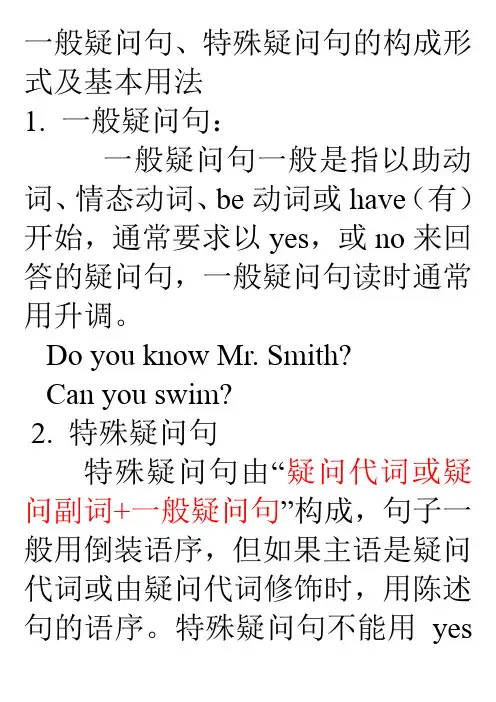
一般疑问句、特殊疑问句的构成形式及基本用法1. 一般疑问句:一般疑问句一般是指以助动词、情态动词、be动词或have(有)开始,通常要求以yes,或no来回答的疑问句,一般疑问句读时通常用升调。
Do you know Mr. Smith?Can you swim?2. 特殊疑问句特殊疑问句由“疑问代词或疑问副词+一般疑问句”构成,句子一般用倒装语序,但如果主语是疑问代词或由疑问代词修饰时,用陈述句的语序。
特殊疑问句不能用yes或no回答,读时用降调。
例如:Who is on duty today?How long have you been in Beijing? What time do you get up every morning?What must I do now?3. 注意疑问词的选择1. 问“谁”用who或whom。
如:Who is a doctor?Li Lei is a doctor.(对主语提问用who,对宾语提问用who,whom均可)2. 问“谁的”用whose。
如:Whose book is this?This is his book.3. 问“地点”用where。
如:Where is the ball?The ball is under the bed.4. 问“原因”用why。
如:Why didn't he come?He didn't come because he was ill.5. 问“身体状况”用how。
如:How are you?I'm fine.6. 问“方式”用how。
如:How did he do it?He did it in that way.7. 问“程度”用“how +被修饰语”。
如:How wide is the river?The river is five metres wide.8. 问“多少”用how much或how many。

1. 一般疑问句的构成:谓语动词提前或者是助动词提前,其他句子成分顺序不变,译为是否……?肯定回答为yes加主语和谓语的肯定形式;否定回答为no加主语和谓语的否定形式。
1)一般现在时时态中和一般过去时时态的一般疑问句eg. It snows here in winter.Does it snow here in winter?Yes, it is. / No, it isn’t.She likes reading books during her spare timeDoes she like reading books during her spare time?Yes, she does. / No, she doesn’t.I went to the big park near my house with my friends.Did you go to the big park near your house with your friends?He was a science teacher ten years ago.Was he a science teacher ten years ago?Mother used to offer afternoon tea for us in the living-roomUsed mother to offer afternoon tea for you in the living-room?Yes, she used to. / No, she used not toDid mother use to offer afternoon tea for you in the living-room?Yes, she did. / No, she did not to注意used to 后接动词不定式表示过于习惯的动作或状态,但是表示的过去习惯和状态不复存在。