
电气工程及其自动化专业英语第一章第六节
- 格式:ppt
- 大小:3.98 MB
- 文档页数:23


电气工程及其自动化专业英语第一章课文翻译
第一章第一篇sectiong
Two variables u(t) and i(t) are the most basic concepts in an
electric circuit, they characterize the various relationships in an
electric circuitu(t)和i(t)这两个变量是电路中最基本的两个变量,它们刻划了电路的各种关系。
Charge and Current
The concept of electric charge is the underlying principle for
explaining all electrical phenomena. Also, the most basic quantity
in an electric circuit is the electric charge. Charge is an electrical
property of the atomic particles of which matter consists,
measured in coulombs (C). 电荷和电流电荷的概念是用来解释所有电气现象的基本概念。也即,电路中最基本的量是电荷。电荷是构成物质的原子微粒的电气属性,它是以库仑为单位来度量的。
We know from elementary physics that all matter is made of
fundamental building blocks known as atoms and that each atom
consists of electrons, protons, and neutrons. We also know that
the charge e on an electron is negative and equal in magnitude

百度文库 - 让每个人平等地提升自我
1 注:电气工程及其自动化专业英语翻译 1~7面
班级:1002班
学号:20
姓名:王定瑞
PART 1 FUNDAMENTALS OF ELECTRIC ENGINEERING
Chapter 1 Circuit Fundamentals
第1部分的电气工程基础
第1章电路原理
Electrostatic Charges
静电荷
Protons and electrons are parts of atoms that make up all things in our world.
The positive charge of a proton is similar to the negative charge of an electron.
However, a positive charge is the opposite of a negative charge. These charges are
called electrostatic charges. Each charged particle is surrounded by an
electrostatic field.
质子和电子部件的原子构成一切事物在我们的世界。正电荷的质子是类似于负电荷的电子。然而,一个正电荷的反面是一个负电荷。这些指控被称为静电荷。每个带电粒子周围是一个静电场。
The effect that electrostatic charges have on each other is very important. They
either repel (move away) or attract (come together)
each other. It is said that like
charges repel and unlike charges attract.
专业英语
电路基础
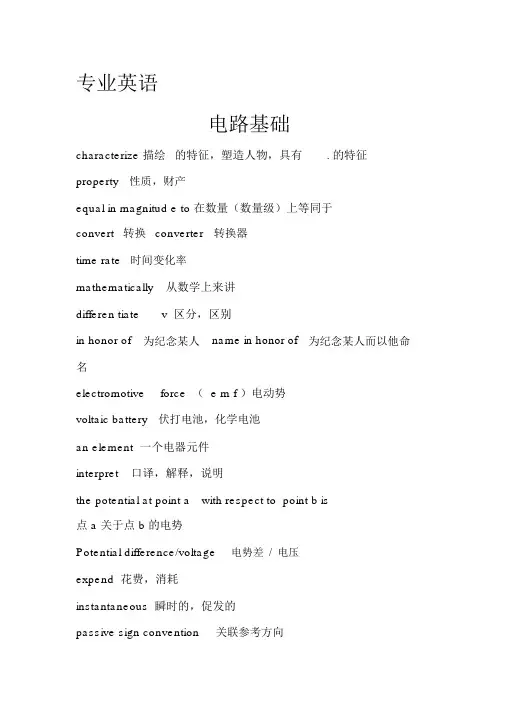
characterize 描绘 的特征,塑造人物,具有 .的特征
property 性质,财产
equal in magnitud e to 在数量(数量级)上等同于
convert 转换 converter 转换器
time rate 时间变化率
mathematically 从数学上来讲
differen tiate
v 区分,区别
in honor of
为纪念某人
name in honor of
为纪念某人而以他命
名
electromotive force ( e m f )电动势
voltaic battery 伏打电池,化学电池
an element 一个电器元件
interpret 口译,解释,说明
the potential at point a with respect to point b is
点 a 关于点 b 的电势
Potential difference/voltage 电势差 / 电压
expend 花费,消耗
instantaneous 瞬时的,促发的
passive sign convention 关联参考方向 精选文库
the law of conservation of energy 能量守恒定律
reference polarity 参考极性
electron 电子 electronic 电子的 electric 电的,电动的
time-varying 时变的 constant-valued 常量的 metallic 金属的
be due to 是因为,由于,归功于
building block 模块
Coulomb 库伦,Ampere 安培,joule 焦耳,Volt 伏特, Watt 瓦特,
work 功
变量 u(t),i(t) 是电路中最基本的概念。他们描述了电路中的各种关系。电荷量的概念是解释电现象的基本原理, 电荷量也是电路中最基本的量。 电荷也是构成物质的原子的电器属性, 量纲是库伦。

电气0714班专业英语复习资料 仅供参考 欢迎指正
第一章 电路基本原理
第一节 电流与电压
u(t)和i(t)这两个变量是电路中最基本的概念,描述了电路中各种不同的关系.
电荷与电流
电荷与电流的概念是解释一切电气现象的基础原则。而电荷也是电路的最基本的量。电荷是构成物质的原子的电气属性,单位是库仑(C)。
通过基础物理学,我们了解到一切物质都是由被称为原子的基本粒子构造而成的,每个原子中都包含电子、质子和中子。我们还知道电子上的电荷带负电,每个电子上的电量是1.60210×10—19库仑。质子带与电子相等的正电荷。原子上质子与电子的数目相等,使其呈中性.
我们来考虑电荷的运动。电或电荷的独特之处就是它们可以移动,也就是说电荷可以从一个地方移动到另一个地方,从而转换成另外一种形式的能量。
当把一根导线接在电池(一种电源)的两端时,电荷受迫而运动;正电荷与负电荷分别向相反的两个方向移动。这种电荷的移动产生了电流。习惯上,我们把正电荷移动的方向或负电荷移动的反方向称为电流的方向,如图1-1所示。这种说法是由美国科学家、发明家本杰明·富兰克林提出的。即使我们知道金属导体中的电流是由于带负电荷的电子(运动)而产生的,(我们)也使用默认的习惯,将正电荷运动的方向定义为电流的方向.因此,电流是单位时间内电荷的变化率,单位是安培(ampere,A).
在数学上,电流i、电荷q和时间t的关系为
i=dtdq (1—1)
将等式的两边同时进行积分,则可得到电荷在时间t和t0之间的变化。有
q==0ttidt (1-2)
在等式(1—1)中我们给电流i的定义表现了电流不是一个定值量,电荷随时间的变化不同,电流也与之呈不同的函数关系。