
南大2005年复试快题考研真题
- 格式:pdf
- 大小:309.69 KB
- 文档页数:1


2005年南京大学政府管理学院433行政管理学考研真题
南京大学2005年硕士研究生入学考试试题
考试科目:行政管理
一、解释以下概念或问题
1.行政权力
2.行政责任
3.非程序化决策
4.渐进决策模式
5.人事行政体制
6.财务行政
7.我国司法监督
8.行政要素评分法
二、简答
1.霍桑实验所总结的人际关系原理包括?
2.我国行政职能转变的目标?
3.简述马克思和恩格斯的行政组织理论。
4.简述我国公务员职务分类制度的基本内容。
5.简述行政组织的构成要素。
6.简析我国公务员考核制度的主要特点。
7.什么是审计?审计的主要任务?
8.我国国家权力机关对政府机关的工作监督范围及内容。
三、论述
1.联系我国实际,论述行政领导的主要方法。
2.结合我国行政管理实际,阐述人事行政的重要地位和作用。
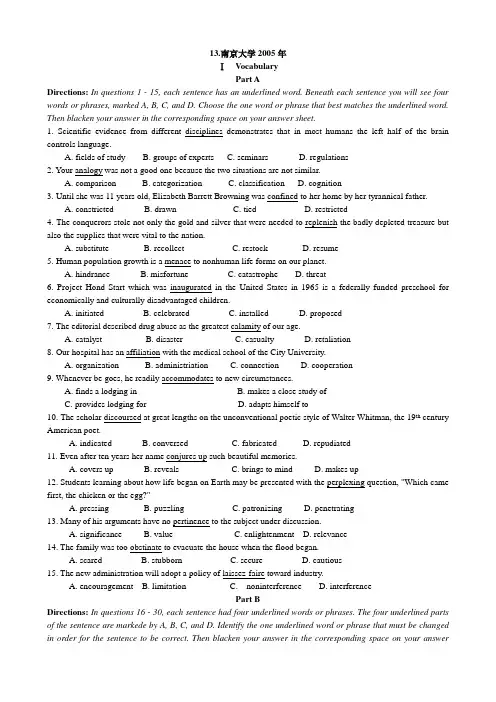
13.南京大学2005年ⅠVocabularyPart ADirections: In questions 1 - 15, each sentence has an underlined word. Beneath each sentence you will see four words or phrases, marked A, B, C, and D. Choose the one word or phrase that best matches the underlined word. Then blacken your answer in the corresponding space on your answer sheet.1. Scientific evidence from different disciplines demonstrates that in most humans the left half of the brain controls language.A. fields of studyB. groups of expertsC. seminarsD. regulations2. Your analogy was not a good one because the two situations are not similar.A. comparisonB. categorizationC. classificationD. cognition3. Until she was 11 years old, Elizabeth Barrett Browning was confined to her home by her tyrannical father.A. constrictedB. drawnC. tiedD. restricted4. The conquerors stole not only the gold and silver that were needed to replenish the badly depleted treasure but also the supplies that were vital to the nation.A. substituteB. recollectC. restockD. resume5. Human population growth is a menace to nonhuman life forms on our planet.A. hindranceB. misfortuneC. catastropheD. threat6. Project Hond Start which was inaugurated in the United States in 1965 is a federally funded preschool for economically and culturally disadvantaged children.A. initiatedB. celebratedC. installedD. proposed7. The editorial described drug abuse as the greatest calamity of our age.A. catalystB. disasterC. casualtyD. retaliation8. Our hospital has an affiliation with the medical school of the City University.A. organizationB. administriationC. connectionD. cooperation9. Whenever be goes, he readily accommodates to new circumstances.A. finds a lodging inB. makes a close study ofC. provides lodging forD. adapts himself to10. The scholar discoursed at great lengths on the unconventional poetic style of Walter Whitman, the 19th century American poet.A. indicatedB. conversedC. fabricatedD. repudiated11. Even after ten years her name conjures up such beautiful memories.A. covers upB. revealsC. brings to mindD. makes up12. Students learning about how life began on Earth may be presented with the perplexing question, "Which came first, the chicken or the egg?"A. pressingB. puzzlingC. patronizingD. penetrating13. Many of his arguments have no pertinence to the subject under discussion.A. significanceB. valueC. enlightenmentD. relevance14. The family was too obstinate to evacuate the house when the flood began.A. scaredB. stubbornC. secureD. cautious15. The new administration will adopt a policy of laissez-faire toward industry.A. encouragementB. limitationC. noninterferenceD. interferencePart BDirections: In questions 16 - 30, each sentence had four underlined words or phrases. The four underlined parts of the sentence are markede by A, B, C, and D. Identify the one underlined word or phrase that must be changed in order for the sentence to be correct. Then blacken your answer in the corresponding space on your answerSheet.16. Satellite technology (means) (that people) can watch the same TV programs in (other) parts of the world (like) in America.A. meansB. that peopleC. otherD. like in17. (Depictions) of animals and hunting scenes (can found) (in) the prehistoric cave paintings of (nearly every) continent.A. DepictionsB. can foundC. inD. nearly every18. Perhaps the most typically American (types) of feature movie, the western, (has been) a resurgence (in) popularity (in recent years).A. typesB. has beenC. inD. in recent years19. The groundhog comes (out its) burrow (after) hibernating (through) winter, and wanders about the prairie (looking) for food.A. out itsB. afterC. throughD. looking20. The immune system (protects) the body (by) recognizing and destroying (abnormally) or foreign cells, as well as (providing) antibodies to fight bacteria.A. protectsB. byC. abnormallyD. providing21. Public health experts say that (the) money one spends (avoiding) illness is (less) than the cost (to be) sick.A. theB. avoidingC. lessD. to be22. Crustaceans, (alike) insects, are invertebrate animals (that) (possess) external (skeletons).A. alikeB. thatC. possessD. skeletons23. D.W. Griffith, (directing) and producing his own silent movies, (achieving) great popularity (and was) a pioneer of (modern) cinema.A. directingB. achievingC. and wasD. modern24. Cheap labor (scarcity was) in the cotton plantations (of the) American South, and (slaves) became (standard) practice.A. scarcityB. of theC. slavesD. standard25. A pacifist is a person (with) a deeply (hold) belief (in solving) disputes only (via) peaceful means.A. withB. holdC. in solvingD. via26. (In) the nineteenth century the Mohave Indians (lived) in the Northern Hemisphere grew (their) crops on river bottom (lands).A. InB. livedC. theirD. lands27. (The) number of leprosy cases around the world (has been) cut (of) ninety (percent) during the past ten years.A. TheB. has beenC. ofD. percent28. (In) the same way that (news services) have changed (since) the invention of television. So(does) entertainment.A. InB. news servicesC. sinceD. does29. Some (research) suggests (what) there is a (link between) the body's calcium balance (and) tooth decay.A. researchB. whatC. link betweenD. and30. The ozone layer (must be protected) because (it) shields the Earth (from) excessive ultra-vilolet (radiations).A. must protectedB. itC. fromD. radiationsPart CDirections:For each blank for questions 31 -40 in the following passage, choose the best answer from the choices given following the passage. Then blacken your answer in the corresponding space on your answer sheet.When television first began to expand, very few of the people who had become famous as radio commentators (31) effective on television. Some of the difficulties they experienced when they were trying to (32) themselves to the new medium (33) When working (34) radio for example, they hadbecome (35) to seeing on behalf of the listener. This art of seeing for others means that the commentator had to be very good at taling. (36) all he has to be able to create a continuous sequence of visual images which add meaning to the sounds which the listener hears. In the case of television, however, the commentator sees everything with the viewer. His role, (37) is completely different. He is there to make sure that the viewer does not miss some point of interest, to help him focus on particular things, and (38) the images on the television screen. Unlike his radio colleague, he (39) know the value of silence and how to use it at those moments (40) the pictures speak for themselves.31. A. were able to be equally B. were able to be equalC. were able being equallyD. were able to be equal32. A. turn B. adapt C. alter D. modify33. A. was technical B. was technicallyC. were technicalD. were technically34. A. on B. at C. with D. behind35. A. experienced B. determined C. established D. accustomed36. A. After B. Above C. Of D. In37. A. however B. after all C. therefore D. in effect38. A. exhibit B. demonstrate C. expose D. interpret39. A. should B. must C. can D. would40. A. if B. when C. which D. asSection ⅡReading ComprehensionDirections: In this section you will read four passages. Each one is followed by several questions about it. For questions 41 - 70, you are to choose the best answer from A, B, C, or D to each question. Then blacken your answer in the corresponding space on your answer sheet.Passage OneAs individuals, we are inherently more bruited than a community. Although we can consult books and friends and critics, in the end we are limited to our own single perspectives. We are only one person--looking at the world from one place, one history, one pattern of knowing.A community, on the other hand can see things through many eyes, many histories, many ways of knowing. The question is whether it dismisses or creatively makes use of and integrates that diversity.Communities are wise to the extent they use diversity well. The wisest know that every viewpoint represents a part of the truth and that it is through the cooperative creative interplay of the viewpoints that the wisest, most comprehensive and powerful truths emerge. So they engage in that interplay, that dialogue--a creative controversy or consensus process that winds its way to wise public judgment.The best government is that government which enables communities to do this--to nurture and utilizes their wisdom and resources--especially their diversity--in such a way that they require less and less government.A community that can manage itself in a wise and sustainable manner is one that has mastered democracy. They know they can't depend on leaders to do things for them. They know that democratic citizens and leaders work best in partnership with each other, co-creating each other's power. They know that leaders work must be seen as living extensions of their own will and wisdom, which must be kept active. They know that passive "followership" abandons leaders, deprives them of the wisdom and creativity of the community, and opens them up to the corruptions of alienated power. A democratic community grows beyond dependence and paternalism. In a sense, the more democratic a society is, the more it has "come of age". Movements for democracy might even be seen as the maturation process of a culture. A mature society knows how to handle itself in dynamic context with others, drawing on its inner resources (its diverse members) and relating responsively and creatively with its environment.41. The writer believes that individuals ______.A. are inevitably more narrow-minded and less resourcefulB. are able to develop lasting friendship within a limited circleC. can focus on one history or one aspect of knowledgeD. must decide whether or not to take advantage of the diversity42. The writer compares individuals and communities in order to ______.A. argue that communities are wiser than individualsB. criticize community's lack of friendliness and perspectiveC. prove that each has its own merits and advantagesD. show how community wisdom comes from individuals43. According to the passage, the best truth comes when ______.A. all different communities are equally smartB. the wisest men are chosen to stand for the whole communityC. people of various opinions work together in a productive wayD. people hold debates and put on plays to find out the wise judgment44. It can be concluded that the best goverment is one ______.A. that guides communities to make wise judgmentB. that encourages communities to work for the governmentC. that makes use of community's wisdom and diversity to perform its functionD. that leaves governing to the wisdom of communities and governs least45. According to the passage, in a democratic society ______.A. collective wisdom is employed in the management of the communityB. government is regarded as useless and unnecessaryC. leaders must be powerful and wise enough to guide peopleD. people are allowed to do whatever they want to do46. In the last paragraph, the phrase "come of age" is closest in meaning to ______.A. arrival of a new timeB. reaching maturationC. being advancedD. catching up with the trendPassage TwoMost new words are made up from other earlier words; language-making is a conservative process, wasting little. When new words unfold out of old ones, the original meaning usually hangs around like an unrecognizable scent, a sort of secret.There are two immense words from Indo-European, gene and bheu, each a virtual anthill in itself, from which we have constructed the notion Of everything. At the beginning or as far back as they are traceable, they meant something like being. Gene signified beginning, giving birth, while bheu indicated existence and growth. Gene turned itself successively into kund jaz (Germanic) and gecynd (Old English), meaning kin or kind. Kind was at first a family connection, later an elevated social rank, and finally came to rest meaning kindly or gentle. Meanwhile, a branch of gene became the Latin gens which emerged as genus, genius, genital, and generous; then still holding on to its inner significance it became "nature" (out of gnasci).While gene was evolving into "nasture" and "kind" bheu was moving through similar transformations. One branch became the English word "build". It also moved into Greek, as phuein, meaning to bring forth and make grow; then as phusis, which was another word for nature. Phusis became the source of physic which at first meant natural science and later was the word for medicine. Still later, physic became physics.Both words, at today's stage of their evolution, can be taken together to mean, literally, everything in the universe. You do not come by words like this easily; they cannot just be made up from scratch. They need long lives before they can signify. "Everyting," C. S. Lewis observed in a discussion of the words, "is a subject on which there is not much to be said." The words themselves must show the internal marks of long use; they mustcontain their own inner conversation.47. The passage is mainly concerned with ______.A. how to coin new wordsB. where to trace the origin of languageC. the evolution of wordsD. language and nature48. When a new word is formed from an old one ______.A. the original meaning of the old dies outB. it is hard to know the secret of the development of the wordC. the new word carries with itself some of the original meaningD. the meaning of the new word is often confusing49. Why does the writer say "gene" and "bheu" are immense words?A. Because they are rich in meaning.B. Because they come from a very old language.C. Beacuse they remind us of anthill.D. Because they mean beginning and birth.50. The word "gene" develops into the following meaings and words EXCEPT ______.A. beginningB. growthC. generousD. gentlePassage ThreeTraditionally, the study of history has had fixed boundaries and focal points—perious, countries, dramatic events, and great leaders. It has also had clear and firm notions of scholarly procedure: how one inquires into a historical problem, how one presents and documents one's findings, what constitutes admissible and adequate proof.Anyone who has followed recent historical literature, can testify to the revolution that is taking place in historical studies. The currently fashionable subjetcs come directly from the sociology catalog: childhood, work, leisure. The new subjects are accompanied by new methods. Where history once was primarily narrative, it is now entirely analytic. The old questions "What happened?" and "How did it happen?" have given way to the question "Why did it happen?" Prominent among the methods used to answer the question "Why" is psychoanalysis, and its use has given rise to psychohistory.Psychohistory does not merely use psychological explanations in historical context. Historians have always used such explanations when they were appropriate and when there was sufficient evidence for them. But this practical use of psychology is not what psychohistorians intend. They are committed not just to psychology in general, but to Frendian psychoanalysis. This commitment precludes a commitment history as historians have always understood it. Psychohistory derives its "facts" not from history, the detailed records of events and their consequences, but from psychoanalysis of the individuals who made history, and deduces its theories not from this or that instance in their lives, but from a view of human nature that transcends history. It denies the basic criterion of historical evidence that evidence be publicly accessible to, and therefore assessable by, all historians. And it violates the basic tenet of historical method: that historians be alert to the negative instances that would refute their rightness of their theses. Psychohisotrians, convinced of the absolute rightness of their own theories, are also convinced that theirs is the "deepest" explanation of any event, that other explanations fall short of the truth.Psychohistory is not content to violate the discipline of history (in the sense of the proper mode of studying and writing about the past); ii also violates the past itself. It denies to the past an integrity and will of its own, in which people acted out of a variety of motives and in which events had a multiplicity of causes and effects. It imposes upon the past the same determinism that it imposes upon the present, thus robbing people and events of their individuality and of their complexity, Instead of respecting the particularity of the past, it assimilates all events, past and present, into a single deterministic schema that is presumed to be true at all times and in allcircum stances.51. Which of the following best states the main point of the passage?A. The approach of psychohistorians to historical study is currently popular even though it lacks the rigor and verifiability of traditional historical method.B. Traditional historians can benefit from studying the techniques and findings of psychohistorians.C. Areas of sociological study such as childhood and word are of little interest to traditional historians.D. The psychological assessment of an individual's behavior and attitudes is more informative than the details of his or her daily life.52. It can be inferred from the passage that one way in which traditional history can be distinguished from psychohistory is that traditional history usually ______.A. views past events as complex and having their own individualityB. relies on a single interpretation of human behavior to explain historical eventsC. interprets historical events in such a way that their specific nature is transcendedD. turns to psychological explanations in historical contexts to account for events53. The author mentions which of the following as a characteristic of the practice of psychohistorians?A. The lives of historical figures are presented in episodic rather than narrative form.B. Archives used by psychohistorians to gather material are not accessible to other scholars.C. Past and current events are all placed within the same deterministic schema.D. Events in the adult life of a historical figure are seen to be more consequential than are those in the childhood of the figure.54. It can be inferred from the passage that the methods used by psyehohistorians probably prevent them from ______.A. producing a one-sided picture of an individual's personality and motivationB. uncovering alternative explanations that might cause them to question their own conclusionsC. offering a consistent interpretation of the impact of personality on historical eventsD. recognizing connections between a government's political actions and the aspirations of government leaders55. In presenting her analysis, the author does all of the following EXCEPT ______.A. describe some of the criteria employed by traditional historiansB. question the adequacy of the psychohistorians' interpretation of eventsC. point out inconsistencies in the psychohistorians' application if their methodsD. contrast the underlying assumptions of psychohistorians with those of traditional historians.Passage FourDearest Scottie:I don't think I will be writing letters many more years and I wish you would read this letter twice--bitter as it may seem. You will reject it now, but at a later period some of it may come back to you as truth. When I'm talking to you, you think of me as an older person, an "authority," and when I speak of my own youth what I say becomes unreal to you--for the young can't believe in the youth of their fathers. But perhaps this little bit will be understandable if I put it in writing.When I was your age I lived with a great dream. The dream grew and I learned how to speak of it and make people listen. Then the dream divided one day when I decided to marry your mother after all, even though I knew she was spoiled and meant no good to me. I was sorry immediately I had married her but, being patient in those days, made the best of it and got to love her in another way. Yor came along and for a long time we made quite a lot of happiness out of our lives. But I was a man divided-- she wanted me to work too much for her and not enough for my dream. She realized too late that work was dignity, and the only dignity, and tried to atone for it by working herself, but it was too late and she broke and is broken forever.……The mistake I made was in marrying her. We belonged to different worlds--she might have been happy with a kind simple man in a southern garden. She didn't have the strength for the big stage-- sometimes she pretended, and pretended beautifully, but she didn't have it. She was soft when she should have been hard, and hard when she should have been yielding. She never knew how to use her energies--she's passed that failling onto you.For a long time I hated her mother for giving her nothing in the line of good habit-- nothing but "getting by" and conceit. I never wanted to see again in this world women who were brought up as idlers. And one of my chief desires in life was to keep you from being that kind of persons, one who brings ruin to themselves and others. When you began to show disturbing signs at about fourteen, I comforted myself with the idea that you were too precocious socially and a strict school would fix things. But sometimes I think that idlers seem to be a special class for whom nothing can be planned, plead as one will with them--their only contribution to the human family is to warm a seat at the common table.……56. Why does the father talk about his youth in the form of writing a letter?A. Because the father decides that he won't write any letters in the future.B. Because the written letter appears more authoritative and formal.C. Because the father intends his daughter to find the truth hidden in the letter by carefully reading it.D. Because the father views this as a better way for his daughter to know him.57. How did the marriage affect the father's ambition?A. Ever since his marriage, the father could not speak to people any more.B. His mismatched marriage exerted a negative effect on his dream and career.C. Dissatisfied with the marriage, the father worked harder to fulfill his dream.D. Taking too much care of the sick mother, the father had little time to work for his dream.58. In the eyes of the father, the mother should ______.A. settle for a quiet and peacefull life instead of having a high aspirationB. work for herself and gain dignity by great achievementC. know her power and learn to be strongD. never give up her energy nor yield to failure59. It can be inferred that the father disapproves of idlers because ______.A. these idlers are proud for no good reasonB. these idlers need special care from their parentsC. idleness is destructive to lifeD. the idle person cannot be a bread earner in the family60. Which of the following statements does the letter justify?A. The father explained his reason why he divorced his wife.B. Daughter was rebellious because of lack of family love.C. The birth of the daughter brought happiness to the family.D. The father was upset that his daughter was an idler.Section ⅢTranslationPart ADirections: Put the following passages into Chinese.1. Academic circles had long recognized that regulatory agencies were often "captured" by a regulated industry. The public would become aroused by the revelation of an abuse in a certain industry and a regulatory agency would be created, staffed initially by people responsive to the public interest, or at least highly critical of the industry. But eventually, public attention would turn to other problems, and only the regulated industry itself would maintain an interest in who was appointed to the agency and what decisions it rendered. In the long run,people sympathetic to the regulated industry would be appointed to the regulatory agency, and rulings would be made in the interest of the industry rather than in the interest of the public.2. In recent years there has been considerable discussion of the relation between science and the humanities. The differences in attitudes are related in part to the different objectives of science and the humanities. In gross terms, one objective of science is to achieve precise and parsimonious statements about the structure and processes of the animate and inanimate world. Ideally, these statements allow us to describe, understand, and predict something about that world. As stated earlier, elegance or aesthetic appeal have their place in the world of the scientist, but these qualities can be expressed in terms of precision and parsimony. A primary objective of the humanities is to enrich the life of the beholder by arousing some sensual experience, emotion, or feeling. Some of these feelings are quite complex and intricate, and need developing an activity that requires a great deal of talent. There are a number of ways in which the humanities and sciences are alike. One of the principal likenesses is the motivations for both groups.Part BDirections: Put the following sentences into English.1.美国在1940年代崛起为军事和经济强国,他们在各个领域的卓越成就让东方人为之神往。
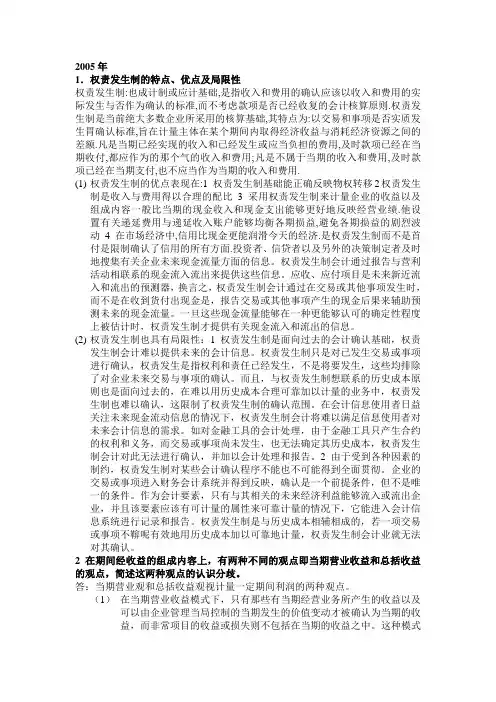
2005年1.权责发生制的特点、优点及局限性权责发生制:也成计制或应计基础,是指收入和费用的确认应该以收入和费用的实际发生与否作为确认的标准,而不考虑款项是否已经收复的会计核算原则.权责发生制是当前绝大多数企业所采用的核算基础,其特点为:以交易和事项是否实质发生胃确认标准,旨在计量主体在某个期间内取得经济收益与消耗经济资源之间的差额.凡是当期已经实现的收入和已经发生或应当负担的费用,及时款项已经在当期收付,都应作为的那个气的收入和费用;凡是不属于当期的收入和费用,及时款项已经在当期支付,也不应当作为当期的收入和费用.(1)权责发生制的优点表现在:1 权责发生制基础能正确反映物权转移2权责发生制是收入与费用得以合理的配比 3 采用权责发生制来计量企业的收益以及组成内容一般比当期的现金收入和现金支出能够更好地反映经营业绩.他设置有关递延费用与递延收入账户能够均衡各期损益,避免各期损益的剧烈波动 4 在市场经济中,信用比现金更能润滑今天的经济.是权责发生制而不是首付是限制确认了信用的所有方面.投资者、信贷者以及另外的决策制定者及时地搜集有关企业未来现金流量方面的信息。
权责发生制会计通过报告与营利活动相联系的现金流入流出来提供这些信息。
应收、应付项目是未来新近流入和流出的预测器,换言之,权责发生制会计通过在交易或其他事项发生时,而不是在收到货付出现金是,报告交易或其他事项产生的现金后果来辅助预测未来的现金流量。
一旦这些现金流量能够在一种更能够认可的确定性程度上被估计时,权责发生制才提供有关现金流入和流出的信息。
(2)权责发生制也具有局限性:1权责发生制是面向过去的会计确认基础,权责发生制会计难以提供未来的会计信息。
权责发生制只是对已发生交易或事项进行确认,权责发生是指权利和责任已经发生,不是将要发生,这些均排除了对企业未来交易与事项的确认。
而且,与权责发生制想联系的历史成本原则也是面向过去的,在难以用历史成本合理可靠加以计量的业务中,权责发生制也难以确认,这限制了权责发生制的确认范围。

2005年南京大学421管理学原理考研真题及详解科目代码:421科目名称:管理学原理试回答下述问题(每题30分,共150分)1.有人认为企业文化的特点决定了它是不可被移植(或被模仿)的。
你是否同意这个观点?请说明理由。
答:我同意这个观点。
企业文化是指组织在长期的实践活动中所形成的的并且为组织成员普遍认可和遵循的具有本组织特色的价值观念、团体意识、行为规范和思维模式的总和。
(1)企业文化至所以能产生管理的功效,完全取决于组织文化自身所具有的特点,以及这些特点在管理中所产生的作用。
一般而言,企业文化具有以下几个方面的特点:①企业文化是以组织的价值观念为基础的。
任何一个组织都是把自己认为最有价值的对象作为本组织的最高追求目标、最高理想和最高宗旨。
所以,价值观念是组织存在的支柱,也是企业文化的灵魂。
当这种最高发挥人的主观能动性,努力提高组织成员的社会责任感和使命感,使组织成员成为真正的命运共同体和利益共同体,才能不断地增强组织的活力。
②企业文化的中心是以人为主体的人本文化。
从企业发展的过程来看,人在企业中的重要性也不是随企业的诞生而出现的。
20世纪初,劳动者只是“泰勒制”驱使下的机器;40年代,行为科学进入管理领域,开始强调人的精神作用,人的需求受到重视;60年代人力资源成了企业管理的一种重要的战略要素,受到关注;80年代后期,信息技术和知识经济的迅猛发展,企业认识到人力资源是所有资源中最重要的,人的才能可以创造巨大的价值。
人在企业中的地位日益重要的过程,实际上就是孕育企业文化的过程。
因此,确立起以人为主的人本文化,以组织成员的成长与发展为中心,提供有于他们实现自我价值的工作平台和发展空间,这是企业文化的主旋律。
③企业文化的管理方式是以柔性管理为主。
企业文化是一种以文化的形式出现的现代管理方式,它是通过文化的柔性引导来构建组织的合作关系,建立和谐的心理环境以及协调的人群氛围,调节组织成员的心态与行为,并通过对企业文化的心理认同,逐步内化为组织成员的主体文化,使组织目标转化为员工的自觉行为。