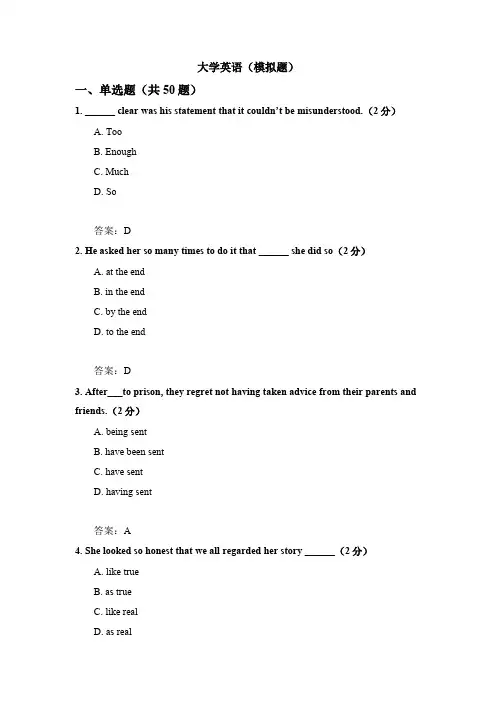
厦门大学网络教育2016-2017学年第一学期《英语1》课程复习题I. Use of English1. —You look so young in red.—_________ .A. I don't mindB. So do youC. Thank youD. Don't say so2. —I'll be in the relay race. It's my turn. Bye.— _________! Bye.A. GreatB. Good luckC. Be carefulD. Best wishes3. —I'm so sorry to take up so much of your time.—__________ .A. Never mindB. All rightC. That's all rightD. That's right4. —Ah, there are so many magazines here, can I have a look at them please?—__________ .A. Help yourselfB. Why not?C. It doesn't matterD. That's OK5. —Would you like something to drink?—__________. I really feel a little thirsty.A. Sorry, I don't think soB. Never mindC. No, pleaseD. Yes, please6. —Thank you for your beautiful present for my birthday.—Not at all. ___________.A. You're welcomeB. Don't say soC. It's a pleasureD. Thanks a lot7. —“Merry Christmas and Happy New Year to you!”—“________.”A. Thank you, the same to youB. I hope soC. I wish soD. I’m glad to hear that8. —- “Sorry to trouble you.”—“________.”A. All rightB. No troubleC. That’s rightD. It doesn’t matter9. —Well, it's getting late. I must be going. Thank you again for inviting me to the party.— ____________.A. Oh, it's so lateB. Thank you for comingC. Oh, so soon?D. I really had a happy time10. —I want to go to New York. What's the fare?— ____________.A. Pardon me?B. I'm sorryC. Yes, I don't understandD. I'm not understanding11. — These are certainly beautiful flowers. Thank you very much.— ____________________.A. No, no. it’s nothing.B. You’re welcomeC. Yes, I agreeD. Yes, I think so12. — Hi, Sam, I think you did a good job.— ___________________.A. Thank youB. Don’t mention itC. Not at allD. I did it quite badly13. — Good morning, sir. May I help you?— ___________________.A. No, I don’t buy anything.B. No, I don’t need your helpC. Yes, I need some sugarD. Oh, no. That’s OK14. — Would you like to have dinner with us this evening?— ____________.A. OK, but I have to go to a meeting nowB. No, I can’tC. Sorry, but this evening I have to go to the airport to meet my parentsD. I don't know15. — Hi, is Mary there, please?— ____________.A. Hold on. I’ll get herB. No, she isn’t hereC. Yes, she live hereD. Yes, what do you want16. — Please help yourself to the fish.— ____________.A. Thanks, but I don’t like fishB. Sorry, I can’t helpC. Well, fish don’t suit meD. No, I can’t17. — Excuse me, but can you tell me the way to the airport?— ____________.A. Don’t ask thatB. Sorry, I’m a stranger hereC. No, I can’t say thatD. No, you’re driving too fast18. — How about a date to the movies tonight, Jane?— ____________.A. I don’t think soB. I’m sorry. I have to drive my mother home tonightC. Never mindD. Take it easy19. — Good night and thanks again.— ____________.A. You can’t say thatB. No, no. It’s what I can doC. How can you say thatD. Good night20. —Oh, I’m sorry. But I promise I’ll be careful next time.— ____________.A. It’s nothing at allB. Oh, never mind. It doesn’t matterC. Thank youD. There are no questionsII. Reading Comprehension:Passage 1Millions of stars are traveling about in space. A few form groups which journey together, but most of them travel alone. And they travel through a universe so large that one star seldom comes near to another. For the most part each star makes its journey in complete loneliness, like a ship on an empty ocean. The ship will be well over a million miles from its nearest neighbor. From this it is easy to understand why a star seldom finds another anywhere near it.We believe, however, that some two thousand million years ago, another star wandering through space happened to come near our sun. Just as the sun and the moon raise tides on the earth, so this star must have raised tides on the surface of the sun. But they were very different from the small tides that are raised in our oceans; a large tidal wave must have traveled over the surface of the sun, at last forming a mountain so high that we cannot imagine it. As the cause of the disturbance came nearer, so the mountain rose higher and higher. And before the star began to move away again, its tidal pull had become so powerful that this mountain was torn to pieces and threw off small parts of itself into space. These small pieces have been going round the sun ever since. They are the planets.1. Millions of stars are _______.A. following their own paths in spaceB. moving about without a fixed courseC. seldom wandering about in the universeD. always traveling together2. Some two thousand million years ago, the mountain on the sun was raised probably because_______.A. a large tidal wave of a star traveled over the surface of the sunB. another star happened to come near the sunC. the sun and the moon raised the tides on the earthD. the star moved away from the sun3. The article suggests that _______.A. our earth exists before the sunB. how space formedC. no one knows where the earth comes fromD. our earth used to be part of a high mountain on the sun4. The expression "the cause of the disturbance" refers to _______.A. the large tidal waveB. the powerful tidal pullC. the star coming near the sunD. one of the sun's planets5. In this article, the writer mainly wants to tell the readers _______.A. that the universe is so large that we cannot imagine itB. how the high mountains were formed on the sunC. why the tides over the surface of the sun were so powerfulD. where the planets in the universe came fromPassage 2By adopting a few simple techniques, parents who read to their children can greatly increasetheir children's language development. It is surprising but true. How parents talk to their children makes a big difference in the children's language development. If a parent encourages the child to actively respond to what the parent is reading, the child's language skills increase.A study was done with 30 three-year-old children and their parents. Half of the children participated in the experimental study; the other half acted as the control group. In the experimental group, the parents were given a two-hour training session in which they were taught to ask open-ended questions rather than yes-or-no questions. For example, the parent should ask, "What is the doggie doing?" rather than "Is the doggie running away?" The parents in the experimental group were also instructed in how to help children find answers, how to suggest alternative possibilities and how to praise correct answers.At the beginning of the study, the children did not differ in measures of language development, but at the end of one month, the children in the experimental group showed 5.5 months ahead of the control group on a test of verbal expression and vocabulary. Nine months later, the children in the experimental group still showed an advance of 6 months over the children in the control group.6. Which of the following can be inferred from the passage?A. Children who talk a lot are more intelligent.B. Parents who listen to their children can teach them more.C. Active children should read more and be given more attention.D. Verbal ability can easily be developed with proper methods.7. What does "it" in line 2 can most probably be replaced by?A. Parents increasing children's language developmentB. Reading techniques being simpleC. Parents reading to childrenD. Children's intelligence development8. According to the author, which of the following questions is the best type to ask children about?A. Do you see the elephant?B. Is the elephant in the cage?C. What animals do you like?D. Shall we go to the zoo?9. The difference between the control group and the experimental group was __________.A. the training that parents receivedB. the age of the childrenC. the books that were readD. the number of the children10. The best conclusion we can draw from the passage is that __________.A. parents should be trained to read to their childrenB. the more children read, the more intelligent they will becomeC. children's language skills increase when they are required to respond activelyD. children who read actively seem six months olderPassage 3Different as they are, advertisements are alike in one important way. They have the same purpose, to get people to buy something.In the days of the cave men there was no advertising. There was no need for it. But as soon as people began to make things to sell, advertising was found to be useful. The businessmen of ancient Egypt employed "criers" to walk through the streets shouting or singing about the thingsthey wanted to sell. Newsboys still "cry" their papers now.In the Middle Ages businessmen hung picture signboards over their shop door showing what they had to sell. A large picture of a shoe above a shop door meant that it was a shoemaker's shop. It suggested buying shoes or having old ones mended.As more things were made to be sold, advertising grew. Today advertising is one of the biggest businesses. A great many people work at the advertisement. Every year billions of dollars are spent on advertising.Advertising helps sell more things to more people. This in turn makes it possible to produce more things to sell. Sometimes it even helps make things cost less. Radios, for example, used to cost much more than they do because they were turned out slowly and expensively by hand. But advertising made more people want radios. When producers began making them by the thousands, they found quicker and cheaper ways of doing the job.11. Advertising is almost all made ___________.A. by people who sell thingsB. by people who buy thingsC. by employed "criers"D. by ancient Egyptians12 All advertisements are the same in that ___________.A. they are of the same colorB. they help sell thingsC. they are made on televisionD. they often look alike13. It is not mentioned in the passage that__________.A. advertising can be in both spoken and written formsB. advertising on TV is much preferredC. the cave men did not make any advertisementD. advertising today employs many "criers"14. Radios used to cost much more than they do today because_____________.A. people did not advertiseB. no one wanted to buy themC. they were made slowly by handD. they were made quickly by machines15 Advertising which is one of the biggest businesses probably began __________.A. in the days of the cave menB. in the Middle AgesC. in the modern timeD. when there were things to sellPassage 4Recycling—using materials for the second time—is nothing new. Waste paper, rags, scrap-iron and many other things have been recycled and used again in many different ways for years. It is only the word that is new. But now that natural materials are becoming more difficult to find, many countries are experimenting with other ways of keeping materials.In the USA, a publishing firm has brought out several books on pollution and waste. The books are made of recycled paper—that is paper that has been used before. In this way, several thousand trees are saved. Multiply those books by a hundred, or even a thousand, and whole forests are saved. One clever schoolboy has worked it out that if every schoolbook in the USA was recycled, there would be enough paper for fifty packets of peanuts for every child in the world for five years. He does not say where the peanuts are to come from.Several firms are experimenting with making containers from a hard plastic which, when the contents of the containers are finished, can be used as building materials, a kind of brick. If themountains of empty cans all over the world can be changed into building materials that are not too expensive, that, too, is a new source of material.16. Waste paper, rags and scrap-iron can _______.A. be thrown awayB. not be used againC. not be keptD. be recycled and used again17. Since natural materials are becoming ______, people are finding ways of making use of wastematerials.A. more valuableB. more usefulC. more expensiveD. more difficult to find18. Firms using _______ may save money.A. old paperB. recycled paperC. new paperD. imported paper19. Empty containers made of ______ can be used as building materials.A. ironB. a hard plasticC. tinD. a soft plastic20.Which of the following can best describe the main idea of this passage?A. building materialB. pollutionC. recyclingD. experimentingIII. Vocabulary and Structure1. Just imagine Mary ________ in her favorite chair back home.A. to sitB. sitC. sittingD. has been sat2. Mr. Thomas found the coins while ________ in his back garden.A. diggingB. was diggingC. dugD. being digging3. Snap judgments, if ________, have usually been considered signs of immaturity or lack ofcommon sense.A. taking seriouslyB. taken seriouslyC. take seriouslyD. to be taken seriously4. I'd offer to give you a lift if I ________ my car here.A. haveB. am havingC. do haveD. had5. At the end of game, the whole crowd ________ their feet and cheered wildly.A. emerged fromB. rose fromC. got toD. stood up6. Being with his family for a few days I gained one or two insights ________ the reason hebehaves the way he does.A. intoB. ofC. onD. off7. His thoughts were _______ from the subject by the arrival of his friends.A. attractedB. sufferedC. distractedD. related8. She is a ______ woman who is certain of her ideas and actions.A. significantB. awareC. confidentD. intense9. The method he used turned out to be _______ in improving the students' English.A. effectiveB. ableC. capableD. explicit10. The boss refused to give any _______ on the fact that his workers were out of jobs.A. responseB. commentC. answerD. reply11. They are teachers and don't realize ______ to start and run a company.A. what it takesB. what takes itC. what they takeD. what takes them12. He refuses to let others speak and ________ every meeting.A. confrontsB. affectsC. attachesD. dominates13. The creating of the steam machine, by James Watt, was a(n) ________ idea.A. spontaneousB. originalC. previousD. cautious14. Young children have a limited attention ________ and can't focus on one activity for verylong.A. rangeB. spanC. reachD. spread15. The train was ________ slow I was almost two hours late.A. soB. suchC. veryD. that16. He's not got another job yet and it's not ______ he will for some time.A. likesB. unlikeC. likelyD. like17.She shared her deepest thoughts and fears in handwritten letters with Mary ____ they werechatting in her living room.A. althoughB. as ifC. becauseD. for18. He pretended to be very sick and she was ____ into sympathy for him.A. fooledB. takenC. prescribedD. affected19. ______ I admit that the problems are difficult, I don't agree that they can't be solved.A. For fear thatB. BecauseC. WhileD. Until20. I'm going to spend the winter vacation in Shanghai, ______ I have relatives.A. becauseB. whichC. thatD. where21. If you try to learn too many things at a time, you may get _______.A. alarmedB. scaredC. surprisedD. confused22. ________ else goes, I won't.A. WhoB. WhomC. WhoeverD. He who23. Thanks go to the trashmen who leave the streets ________ each night.A. cleanestB. cleanerC. cleaningD. more cleaner24. I ________ he'd do something silly; he's been acting strangely all week.A. may have knownB. would knowC. have knownD. had known25. With the job ________, he went to see a film with his colleagues.A. doneB. doingC. to doD. do26. Neither his colleagues nor his mother ________ his marriage to that girl.A. acceptB. acceptsC. agreeD. agrees27. He makes up his mind to ________ the post till the end of the year.A. keep inB. remain underC. stay atD. go on28. Good managing of a company ________ great efforts.A. calls onB. calls outC. calls inD. calls at29. Most people have no real idea how to change to healthy food, and Maureen was no ________.A. foundationB. possibilityC. exceptionD. ignorance30. He always knew what time it was, as if by ________.A. instinctB. imaginationC. reactionD. reality31. My uncle is great. In our family, he's ______ his cooking.A. famous aboutB. famous withC. famous forD. famous in32. The heating system here has an ______ temperature control.A. aggressiveB. intentionalC. accidentalD. automatic33. It is nice to travel with ______ paid by your employers, at no cost to yourself.A. facilitiesB. costsC. loansD. activities34. The gasoline ______ destroyed the company and injured many people.A. exploredB. extendedC. exportedD. explosion35. Only two people survived the fire that ______ at midnight.A. broke outB. broke offC. broke upD. broke down36. To complete the task successfully, we have to get well prepared ______.A. in advanceB. in detailC. in turnD. in force37. The policeman went from house to house, ______ whether anyone had seen the lost boy.A. inquiringB. interruptingC. informingD. introduction38. _______ is a spell of warm sunshine.A. What do all of us needB. What all of us need doC. What need all of usD. What all of us need39. To be frank, I' d rather you ________ in the case.A. will not be involvedB. not involvedC. not to be involvedD. were not involved40. If you think that the illness might be serious you should not ______ going to the doctor.A. put offB. hold backC. put awayD. hold up41. ________ 25 years ago next month, the club is holding a party for past and present members.A. FormingB. Being formedC. FormedD. To form42. Why are children so easily ________ by what their friends do, think, or say?A. effectedB. respectedC. convincedD. affected43. _______ coming of the Space Age, a new area has been added to the study of the planets.A. WhileB. It is theC. When theD. With the44. It was the training that he had as a young man _______ made him such a good engineer.A. thatB. hasC. whatD. later45. ______ they reached the centre of the city, they stopped the car at a restaurant.A. Before a mile or so whenB. For a mile or so afterC. Further than a mile or soD. A mile or so beforeIV. Cloze:(1)Mice in general are not well-liked, but a mouse named Mickey has won the hearts of millions. Movies about Mickey Mouse have been __1__ with audiences almost everywhere for more than forty years.Walt Disney, who created this lovely cartoon __2__, was born in Chicago in 1901. Later his family moved to a farm near Kansas City, where Walt worked for some time __3__ a newsboy. However, what he really enjoyed was drawing pictures. When World War I __4__, he joined the Red Cross and went to France. After the war, Disney __5__to Kansas City to work for a company that made fairy story cartoons. This was the kind of work he liked best. He __6__ up his mind to find better ways of making the cartoon movie __7__ they would seem alive. Sound was just starting to be used in __8__, and Disney believed it had great possibilities. He quickly __9__sound to his cartoons. When he made Mickey mouse talk on the film screen, audiencewere quite __10___. Mickey became a great success with both young and old.1. A. popular B. pleased C. satisfied D. strict2. A. picture B. character C. animal D. creature3. A. for B. with C. as D. after4. A. broke down B. broke up C. broke out D. broke in5. A. removed B. arrived C. visited D. returned6. A. did B. made C. put D. took7. A. so that B. as C. since D. when8. A. TV B. movies C. radio D. magazines9. A. added B. carried C. invented D. produced10. A. favorite B. favored C. delightful D. delighted(2)Coffee and tea are the most popular 1in the world. Coffee is a favorite drink of Canadians. Many Canadians like to start their day 2_ a cup of coffee. At work, they may take a coffee break. Coffee break is a time _ 3_ stop and relax for a few minutes over a cup of coffee or a snack.___4_ is coffee so popular? For one thing, it has a rich, strong taste that many people like. It is served hot, with milk, cream or sugar. Many people like coffee in the morning because it helps them ____5 . Coffee has caffeine in it. Caffeine gives people more energy.Every day, millions of people all over the world drink tea. Tea is the 6 drink of China, Japan, England and Russia. In England, it is a custom to drink tea in the afternoon. In Japan, drinking tea is also a social _7__ and there are special rules for tea drinking.Tea comes from tea 8 . We make tea by pouring 9 water on dried tea leaves. People usually drink hot tea, but it can be served cold. Some people like to drink tea with milk or cream. Other people 10__ milk or cream in tea, but they put in honey, sugar or lemon. Tea also has some caffeine in it.1. A. drinks B. drink C. water D. drinking water2. A. from B. at C. in D. with3. A. for B. to C. with D. at4. A. Why B. What C. Which D. When5. A. move away B. wake up C. come in D. look down6. A. personal B. general C. possible D. national7. A. study B. custom C. way D. belief8. A. roots B. stems C. branches D. leaves9. A. cooling B. running C. boiling D. fresh10. A. hate B. like C. enjoy D. love(3)Nobody wants to be 1 . Unfortunately our bodies can develop problems. When we aren't 2 , our bodies tell us. Sometimes a part of our body hurts. When a part of our body ____3 , we say we have aches and pains. We can have aches and pains in different parts of the body.We call some simple 4 problems "aches." For example, we can have a headache, a toothache, an earache, a backache or a stomachache. Other simple problems are not 5 aches, so we describe them in different ways. For example, we can have a sore throat, a sore leg, a soretoe."Pain" is another word that we use to 6 a problem. We can have a pain in the chest, a pain in the shoulder or a pain 7 the back. A pain is strong. Also, a pain hurts in a specific place. When aches and pains aren't too 8 , we can buy medicine in the drugstore. Usually small aches go away quickly. When pain is more serious, we 9 to visit the doctor (or the dentist). The doctor asks us what our symptoms are. The doctor may have to do tests or take X-rays to 10 what is wrong. Then he or she will tell us what to do.1. A. sleep B. bad C. cold D. sick2. A. healthy B. well C. health D. fat3. A. hurt B. hurting C. hurts D. have hurt4. A. healthy B. health C. well D. fat5. A. talked B. spoken C. seen D. called6. A. describe B. tell C. talk D. speak7. A. at B. on C. in D. over8. A. light B. serious C. series D. heavy9. A. having B. had C. have D. has10. A. believe B. know C. talk D. sayV. Translate the following sentences from Chinese into English or English into Chinese:1.网上教育需要更多的投入来跟上课程进度。