
宏观经济学 chapter 3
- 格式:pptx
- 大小:2.85 MB
- 文档页数:30


2'dYT
yf
dnn=−.
f1
“”
1
1924/1996

《宏观经济学》参考文献
一、各章参考文献
第一章导论
1、凯恩斯:《就业利息与货币通论》,商务印书馆1963年版。
2、Hall and Tayler, “Macroecnomics” , 2nd Ed., Norton Co. , New York, 1988,
Chapter 1
3、蔡继明,《宏观经济学》,人民出版社2003年版,第一章。
4、高鸿业,《西方经济学(宏观部分)》,中国经济出版社1996年版,第一章。
5、宋承先,《现代西方经济学(宏观经济学)》,复旦高校出版社1999年版,第一章。
其次章宏观经济的衡量与均衡
1、Hall and Tayler, < , 2nd Ed., Norton Co., New York, 1988, Chapter 2
2、蔡继明,《宏观经济学》,人民出版社2003年版,第一章。
3、高鸿业,《西方经济学(宏观部分)》,中国经济出版社1996年版,第一章。
4、宋承先,《现代西方经济学(宏观经济学)》,复旦高校出版社1999年版,第一章。
5、美国商务部,《当今商业概览》,1976年一月号。
第三章经济增长
1、Jones, “An Introduction to Mordern Theories of Economic Growth,, , McGraw-Hill
Co.,
New York, 1976
2 > So low, ^Technical Change and Agregate Production Inunction n , in “Review of
Economics
and Statistics” , 1957
第四章失业
1、凯恩斯:《就业利息与货币通论》,商务印书馆1963年版。
2、斯蒂格利茨,《经济学》(其次版),中国人民高校出版社2000年版。
3、兰荣华,《我们国家当前失业的缘由和再就业的措施》,载《上海铁道高校学报》2000年第
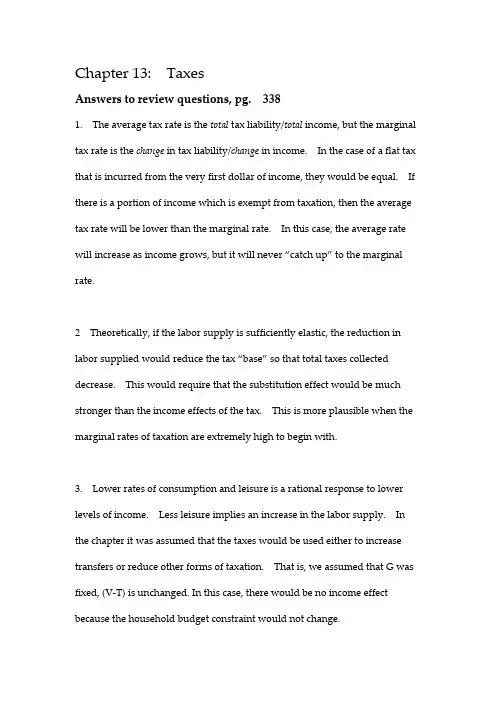
Chapter 13: Taxes
Answers to review questions, pg. 338
1. The average tax rate is the total tax liability/total income, but the marginal
tax rate is the change in tax liability/change in income. In the case of a flat tax
that is incurred from the very first dollar of income, they would be equal. If
there is a portion of income which is exempt from taxation, then the average
tax rate will be lower than the marginal rate. In this case, the average rate
will increase as income grows, but it will never “catch up” to the marginal
rate.
2 Theoretically, if the labor supply is sufficiently elastic, the reduction in
labor supplied would reduce the tax “base” so that total taxes collected
decrease. This would require that the substitution effect would be much
stronger than the income effects of the tax. This is more plausible when the

Chapter 18: Exchange Rates
Answers to review questions, pg. 465
1. The nominal exchange rate is the rate at which one currency can be
traded for another in the foreign exchange market. The real exchange rate
adjusts the nominal values for differences in the price level of the two nations.
For example, if the price level is 1 in the domestic economy and 4 in the
foreign economy, then a nominal exchange rate of 4:1 would generate a real
exchange rate of (4/4)/(1/1) = 1. In this example the domestic currency can
purchase 4 units of the foreign currency, but only 1 units of the foreign GDP.
A fixed exchange rate is based on nominal values.
2. The condition is based on the theory that arbitrage (buying goods in
markets where the price is low and selling them in markets where the price is
high) will tend to eliminate differences in the price of goods in different