
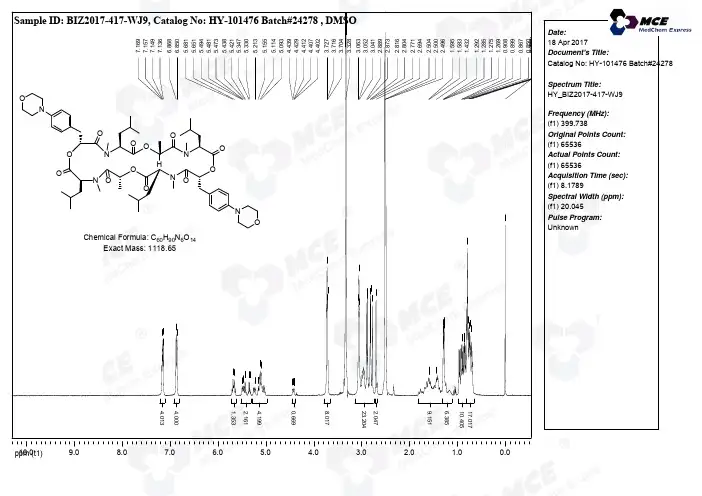
Emodepside_HNMR_24278_MedChemExpress
- 格式:pdf
- 大小:736.63 KB
- 文档页数:1

Inhibitors, Agonists, Screening LibrariesSafety Data Sheet Revision Date:Oct.-10-2018Print Date:Oct.-10-20181. PRODUCT AND COMPANY IDENTIFICATION1.1 Product identifierProduct name :NMDI14Catalog No. :HY-111374CAS No. :307519-88-61.2 Relevant identified uses of the substance or mixture and uses advised againstIdentified uses :Laboratory chemicals, manufacture of substances.1.3 Details of the supplier of the safety data sheetCompany:MedChemExpress USATel:609-228-6898Fax:609-228-5909E-mail:sales@1.4 Emergency telephone numberEmergency Phone #:609-228-68982. HAZARDS IDENTIFICATION2.1 Classification of the substance or mixtureNot a hazardous substance or mixture.2.2 GHS Label elements, including precautionary statementsNot a hazardous substance or mixture.2.3 Other hazardsNone.3. COMPOSITION/INFORMATION ON INGREDIENTS3.1 SubstancesSynonyms:NoneFormula:C21H25N3O4SMolecular Weight:415.51CAS No. :307519-88-64. FIRST AID MEASURES4.1 Description of first aid measuresEye contactRemove any contact lenses, locate eye-wash station, and flush eyes immediately with large amounts of water. Separate eyelids with fingers to ensure adequate flushing. Promptly call a physician.Skin contactRinse skin thoroughly with large amounts of water. Remove contaminated clothing and shoes and call a physician.InhalationImmediately relocate self or casualty to fresh air. If breathing is difficult, give cardiopulmonary resuscitation (CPR). Avoid mouth-to-mouth resuscitation.IngestionWash out mouth with water; Do NOT induce vomiting; call a physician.4.2 Most important symptoms and effects, both acute and delayedThe most important known symptoms and effects are described in the labelling (see section 2.2).4.3 Indication of any immediate medical attention and special treatment neededTreat symptomatically.5. FIRE FIGHTING MEASURES5.1 Extinguishing mediaSuitable extinguishing mediaUse water spray, dry chemical, foam, and carbon dioxide fire extinguisher.5.2 Special hazards arising from the substance or mixtureDuring combustion, may emit irritant fumes.5.3 Advice for firefightersWear self-contained breathing apparatus and protective clothing.6. ACCIDENTAL RELEASE MEASURES6.1 Personal precautions, protective equipment and emergency proceduresUse full personal protective equipment. Avoid breathing vapors, mist, dust or gas. Ensure adequate ventilation. Evacuate personnel to safe areas.Refer to protective measures listed in sections 8.6.2 Environmental precautionsTry to prevent further leakage or spillage. Keep the product away from drains or water courses.6.3 Methods and materials for containment and cleaning upAbsorb solutions with finely-powdered liquid-binding material (diatomite, universal binders); Decontaminate surfaces and equipment by scrubbing with alcohol; Dispose of contaminated material according to Section 13.7. HANDLING AND STORAGE7.1 Precautions for safe handlingAvoid inhalation, contact with eyes and skin. Avoid dust and aerosol formation. Use only in areas with appropriate exhaust ventilation.7.2 Conditions for safe storage, including any incompatibilitiesKeep container tightly sealed in cool, well-ventilated area. Keep away from direct sunlight and sources of ignition.Recommended storage temperature:Powder-20°C 3 years4°C 2 yearsIn solvent-80°C 6 months-20°C 1 monthShipping at room temperature if less than 2 weeks.7.3 Specific end use(s)No data available.8. EXPOSURE CONTROLS/PERSONAL PROTECTION8.1 Control parametersComponents with workplace control parametersThis product contains no substances with occupational exposure limit values.8.2 Exposure controlsEngineering controlsEnsure adequate ventilation. Provide accessible safety shower and eye wash station.Personal protective equipmentEye protection Safety goggles with side-shields.Hand protection Protective gloves.Skin and body protection Impervious clothing.Respiratory protection Suitable respirator.Environmental exposure controls Keep the product away from drains, water courses or the soil. Cleanspillages in a safe way as soon as possible.9. PHYSICAL AND CHEMICAL PROPERTIES9.1 Information on basic physical and chemical propertiesAppearance Light yellow to yellow (Solid)Odor No data availableOdor threshold No data availablepH No data availableMelting/freezing point No data availableBoiling point/range No data availableFlash point No data availableEvaporation rate No data availableFlammability (solid, gas)No data availableUpper/lower flammability or explosive limits No data availableVapor pressure No data availableVapor density No data availableRelative density No data availableWater Solubility No data availablePartition coefficient No data availableAuto-ignition temperature No data availableDecomposition temperature No data availableViscosity No data availableExplosive properties No data availableOxidizing properties No data available9.2 Other safety informationNo data available.10. STABILITY AND REACTIVITY10.1 ReactivityNo data available.10.2 Chemical stabilityStable under recommended storage conditions.10.3 Possibility of hazardous reactionsNo data available.10.4 Conditions to avoidNo data available.10.5 Incompatible materialsStrong acids/alkalis, strong oxidising/reducing agents.10.6 Hazardous decomposition productsUnder fire conditions, may decompose and emit toxic fumes.Other decomposition products - no data available.11.TOXICOLOGICAL INFORMATION11.1 Information on toxicological effectsAcute toxicityClassified based on available data. For more details, see section 2Skin corrosion/irritationClassified based on available data. For more details, see section 2Serious eye damage/irritationClassified based on available data. For more details, see section 2Respiratory or skin sensitizationClassified based on available data. For more details, see section 2Germ cell mutagenicityClassified based on available data. For more details, see section 2CarcinogenicityIARC: No component of this product present at a level equal to or greater than 0.1% is identified as probable, possible or confirmed human carcinogen by IARC.ACGIH: No component of this product present at a level equal to or greater than 0.1% is identified as a potential or confirmed carcinogen by ACGIH.NTP: No component of this product present at a level equal to or greater than 0.1% is identified as a anticipated or confirmed carcinogen by NTP.OSHA: No component of this product present at a level equal to or greater than 0.1% is identified as a potential or confirmed carcinogen by OSHA.Reproductive toxicityClassified based on available data. For more details, see section 2Specific target organ toxicity - single exposureClassified based on available data. For more details, see section 2Specific target organ toxicity - repeated exposureClassified based on available data. For more details, see section 2Aspiration hazardClassified based on available data. For more details, see section 212. ECOLOGICAL INFORMATION12.1 ToxicityNo data available.12.2 Persistence and degradabilityNo data available.12.3 Bioaccumlative potentialNo data available.12.4 Mobility in soilNo data available.12.5 Results of PBT and vPvB assessmentPBT/vPvB assessment unavailable as chemical safety assessment not required or not conducted.12.6 Other adverse effectsNo data available.13. DISPOSAL CONSIDERATIONS13.1 Waste treatment methodsProductDispose substance in accordance with prevailing country, federal, state and local regulations.Contaminated packagingConduct recycling or disposal in accordance with prevailing country, federal, state and local regulations.14. TRANSPORT INFORMATIONDOT (US)This substance is considered to be non-hazardous for transport.IMDGThis substance is considered to be non-hazardous for transport.IATAThis substance is considered to be non-hazardous for transport.15. REGULATORY INFORMATIONSARA 302 Components:No chemicals in this material are subject to the reporting requirements of SARA Title III, Section 302.SARA 313 Components:This material does not contain any chemical components with known CAS numbers that exceed the threshold (De Minimis) reporting levels established by SARA Title III, Section 313.SARA 311/312 Hazards:No SARA Hazards.Massachusetts Right To Know Components:No components are subject to the Massachusetts Right to Know Act.Pennsylvania Right To Know Components:No components are subject to the Pennsylvania Right to Know Act.New Jersey Right To Know Components:No components are subject to the New Jersey Right to Know Act.California Prop. 65 Components:This product does not contain any chemicals known to State of California to cause cancer, birth defects, or anyother reproductive harm.16. OTHER INFORMATIONCopyright 2018 MedChemExpress. The above information is correct to the best of our present knowledge but does not purport to be all inclusive and should be used only as a guide. The product is for research use only and for experienced personnel. It must only be handled by suitably qualified experienced scientists in appropriately equipped and authorized facilities. The burden of safe use of this material rests entirely with the user. MedChemExpress disclaims all liability for any damage resulting from handling or from contact with this product.Caution: Product has not been fully validated for medical applications. For research use only.Tel: 609-228-6898 Fax: 609-228-5909 E-mail: tech@Address: 1 Deer Park Dr, Suite Q, Monmouth Junction, NJ 08852, USA。

一甲基澳瑞他汀e 化学结构-概述说明以及解释1. 引言1.1 概述一甲基澳瑞他汀(Simvastatin)是一种广泛应用于临床治疗高胆固醇血症和心血管疾病的药物。
它属于被称为他汀类药物的一员,是一种竞争性抑制HMG-CoA还原酶的药物,通过降低胆固醇的合成来达到降低血浆胆固醇的效果。
随着现代生活方式的改变和不良饮食习惯的普遍存在,高胆固醇血症在全球范围内变得越来越普遍。
该疾病不仅与心血管疾病的发展密切相关,还可能导致其他严重的健康问题,如动脉粥样硬化和心肌梗死等。
一甲基澳瑞他汀由黄曲霉属真菌产生,即通过天然发酵法生产得到。
然而,为了提高其药代动力学性质和治疗效果,科学家们通过改进和优化合成方法,合成了合成一甲基澳瑞他汀。
现在,一甲基澳瑞他汀已经成为一种被广泛研究和临床使用的药物。
在本篇文章中,我们将介绍一甲基澳瑞他汀的化学结构、合成方法、性质与用途等方面的内容。
通过深入了解一甲基澳瑞他汀,我们可以更好地理解它在治疗高胆固醇血症和心血管疾病方面的作用机制,并有望对该药物的未来发展提供一定的启示。
在接下来的章节中,我们将详细介绍一甲基澳瑞他汀的化学结构、合成方法以及它在临床上的广泛用途。
最后,我们将总结这篇文章的主要观点,并对一甲基澳瑞他汀的未来进行展望。
通过本文的阅读,读者将能够全面了解一甲基澳瑞他汀,为今后的相关研究和临床实践提供有益的指导与参考。
文章结构部分的内容如下:1.2 文章结构本文主要包含以下几个部分:引言、正文和结论。
引言部分通过概述一甲基澳瑞他汀的化学结构和合成方法,介绍背景知识和研究意义。
此外,本部分还会明确文章的目的,即对一甲基澳瑞他汀进行全面的分析和探讨。
正文部分将围绕一甲基澳瑞他汀展开讨论。
首先,我们将介绍一甲基澳瑞他汀的化学结构,包括其分子式、分子量等信息,并通过图表等形式直观地展示其结构。
其次,我们将详细介绍一甲基澳瑞他汀的合成方法,包括起始原料的选择、反应步骤和条件等。

迷迭香酸(罗丹酚酸)对H2O2处理过的皮肤黑色素瘤细胞的抗氧化作用Sun Mi Yoo1 and Jeong Ran Kang2*1.韩国光州500-741号东冈大学美容系2.韩国首尔143-701号建国大学生物工程系2009.2.6收到 2009.4.17接收本学科旨在检测迷迭香酸对人工孵育的皮肤黑色素瘤细胞在ROS下的抗氧化作用。
通过XTT比色法,以细胞毒性和抗氧化作用来分析细胞粘附活性,DPPH自由基清除活性以及H2O2处理1-10h和未经处理的两种情况下乳酸脱氢酶的活性。
用20-110 μM 的H2O2处理皮肤黑色素瘤细胞5-7h后,细胞活性的降低呈剂量和时间依赖性。
通过XTT比色法测得H2O2的半抑制浓度(IC50 )为90μM。
同时H2O2增强了LDH细胞的剂量依赖性。
用50-90μM的H2O2处理8h后测得LDH50为60 μM H2O2。
迷迭香酸能增强细胞活性和DPPH自由基清除活性,降低乳酸盐脱氢酶的活性。
细胞的H2O2处理证实了对人工孵育的皮肤黑色素瘤细胞的强抗氧化作用。
通过H2O2的处理,迷迭香酸能在细胞内能增强细胞活性和DPPH 自由基清除活性,降低乳酸盐脱氢酶的活性。
这被认为是迷迭香酸对ROS(ROS)如H2O2的抗氧化作用。
Key words:DPPH-radical scavenging, LDH, rosmarinic acid, XTT assay关键字:DPPH自由基清除活性,乳酸脱氢酶,迷迭香酸,XTT比色法据研究发现,ROS通过氧化应激对细胞的损伤和一些脑部疾病比如帕金森症或心脏疾病例如心肌梗塞之间有很大的关联[Difazio et al., 1992; Delanty and Dichter, 1998].尤其是研究人员认为ROS是皮肤老化的一个主要的因素后,一直试图从ROS方面研究衰老。
[Yokozawa et al., 1998].据研究表明,ROS的氧化应激会通过萎缩细胞引起各种疾病,例如超氧自由基、H2O2(H2O2)或羟基自由基的巯基蛋白反应中断酶的活性,破坏脱氧RMA(DNA)或RMA(RNA),诱导细胞膜脂质过氧化。
