
方位介词2
- 格式:ppt
- 大小:379.50 KB
- 文档页数:3
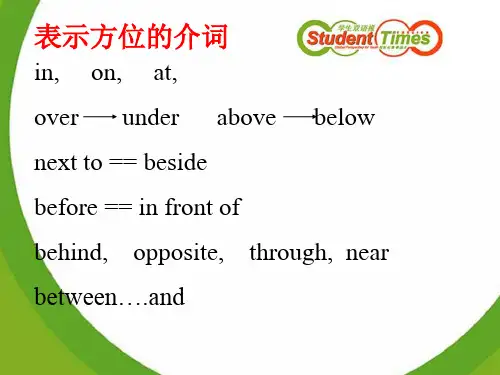

方位介词用法总结方位介词主要用于描述物体之间的相对位置关系。
以下是一些常见的方位介词及其用法的总结:1.in:表示某物在另一物的内部。
例如,“The book is in the box.”(书在盒子里。
)2.on:表示某物在另一物的上面,且两者接触。
例如,“The book is on the table.”(书在桌子上。
)3.above:表示某物在另一物的垂直上方,两者可以不接触。
例如,“The plane is above the clouds.”(飞机在云的上方。
)4.over:表示某物在另一物的正上方,并且通常有一定的垂直距离。
例如,“The bridge is over the river.”(桥在河的正上方。
)5.below:表示某物在另一物的垂直下方。
例如,“The key is below the door.”(钥匙在门的下方。
)6.under:表示某物在另一物的下方,且两者接触。
例如,“The cat is under the table.”(猫在桌子下。
)7.beside:表示某物在另一物的旁边。
例如,“The chair is beside the table.”(椅子在桌子的旁边。
)8.behind:表示某物在另一物的后面。
例如,“The dog is behind the door.”(狗在门的后面。
)9.in front of:表示某物在另一物的前面。
例如,“The car is in front of the house.”(车在房子的前面。
)10.between:表示某物在两者之间。
例如,“The apple is between the two oranges.”(苹果在两个橙子之间。
)请注意,这些方位介词有时会根据语境和具体的物体有所变化,以上总结仅为一般性的用法。
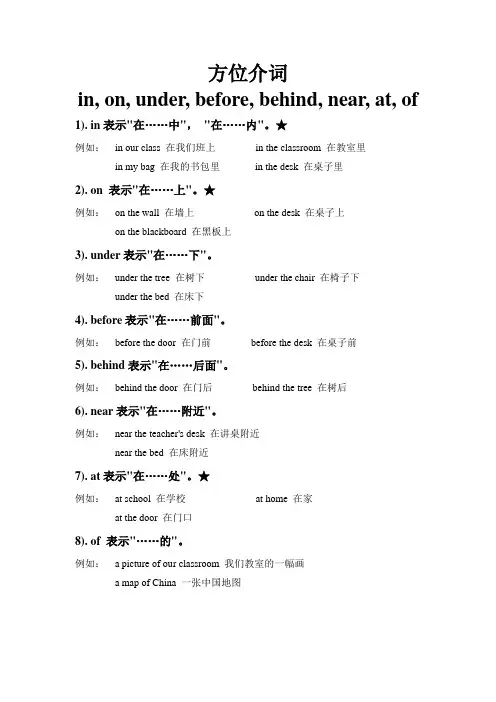
方位介词in, on, under, before, behind, near, at, of 1). in表示"在……中","在……内"。
★例如:in our class 在我们班上in the classroom 在教室里in my bag 在我的书包里in the desk 在桌子里2). on 表示"在……上"。
★例如:on the wall 在墙上on the desk 在桌子上on the blackboard 在黑板上3). under表示"在……下"。
例如:under the tree 在树下under the chair 在椅子下under the bed 在床下4). before表示"在……前面"。
例如:before the door 在门前before the desk 在桌子前5). behind表示"在……后面"。
例如:behind the door 在门后behind the tree 在树后6). near表示"在……附近"。
例如:near the teacher's desk 在讲桌附近near the bed 在床附近7). at表示"在……处"。
★例如:at school 在学校at home 在家at the door 在门口8). of 表示"……的"。
例如: a picture of our classroom 我们教室的一幅画a map of China 一张中国地图。
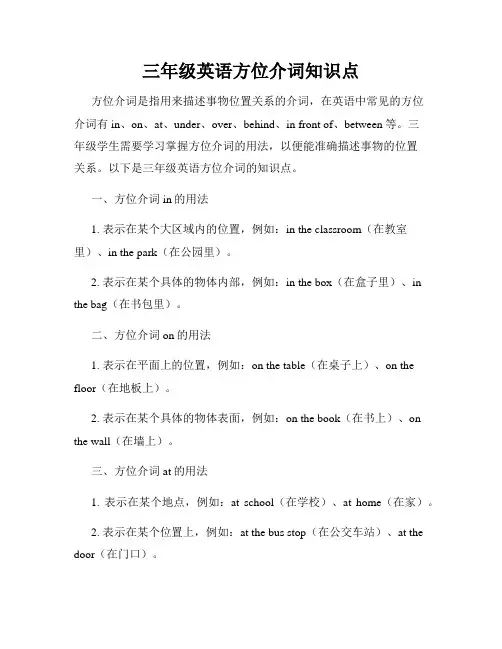
三年级英语方位介词知识点方位介词是指用来描述事物位置关系的介词,在英语中常见的方位介词有in、on、at、under、over、behind、in front of、between等。
三年级学生需要学习掌握方位介词的用法,以便能准确描述事物的位置关系。
以下是三年级英语方位介词的知识点。
一、方位介词in的用法1. 表示在某个大区域内的位置,例如:in the classroom(在教室里)、in the park(在公园里)。
2. 表示在某个具体的物体内部,例如:in the box(在盒子里)、in the bag(在书包里)。
二、方位介词on的用法1. 表示在平面上的位置,例如:on the table(在桌子上)、on the floor(在地板上)。
2. 表示在某个具体的物体表面,例如:on the book(在书上)、on the wall(在墙上)。
三、方位介词at的用法1. 表示在某个地点,例如:at school(在学校)、at home(在家)。
2. 表示在某个位置上,例如:at the bus stop(在公交车站)、at the door(在门口)。
四、方位介词under的用法1. 表示在某物体下面,例如:under the tree(在树下)、under the bed(在床下)。
五、方位介词over的用法1. 表示在某物体上方,例如:over the bridge(在桥上)、over the head(在头上)。
六、方位介词behind的用法1. 表示在某物体的后面,例如:behind the chair(在椅子后面)、behind the car(在车后面)。
七、方位介词in front of的用法1. 表示在某物体的前面,例如:in front of the house(在房子前面)、in front of the mirror(在镜子前面)。
八、方位介词between的用法1. 表示在两个物体之间,例如:between the two trees(在两棵树之间)、between the two houses(在两座房子之间)。

方位介词在英语中用于描述事物之间的相对位置关系,它们通常用来回答“在哪里”或“到哪里”的问题。
以下是一些常见的英语方位介词以及它们的主要用法:1.“In(在)表示某物在一个封闭的区域内。
例句:There“is“a“cat“in“the“box.2.“On(在…上面):表示某物位于另一物体的表面上。
例句:The“book“is“on“the“table.3.“Under(在…下面):表示某物位于另一物体的底部。
例句:The“shoes“are“under“the“bed.4.“Next“to(紧邻,旁边):表示某物位于另一物体的旁边。
““例句:The“car“is“parked“next“to“the“tree.5.“Between(在…之间):表示两个物体之间的位置关系。
例句:The“library“is“between“the“school“and“the“park.6.“Behind(在…后面):表示某物位于另一物体的背后。
例句:The“sun“sets“behind“the“mountains.7.“In“front“of(在…前面):表示某物位于另一物体的前面。
例句:There“is“a“garden“in“front“of“the“house.8.“Among(在…之中):表示某物位于一群物体中。
例句:She“found“her“keys“among“the“books.9.“Above(在…上方):表示某物位于另一物体的上方。
例句:The“bird“is“flying“above“the“clouds.10.“Below(在…下方):表示某物位于另一物体的下方。
例句:The“fish“are“swimming“below“the“surface.11.“In“the“middle“of(在…中间):表示某物位于另一物体的中间。
例句:The“restaurant“is“in“the“middle“of“the“street.12.“On“top“of(在…顶部):表示某物位于另一物体的顶部。