
英语语法-动词不定式课件
- 格式:ppt
- 大小:1.86 MB
- 文档页数:22

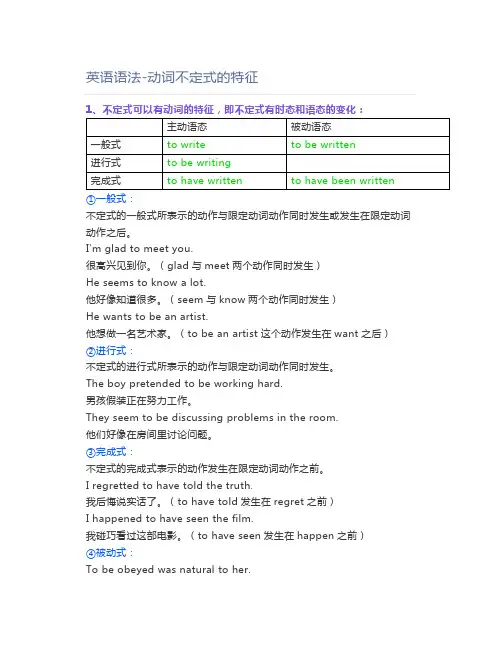
英语语法-动词不定式的特征
1、不定式可以有动词的特征,即不定式有时态和语态的变化:
主动语态 被动语态
一般式 to write to be written
进行式 to be writing
完成式 to have written to have been written
①一般式:
不定式的一般式所表示的动作与限定动词动作同时发生或发生在限定动词动作之后。
I'm glad to meet you.
很高兴见到你。(glad与meet两个动作同时发生)
He seems to know a lot.
他好像知道很多。(seem与know两个动作同时发生)
He wants to be an artist.
他想做一名艺术家。(to be an artist这个动作发生在want之后)
②进行式:
不定式的进行式所表示的动作与限定动词动作同时发生。
The boy pretended to be working hard.
男孩假装正在努力工作。
They seem to be discussing problems in the room.
他们好像在房间里讨论问题。
③完成式:
不定式的完成式表示的动作发生在限定动词动作之前。
I regretted to have told the truth.
我后悔说实话了。(to have told发生在regret之前)
I happened to have seen the film.
我碰巧看过这部电影。(to have seen发生在happen之前)
④被动式:
To be obeyed was natural to her. 她天性要别人听命于她。
The book is intended to be read and not to be torn.
这书是供人阅读而不是供人撕毁的。
2、不定式也有名词性质
不定式的名词性质表现在:在句中可作主语、宾语等。

第十一讲
动词不定式
一、构成与特征
动词不定式是动词的一种非限定形式, 由“to + 动词原形”构成, 在句中起名词、形容词或副
词的作用, 同时也保留动词的一些特征, 可以带宾语或状语, 等等。例如:
He t ried to work out the problem in f ive minutes . 他试图在五分钟之内算出这道题。
(带宾语和状语)
I am sorry to have kept you waiting . 对不起, 让您久等了。(完成式)
I am glad to have been given a chance to visit your country . 我很高兴有机会访问贵国。
(完成时, 被动语态)
不定式在许多场合具有情态意义。作主语时, 相当于一个带有情态动词的主语从句; 作定
语时, 相当于一个带有情态动词的定语从句; 作宾语时, 相当于一个带有情态动词的宾语从
句; 作目的状语时, 相当于由so that 或in order that 引导的目的状语从句。例如:
It is right for her to say so . ( = It is right that she should say so .)
He has a lot of work to do . ( = . . .that he should/ must do .)
I don..t know where to get the ticket . ( = . . .where I could get the ticket .)
She opened the door for the children to come in . ( = . . .so that the children might come
in .)
二、功能
1 . 作主语
To hesitate means failure . 犹豫不决就意味着失败。
英语讲练 责编 闵 芳/mjn n 18@163.corn
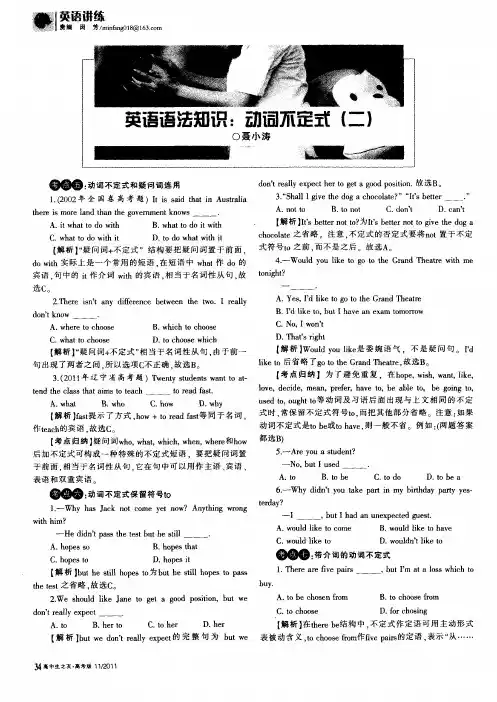
露黼:动词不定式和疑问词连用 1.(2002年全国卷高考题)It is said that in Australia there is more land than the government knows—————————. A.it what to do with B.what to do it with C.what to do with it D.to do what with it 【解析】‘‘疑问词+不定式”结构要把疑问词置于前面, do with实际上是一个常用的短语.在短语中what作d0的 宾语,句中的it作介词with的宾语,相当于名词性从句,故 选C。 2.There isn’t any difference between the two.I really don t know. A.where to choose B.which to choose C.what tO choose D.to choose which 【解析】“疑问词+不定式”相当于名词性从句,由于前一 句出现了两者之间.所以选项C不正确.故选B。 3.(2011年辽宁省高考题)Twenty students want to at— tend the class that aims to teachto read fast. A.what B.who C.how D.why 【解析】fast提示了方式,how+to read fast等同于名词, 作teach的宾语.故选C 【考点归纳】疑问词who,what,which,when,where ̄1/how 后加不定式可构成一种特殊的不定式短语.要把疑问词置 于前面.相当于名词性从句.它在句中可以用作主语、宾语、 表语和双重宾语。 0∞:动词不定式保留符号c0 1.一Why has Jack not come yet now?Anything wrong with him? -He didn’t pass the test but he still——. A.hopes SO B.hopesthat C.hopes tO D.hopes it 【解析】but he still hopes to为but he still hopes to pass the test之省略,故选C。 2.We should like Jane to get a good position,but we don’t really expect A.to B.her to C.to her D.her t解析lbut we don’t really expect的完整句为but we 34高中生之友·高考版11/20"11 don’t really expect her to get a good position.故选B。 3.“Shall I give the dog a chocolate?…‘It’S better——.” A.notto B.to not C.don’t D.can’t 【解析】It’S better not to?为It’S better not to give the dog a chocolate之省略。注意,不定式的否定式要将not置于不定 式符号tO之前,而不是之后。故选A。 4.一Would you like to go to the Grand Theatre with me tonight? 一—————● A.Yes,I'd like to go to the Grand Theatre B.I'd like to,but I have an exam tomorrow C.No。1won’t D.That's right 【解析】Would you like是委婉语气,不是疑问句。I'd like to后省略了go to the Grand Theatre,故选B。 【考点归纳】为了避免重复, ̄hope,wish,want,like, love,decide,mean,prefer,have to,be able to,be going to, used to.ought to等动词及习语后面出现与上文相同的不定 式时,常保留不定式符号tO,而把其他部分省略。注意:如果 动词不定式是to be或to have,则一般不省。例如:(两题答案 都选B1 5.一Are you a student? 一No,but I used—__. A.t0 B.t0 be C.to do D.to be a 6.一Why didn’t you take part in my birthday party yes terday? -I——~,but I had an unexpected guest. A.would like to come B.would like to have C.would like to D.wouldn’t like tO 0日婚:带介词的动词不定式 1.There are five pairs——,but I'm at a loss which to buy. A.to be chosenfrom B.to choosefrom C.to choose D.for chosing 【解析】在there be结构中,不定式作定语可用主动形式 表被动含义 to choose fromZd ̄five pairs! ̄,

初中英语语法动词不定式专项练习
1. Charles Babbage is generally considered ________the first
computer.
A. to have invented B. inventing C. to invent D. having invented
2. Little Jim should love ________to the theatre this evening.
A. to be taken B. to take C. being taken D. taking
3. — I usually go there by train.
— Why not ________by boat for a change?
A. to try going B. trying to go C. to try and go D. try going
4. John was made ________the truck for a week as a
punishment.
A. to wash B. washing C. wash D. to be washing
5. She reached the top of the hill and stopped ________on a
big rock by the side of the path.
A. to have rested B. resting C. to rest D. rest
6. She pretended________ me when I passed by.
A. not to see B. not seeing C. to not see D. having not seen
7. Though he had often made his sister ________, today he was