
牛津译林版英语9AUnit3TeenageproblemsRevision课件(
- 格式:pdf
- 大小:570.66 KB
- 文档页数:1

初中-英语-打印版
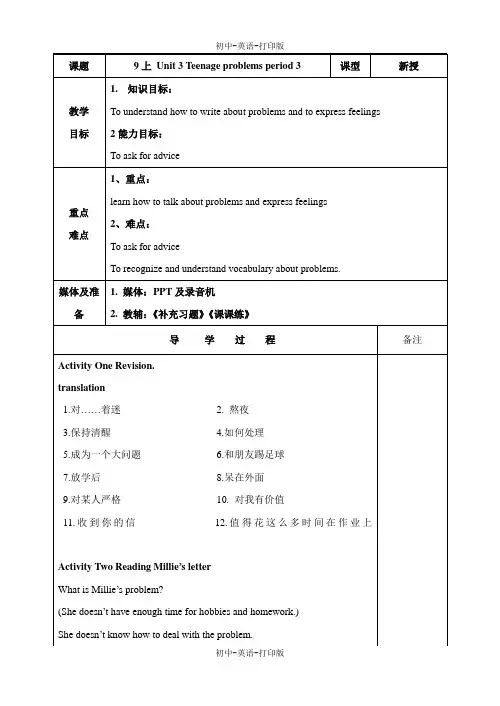
初中-英语-打印版 课题 9上 Unit 3 Teenage problems period 3 课型 新授
教学
目标 1. 知识目标:
To understand how to write about problems and to express feelings
2能力目标:
To ask for advice
重点
难点 1、重点:
learn how to talk about problems and express feelings
2、难点:
To ask for advice
To recognize and understand vocabulary about problems.
媒体及准备 1. 媒体:PPT及录音机
2. 教辅:《补充习题》《课课练》
导 学 过 程 备注
Activity One Revision.
translation
1.对……着迷________________ 2. 熬夜_________________
3.保持清醒 _________________ 4.如何处理 ___________________
5.成为一个大问题____________ 6.和朋友踢足球________________
7.放学后____________________ 8.呆在外面 _______________
9.对某人严格 ________________ 10. 对我有价值________________
11.收到你的信______________ 12.值得花这么多时间在作业上
____________________________
Activity Two Reading Millie’s letter
What is Millie’s problem?
(She doesn’t have enough time for hobbies and homework.)

Dear Mr Friend.
I am Millie, and I am a Grade 9 student. I have a problem, and I do not know how I should deal
with it.
I have a lot of homework every day, and I have no choice but to do it. I often have to stay up late.
Then I sometimes find it hard to stay awake the next day.
I know it is important to finish all my homework on time. However. I hardly have any spare time
for my hobbieslike volleyball and music.
I cannot imagine my life without hobbies. I often doubt whether it is worth spending so much time
on homework.
I dream of a long holiday so that I could have some more time for my hobbies. What should I do?
Can you offer me some suggestions? I hope to hear from you soon.
Best wishes, Millie Wang
Dear Mr Friend.
My name is Simon, and I am in Grade 9. I am crazy about football. I love watching football,

牛津译林版英语九年级上册 Unit 3 《Teenage problems.》 说课稿5
一. 教材分析
《牛津译林版英语九年级上册 Unit 3 Teenage problems》是人教版初中英语教材的一个单元,主题是关于青少年问题的讨论。本节课的内容贴近学生的生活,旨在引导学生关注青少年时期可能遇到的问题,并通过对话、阅读等方式,提高学生的英语听说读写能力。教材内容丰富,包括对话、阅读理解、词汇练习和写作等,有助于学生全面提高英语水平。
二. 学情分析
九年级的学生已经具备一定的英语基础,对于日常生活中的交流和简单阅读已经没有太大的困难。但是,他们的英语听说读写能力还有待进一步提高,特别是在口语表达和写作方面。此外,青少年时期的问题复杂多样,学生可能对此有一定的了解,但可能缺乏深入的思考和探讨。
三. 说教学目标
1. 知识目标:学生能够掌握本节课的生词和短语,理解对话和阅读材料,掌握相关的语法知识。
2. 能力目标:学生能够用英语进行日常交流,提高听说读写能力,特别是口语表达和写作能力。
3. 情感目标:学生能够认识到青少年时期可能遇到的问题,学会如何面对和解决这些问题,培养积极健康的心态。
四. 说教学重难点
1. 重点:学生能够掌握本节课的生词和短语,理解对话和阅读材料,掌握相关的语法知识。
2. 难点:学生能够用英语准确地表达青少年时期的问题,并在交流中运用所学知识。
五. 说教学方法与手段
1. 教学方法:采用任务型教学法,让学生在完成任务的过程中,提高英语听说读写能力。
2. 教学手段:利用多媒体课件、图片、卡片等辅助教学,激发学生的学习兴趣,提高课堂效果。
六. 说教学过程
1. 导入:通过谈论青少年时期的问题,引起学生的兴趣,导入新课。 2. 呈现:展示图片和卡片,引导学生学习生词和短语。
3. 实践:学生进行对话练习,运用所学知识。
4. 阅读:学生阅读阅读材料,理解文章内容,进行相关活动。
初中-英语-打印版
初中-英语-打印版 9A Unit 3 Teenage problems(2)
第三单元 青少年问题
重点难点
21.I hope I cam offer you some useful suggestions.我希望我能够提供一些有用的建议给你。
▲offer 用作动词,意为“提供;”“为…提供机会,给予”常用短语“offer sb. sth或offer sth. For sb.”意思是“为某人提供某物”。如:
①I offered him a glass of wine.我敬了他一杯酒。
① will you offer the guests some coffee?请你给客人拿一些咖啡好吗?
② I﹐ve been offered a job in Japan.日本有份工作要聘请我去做。
③ The company has offered a high salary.公司提出高薪招聘。
④ She offered a reward for the return of her lost bracelet.她为寻回遗失的手镯提出以报酬答谢。
⑤ He offered §3,000 for the house.他提出了3000英镑买这间房子。
⑥ We offered him the house for $ 20,000.我们要他出20,0000美元买这间房子。
offer to do sth.的意思是“主动提出做某事。”如:
She offered to carry the box for her mother. 她主动提出要帮她母亲拿箱子。
We offered to leave. 我们表示要走了。
He offered to lend me his bike.他表示要把自行车借给我。
Never to teach fish to swim.莫班门弄斧。