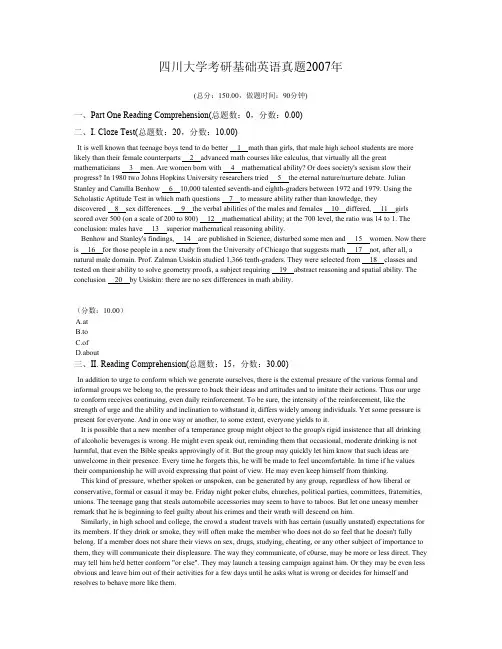
四川大学考研基础英语真题2007年(总分:150.00,做题时间:90分钟)一、Part One Reading Comprehension(总题数:0,分数:0.00)二、Ⅰ. Cloze Test(总题数:20,分数:10.00)It is well known that teenage boys tend to do better 1 math than girls, that male high school students are more likely than their female counterparts 2 advanced math courses like calculus, that virtually all the great mathematicians 3 men. Are women born with 4 mathematical ability? Or does society's sexism slow their progress? In 1980 two Johns Hopkins University researchers tried 5 the eternal nature/nurture debate. Julian Stanley and Camilla Benhow 6 10,000 talented seventh-and eighth-graders between 1972 and 1979. Using the Scholastic Aptitude Test in which math questions 7 to measure ability rather than knowledge, theydiscovered 8 sex differences. 9 the verbal abilities of the males and females 10 differed, 11 girls scored over 500 (on a scale of 200 to 800) 12 mathematical ability; at the 700 level, the ratio was 14 to 1. The conclusion: males have 13 superior mathematical reasoning ability.Benhow and Stanley's findings, 14 are published in Science, disturbed some men and 15 women. Now there is 16 for those people in a new study from the University of Chicago that suggests math 17 not, after all, a natural male domain. Prof. Zalman Usiskin studied 1,366 tenth-graders. They were selected from 18 classes and tested on their ability to solve geometry proofs, a subject requiring 19 abstract reasoning and spatial ability. The conclusion 20 by Usiskin: there are no sex differences in math ability.(分数:10.00)A.atB.toC.ofD.about三、Ⅱ. Reading Comprehension(总题数:15,分数:30.00)In addition to urge to conform which we generate ourselves, there is the external pressure of the various formal and informal groups we belong to, the pressure to back their ideas and attitudes and to imitate their actions. Thus our urge to conform receives continuing, even daily reinforcement. To be sure, the intensity of the reinforcement, like the strength of urge and the ability and inclination to withstand it, differs widely among individuals. Yet some pressure is present for everyone. And in one way or another, to some extent, everyone yields to it.It is possible that a new member of a temperance group might object to the group's rigid insistence that all drinking of alcoholic beverages is wrong. He might even speak out, reminding them that occasional, moderate drinking is not harmful, that even the Bible speaks approvingly of it. But the group may quickly let him know that such ideas are unwelcome in their presence. Every time he forgets this, he will be made to feel uncomfortable. In time if he values their companionship he will avoid expressing that point of view. He may even keep himself from thinking.This kind of pressure, whether spoken or unspoken, can be generated by any group, regardless of how liberal or conservative, formal or casual it may be. Friday night poker clubs, churches, political parties, committees, fraternities, unions. The teenage gang that steals automobile accessories may seem to have to taboos. But let one uneasy member remark that he is beginning to feel guilty about his crimes and their wrath will descend on him.Similarly, in high school and college, the crowd a student travels with has certain (usually unstated) expectations for its members. If they drink or smoke, they will often make the member who does not do so feel that he doesn't fully belong. If a member does not share their views on sex, drugs, studying, cheating, or any other subject of importance to them, they will communicate their displeasure. The way they communicate, of c0urse, may be more or less direct. They may tell him he'd better conform "or else". They may launch a teasing campaign against him. Or they may be even less obvious and leave him out of their activities for a few days until he asks what is wrong or decides for himself and resolves to behave more like them.The urge to conform on occasion conflicts with the tendency to resist change. If group we are in advocates an idea or action that is new and strange to us, we can be torn between seeking their acceptance and maintaining the security of familiar ideas and behavior. In such cases, the way we turn will depend on which tendency is stronger in us or which value we are more committed to. More often, however, the two tendencies do not conflict but reinforce each other. For we tend to associate with those whose attitudes and actions are similar to our own.The writer most probably discusses ______ in the previous part of the text.(分数:10.00)A.advantages that conformity brings usB.internal urge we have to conform with othersC.the definition of conformityD.the necessity of conformityThe world is going through the biggest wave of mergers and acquisitions ever witnessed. The process sweeps from hyperactive America to Europe and reaches the emerging countries with unsurpassed might. Many in these countries are looking at this process and worrying: "Won't the wave of business concentration turn into an uncontrollable anti-competitive force?"There's no question that the big are getting bigger and more powerful. Multinational corporations accounted for less than 20% of international trade in 1982. Today the figure is more that 25% and growing rapidly. International affiliates account for fast-growing segment of production in economies that open up and welcome foreign investment. In Argentina, for instance, after the reforms of the early 1990s, multinationals went from 43% to almost 70% of the industrial production of the 200 largest firms. This phenomenon has created serious concerns over the role of smaller economic firms, of national businessmen and over the ultimate stability, of the world economy.I believe that the most important forces behind the massive M&A wave are the same that underlie the globalization process: falling transportation, and communication costs, lower trade and investment barriers and enlarged markets that require enlarged operations capable of meeting customers' demands. All these are beneficial, not detrimental to consumers. As productivity grows, the world's wealth increases.Examples of benefits or costs of the current concentration-wave are scanty. Yet it is hard to imaging that the merge of a few oil firms today could recreate the same threats to competition that were feared nearly a century ago in the U. S., when the Standard Oil trust was broken up. The mergers of telecom companies, such as World Corn, hardly seem to bring higher prices for consumers or a reduction in the pace of technical progress. On the contrary, the price of communications is coming down fast. In cars, too, concentration is increasing—witness Daimler and Chrysler, Renault and Nissan—but it does not appear that consumers are being hurt.Yet the fact remains that the merger movement must be watched. A few weeks ago, Alan Greenspan warned against the mega mergers in the banking industry. Who is going to supervise, regulate and operate, as lender of last resort with the gigantic banks that are being created? Won't multinationals shift production from one place to another when a nation gets too strict about infringements to fair corn petition? And should one country take upon itself the role of "defending competition" on issues that affect many other nations, as in the U. S.What is the typical trend of businesses today?(分数:10.00)A.To take in more foreign fundsB.To invest more abroadC.To combine and become bigger.D.To trade with more countriesDiscussion of the assimilation of Puerto Ricans in the United States has focused on two factors: social standing and the loss of national culture. In general, excessive stress is placed on one fact or the other, depending on whether fine commentator is North American or Puerto Rica. Many American Social scientists, such as Oscar Handlin, Joseph Fitzpatrick, and Oscar Lewis, consider Puerto Ricans as the most recent in a long line of ethnic entrants to occupy the lowest rung on the social ladder. Such a "socio-demographic" approach tends to regard assimilation as a benign process, taking for granted increased economic advantage and inevitable cultural integration, in a supposedly egalitarian context. However, this approach fails to take into account the colonial nature of the Puerto Rican case, with this group, unlike their European predecessors, coming from a nation politically subordinated to the United States.Even the "radical" critiques of this mainstream research model, such as the critique developed in Divided Society, attach the issue of ethnic assimilation too mechanically to factors of economic and social mobility, and are thus unable to illuminate the cultural subordination of Puerto Ricans as a colonial minority.In contrast, the "Colonialist" approach of island-based writers such as Eduardo Seda-Bonilla, Manuel Maldonado-Denis, and Lius Nieves-Falcon tends to view assimilation as the forced loss of national culture in an unequal contest with imposed foreign values. There is, of course, a strong tradition of culture accommodation among other Puerto Rican thinkers. The writings of Eugenio Fernandez Mendez clearly exemplify this tradition, and many supporters of Puerto Rico's commonwealth status share the same universalizing orientation. But the Puerto Rican intellectuals who have written most about the assimilation process in the United States all advance cultural nationalist views, advocating the preservation of minority cultural distinctions and rejecting what they see as the subjugation of colonial nationalities. This cultural and political emphasis is appropriate, but the colonialist thinkers misdirect it, overlooking the class relations at work in both Puerto Rican and North American history. They pose the clash of national cultures as absolute polarity, with each culture understood as static and undifferentiated. Yet both the Puerto Rican and North American traditions have been subject to constant challenge from cultural forces within their own societies; forces that may move toward each other in ways that cannot be written off as mere "assimilation". Consider, for example, the indigenous and Afro-Caribbean traditions in Puerto Rican culture and how they influence and are influenced by other Caribbean cultures and Black cultures in the United States. The elements of Coercion and inequality, so central to cultural contact according to the colonialist framework, play no role in this kind of convergence of racially and ethnically different elements of the same class.The author's main purpose is to ______.(分数:10.00)A.criticize the emphasis on social standing in discussions of the assimilation of Puerto Ricans in the United StatesB.support the thesis that assimilations has not been a benign process for Puerto RicansC.defend a view of the assimilation of Puerto Ricans that emphasizes the preservation of national cultureD.Indicate deficiencies in two schools of thought on the assimilation of Puerto Ricans in the United States四、Part Two English-Chinese Translation(总题数:0,分数:0.00)五、Passage 1(总题数:1,分数:15.00)5. Schools should consider using signal-blocking devices to prevent pupils using mobile phone text messaging to cheat in examinations, a leading expert on exam fraud said yesterday.Jean Underwood, a Professor of Psychology at Nottingham Trent university, said that although most of the debate on the use of new technology and cheating had focused on universities, the problem was likely to be more widespread in schools."The problems of academic dishonesty may be less well researched in the school system than in the tertiary education sector, but all the evidence points to the problem being both real and on a growing scale," She said.(分数:15.00)__________________________________________________________________________________________六、Passage 2(总题数:1,分数:15.00)6. As she sat facing the open window, she could see in the open square before her house the tops of trees that were all aquiver with the new spring life. The delicious breath of rain was in the air. In the street below a peddler was crying his wars. The notes of a distant song which some one was singing reached her faintly, and countless sparrows were twittering in the eaves. There were patches of blue sky showing here and there through the clouds that had met and piled one above the other in the west facing her window.(分数:15.00)__________________________________________________________________________________________七、Part Three Chinese-English Translation(总题数:1,分数:30.00)7. 当我们从文化的视角放眼全球之际,对本土文化的认同与对未来发展方向的选择成为首要问题。