钢管桩承载力计算公式
- 格式:doc
- 大小:15.66 KB
- 文档页数:6
钢管桩承载力计算公式
英文回答:
The calculation of the bearing capacity of steel pipe
piles is an important aspect in geotechnical engineering.
There are several formulas and methods available for this
calculation, depending on the specific conditions and
requirements of the project.
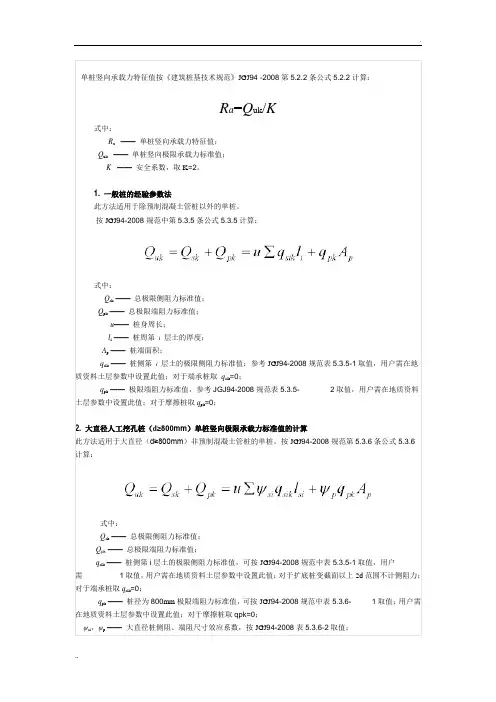
One commonly used formula is the Meyerhof equation,
which calculates the ultimate bearing capacity of a steel
pipe pile in cohesionless soils. The equation is given as:
Qu = A Nq γ D.
Where:
Qu is the ultimate bearing capacity of the pile.
A is the cross-sectional area of the pile.
Nq is the bearing capacity factor.
γ is the unit weight of the soil.
D is the diameter of the pile.
The bearing capacity factor, Nq, is determined based on
the angle of internal friction of the soil. It can be
obtained from tables or charts available in geotechnical
engineering textbooks or software.
Another commonly used formula is the Brinch Hansen
equation, which takes into account the effect of skin
friction on the bearing capacity of the pile. The equation
is given as:
Qu = A c Nc + A σ' Nq + A α Nγ。
Where:
Qu is the ultimate bearing capacity of the pile.
A is the cross-sectional area of the pile.
c is the cohesion of the soil.
Nc is the bearing capacity factor for cohesion.
σ' is the effective vertical stress at the pile tip.
α is the adhesion factor.
Nγ is the bearing capacity factor for friction.
The values of the bearing capacity factors, Nc and Nγ,
can also be obtained from tables or charts based on the
soil properties.
In addition to these formulas, there are other methods
available for calculating the bearing capacity of steel
pipe piles, such as the load test method and the pile
driving formula. These methods take into account additional
factors such as the pile length, soil properties, and pile installation method.
中文回答:
钢管桩承载力的计算是岩土工程中的一个重要方面。根据项目的具体条件和要求,有几种公式和方法可用于计算承载力。
一种常用的公式是Meyerhof公式,用于计算无内聚力土壤中钢管桩的极限承载力。该公式如下:
Qu = A Nq γ D.
其中:
Qu为桩的极限承载力。
A为桩的横截面积。
Nq为承载力系数。
γ为土壤的单位重量。
D为桩的直径。
承载力系数Nq根据土壤的内摩擦角确定,可以从岩土工程教材或软件中的表格或图表中获得。
另一种常用的公式是Brinch Hansen公式,考虑了桩的摩擦力对承载力的影响。该公式如下:
Qu = A c Nc + A σ' Nq + A α Nγ。
其中:
Qu为桩的极限承载力。
A为桩的横截面积。
c为土壤的内聚力。
Nc为内聚力的承载力系数。
σ'为桩尖处的有效垂直应力。
α为粘附系数。
Nγ为摩擦力的承载力系数。
承载力系数Nc和Nγ的值也可以根据土壤性质从表格或图表中获得。
除了这些公式,还有其他方法可用于计算钢管桩的承载力,如荷载试验方法和桩锤公式。这些方法还考虑了桩的长度、土壤性质和桩的安装方法等其他因素。