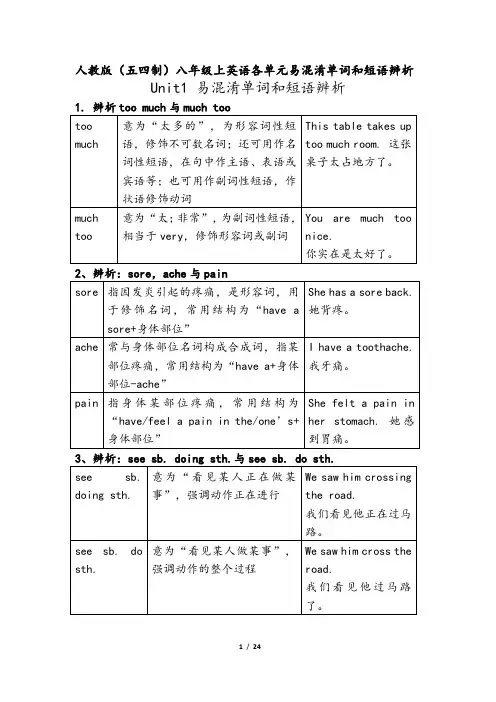
人教版英语八年级下册Unit8 易混淆单词和短语辨析
- 格式:doc
- 大小:61.00 KB
- 文档页数:4
Unit8 易混淆单词和短语辨析
1. 辨析: take, bring, fetch, carry
bring bring带来,拿来,表示把某物或某人从别处带到说话人的地方来,动作由远及近。
fetch fetch去拿来/找来/取来,表示从此处到其他地方把某人找来,或把某物取来,指的是一种往返运动。
take take带去,带走,拿走,其反义词是bring。表示把某物或某人从说话者的地方带到其他地方,动作由近及远。take.... to… 意为“把(某人或某物)拿到/带到(某处)去”,是一个固定词组,to是介词,当地点是here,there等副词时,介词to要去掉。
carry carry携带,可带来也可带去,可肩挑手提,也可车拉船运,无方向性。
例:I want to take these books there.
我想把这些书拿到那儿去。
Please ask Uncle Tom to bring you here in August.
请让汤姆大叔八月份带你到这儿来。
Go and fetch some pieces of chalk.
去拿几支粉笔来。
Can you help me carry the box to the classroom?
你能帮我把这个箱子抬到教室吗?
2. 辨析: look like, be like, feel like
look like look like看上去像,指外观上像。
be like be like像……一样,指品德、相貌等,更多侧重表示人的个性特征。
feel like feel like意为“想要(做某事)”,其后接名词或动名词,不能接不定式。另一个意思是“摸起来好像”。
例:She looks like her mother. 她看起来像她妈妈。
What is he like? 他是个什么样的人?
I feel like a cup of tea. 我想喝杯茶。 It feels like silk.它摸起来像丝绸。
3. 辨析: think about, think of, think over
think about think about意为“想,考虑”,指考虑解决某一问題,“考虑”的宾语可由名词、代词、动名词、疑问词引导的不定式或宾语从句充当。
think of think of 意为“思考,想起,考虑”。表示“考虑”的含义时,可与think about互换,后接名词、代词、v.-ing形式或疑问词引导的从句。
think over think over意为“仔细考虑”,其中over为副词,如宾语为名词,位于over前后均可,如果是代词,必须置于think与over之间。
例:I’m thinking about a problem.
我正在考虑一个问题。
He always thinks of others more than himself.
他总是为别人考虑得多,为自己考虑得少。
You’d better think it over before you do it.
在你做这件事之前,你最好先好好考虑一下。
4. 辨析: the number of, a number of
the number of the number of“ ……的数量”,其后接可数名词复数,做主语时,谓语动词用单数。
a number of a number of 许多,其后接可数名词复数,作主语时,谓语动词用复数。
例:The number of the students in our school is 2,000.
我们学校的学生人数为2000。
A number of students are playing on the playground.
许多学生在操场上玩耍。
5. 辨析: such as, for example
such as such as例如。它一般用于列举同类人或事物中的几个例
子,通常放在被列举的事物的前面以及需要说明的事物的后面,其后不能有逗号。
for example for example例如。它常用作插入语,用来举例说明某一论点或情况,一般只举同类人或事物中的一个为例,可位于句首、句中或句末,且用逗号隔开。
例:I have been to a lot of Chinese cities, such as Beijing, Shanghai and Hangzhou.
我去过中国的许多地方,比如北京,上海和杭州。
For example, I like apples.
例如,我喜欢苹果。
6. 辨析:hope, wish
hope 指对实现某一愿望有信心、有把握,后不能跟复合宾语,只能跟动词不定式或从句。
wish 常指难以实现或不能实现的愿望,后可以跟复合宾语,即wish
sb. to do sth.,也可接双宾语。
例:I hope to visit Beijing.
我希望去北京游览。
I wish that I could fly like a bird. 我希望自己能像小鸟一样飞翔。
7. 辨析:already, yet
already 一般用于肯定句,用于疑问句时表示惊讶,出乎意料。常放于句中,实义动词之前,助动词之后。
yet 一般用于否定句或疑问句。常放在句尾,not yet常用在答语中,意为“尚未;还没有”。
如:He has not come yet.他还没有来。
I have already finished my work.我已经完成了工作。
8. 辨析:find, look for, find out
find 强调“寻找”的结果,表“找到了”,后面直接跟名词。
look for 意思是“寻找”,强调“找”的动作,表示找没找到的东西,后面直接跟名词。
find out 意思是“找出,查出,查明”,多指通过调查、询问之后找出、发现无形的、抽象的东西,强调目的。 例:I find my book in the desk. 我发现我的书在课桌里。
I’ll find out who has broken the window. 我要查明谁打碎了玻璃。
I am looking for my missing gloves. 我正在找我的丢失的手套。
9. 辨析:get, arrive, reach
get 是不及物动词,后跟地点名词时要用get to。
arrive 是不及物动词,后跟地点名词时要用arrive in或arrive at。arrive in后跟相对较大的地方,arrive at后跟相对较小的地方。
reach 是及物动词,其后可以直接跟地点名词。
例:I will get to Beijing in two days.
= I will arrive in Beijing in two days.
= I will reach Beijing in two days.
我会在两天后到达北京。
What time did you get/arrive/reach home? 你是几点到家的?
10. 辨析:leave, leave for, leave…for…, leave from
leave 离开,出发,其后接表示地点的名词,构成“leave+地点名词”短语。
leave for 后接表示地点名词表示“动身去某地”。
leave…for… 表示“离开某地去另一地”。
leave from 从……离开,from后的地点是离开的地方。
如:When did you leave London? 你们是什么时候离开伦敦的?
We are leaving for Rome next week.我们下周将要去罗马。
We will leave Beijing for Shanghai.我们将要离开北京去上海。
I’m leaving from school. 我要从学校离开。