AudreyHepburn奥黛丽赫本简介
- 格式:pdf
- 大小:39.41 KB
- 文档页数:4
AudreyHepburn奥黛丽赫本简介
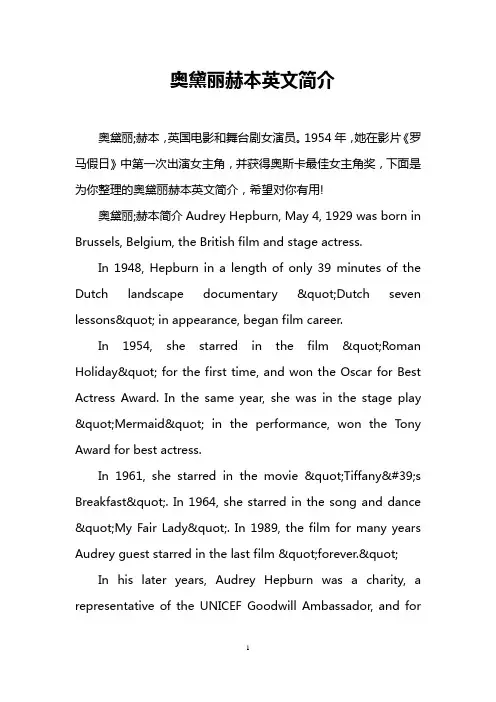
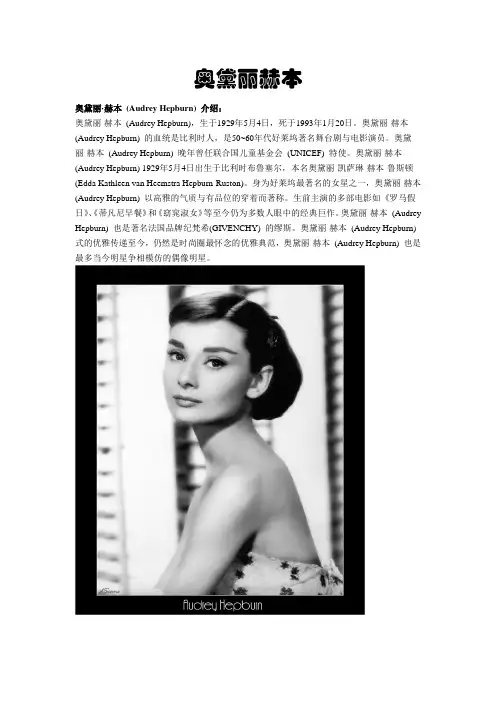
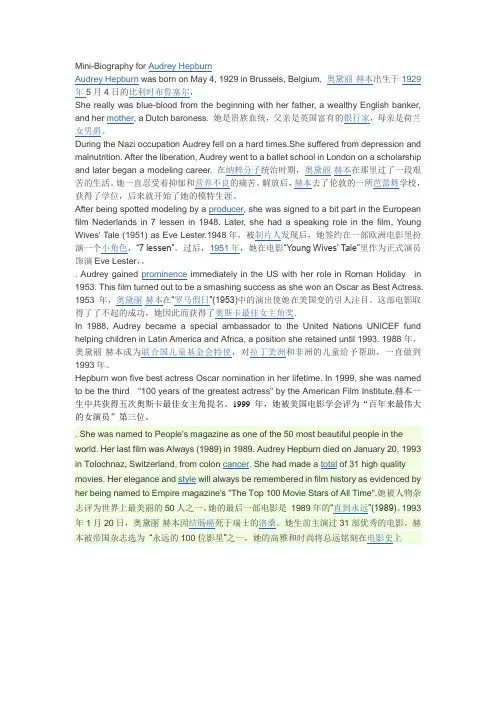
Audrey Hepburn (4 May 1929(1929-05-04) – 20 January 1993) was a British actress and humanitarian.
Born in Ixelles as Audrey Kathleen Ruston, Hepburn spent her childhood chiefly in the Netherlands, including German-
occupied Arnhem, Netherlands, during the Second World War (1939-1945). She studied ballet in Arnhem and then moved to
London in 1948, where she continued to train in ballet and worked as a photographer's model. She appeared in a handful of
European films before starring in the 1951 Broadway play Gigi. Hepburn played the lead female role in Roman Holiday
(1953), winning an Academy Award, a Golden Globe and a BAFTA for her performance. She also won a Tony Award for her
performance in Ondine (1954).
Hepburn became one of the most successful film actresses in the world and performed with such notable leading men as
Gregory Peck, Rex Harrison, Humphrey Bogart, Gary Cooper, Cary Grant, Henry Fonda, William Holden, Fred Astaire, Peter
O'Toole, and Albert Finney. She won BAFTA Awards for her performances in The Nun's Story (1959) and Charade (1963),
and received Academy Award nominations for Sabrina (1954), The Nun's Story (1959), Breakfast at Tiffany's (1961) and Wait
Until Dark (1967).
She starred as Eliza Doolittle in the film version of My Fair Lady (1964), becoming only the third actor to receive $1,000,000
for a film role. From 1968 to 1975 she took a break from film-making, mostly to spend more time with her two sons. In 1976
she starred with Sean Connery in Robin and Marian. In 1989 she made her last film appearance in Steven Spielberg's
Always.
Her war-time experiences inspired her passion for humanitarian work, and although she had worked for UNICEF since the
1950s, during her later life, she dedicated much of her time and energy to the organization. From 1988 until 1992, she
worked in some of the most profoundly disadvantaged communities of Africa, South America and Asia. In 1992, Hepburn
was awarded the Presidential Medal of Freedom in recognition of her work as a UNICEF Goodwill Ambassador. In 1999, she
was ranked as the third greatest female star of all time by the American Film Institute.
Early career
In 1945, after the war, Hepburn left the Arnhem Conservatory and moved to Amsterdam, where she took ballet lessons with
Sonia Gaskell.[17] Hepb urn appeared as a stewardess in a short tourism film for KLM,[18] before travelling with her mother
to London. Gaskell provided an introduction to Marie Rambert, and Hepburn studied ballet at the "Ballet Rambert",
supporting herself with part time work as a model. Hepburn eventually asked Rambert about her future. Rambert assured her
that she could continue to work there and have a great career, but the fact she was relatively tall (1.7m/5.6ft) coupled with her
poor nutrition during the war would keep her from becoming a prima ballerina. Hepburn trusted Rambert's assessment and
decided to pursue acting, a career in which she at least had a chance to excel.[19] After Hepburn became a star, Rambert
said in an interview, "She was a wonderful learner. If she had wanted to persevere, she might have become an outstanding
ballerina."[20]
Hepburn's mother was in menial jobs in order to support them and Hepburn needed to find employment. Since she trained to
be a performer all her life, acting seemed a sensible caree r. She said, "I needed the money; it paid ?3 more than ballet jobs."
[21] Her acting career began with the educational film Dutch in Seven Lessons (1948). She played in musical theatre in
productions such as High Button Shoes and Sauce Piquante. Her theatre work revealed that her voice was not strong and
needed to be developed, and during this time she took elocution lessons with the actor Felix Aylmer.[22] Part time modelling
work was not always available and Hepburn registered with the casting officers of Britain's film studios in the hope of getting
work as an extra.
Hepburn's first role in a motion picture was in the British film One Wild Oat in which she played a hotel receptionist. She
played several more minor roles in Young Wives' Tale, Laughter in Paradise, The Lavender Hill Mob, and Monte Carlo Baby.
During the filming of Monte Carlo Baby Hepburn was chosen to play the lead character in the Broadway play Gigi, which
opened on 24 November, 1951, at the Fulton Theatre and ran for 219 performances.[23] The writer Colette, when she first
saw Hepburn, reportedly said "voilà! There's our Gigi!"[24] She won a Theatre World Award for her performance.[23]
Hepburn's first significant film performance was in the Thorold Dickinson film Secret People (1952), in which she played a
prodigious ballerina. Hepburn did all of her own dancing scenes.