
新视界大学英语综合教程2 unit6
- 格式:ppt
- 大小:5.70 MB
- 文档页数:132
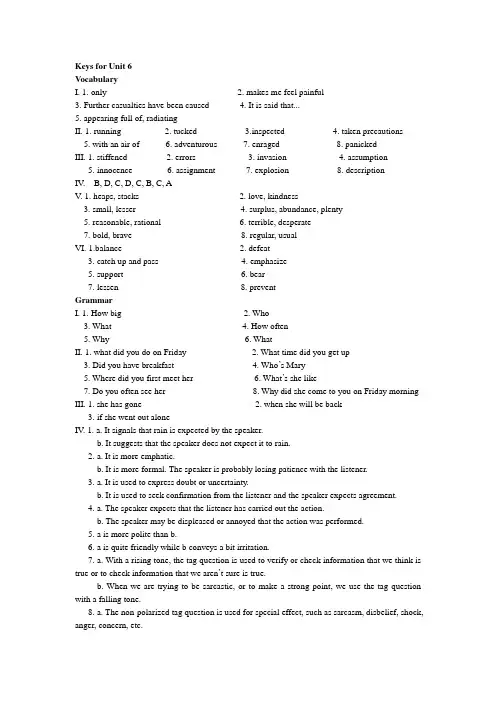
Keys for Unit 6VocabularyI. 1. only 2. makes me feel painful3. Further casualties have been caused4. It is said that...5. appearing full of, radiatingII. 1. running 2. tucked 3.inspected 4. taken precautions5. with an air of6. adventurous7. enraged8. panickedIII. 1. stiffened 2. errors 3. invasion 4. assumption5. innocence6. assignment7. explosion8. descriptionIV. B, D, C, D, C, B, C, AV. 1. heaps, stacks 2. love, kindness3. small, lesser4. surplus, abundance, plenty5. reasonable, rational6. terrible, desperate7. bold, brave 8. regular, usualVI. 1.balance 2. defeat3. catch up and pass4. emphasize5. support6. bear7. lessen 8. preventGrammarI. 1. How big 2. Who3. What4. How often5. Why6. WhatII. 1. what did you do on Friday 2. What time did you get up3. Did you have breakfast4. Who’s Mary5. Where did you first meet her6. What’s she like7. Do you often see her 8. Why did she come to you on Friday morning III. 1. she has gone 2. when she will be back3. if she went out aloneIV. 1. a. It signals that rain is expected by the speaker.b. It suggests that the speaker does not expect it to rain.2. a. It is more emphatic.b. It is more formal. The speaker is probably losing patience with the listener.3. a. It is used to express doubt or uncertainty.b. It is used to seek confirmation from the listener and the speaker expects agreement.4. a. The speaker expects that the listener has carried out the action.b. The speaker may be displeased or annoyed that the action was performed.5. a is more polite than b.6. a is quite friendly while b conveys a bit irritation.7. a. With a rising tone, the tag question is used to verify or check information that we think is true or to check information that we aren’t sure is true.b. When we are trying to be sarcastic, or to make a strong point, we use the tag question with a falling tone.8. a. The non-polarized tag question is used for special effect, such as sarcasm, disbelief, shock, anger, concern, etc.b. The polarized tag question is used to verify or check information.V. ... They had recently sent out their youngest reporter around their local hospitals. He had found that while in some cases the facilities provided for out-patients were extremely good, and waiting rooms were bright and cheerful places, in others, patients were still expected to sit in dreary passages, moving from chair to chair as the queue diminished, no literature was provided, and the canteen, if one existed at all, might be five minutes’ walk away. They felt that far more could be done to obviate such inconvenience, and that some hospitals were not taking full advantage of the various voluntary bodies which offered excellent assistance in the provision of canteens and suchlike.Translation1. 我所到之处满目疮痍,楼房夷为瓦砾,活人成了死尸,生命的欢乐已然封存在这一具具死体之内,这一切时时刻刻都在刺痛着我的心。

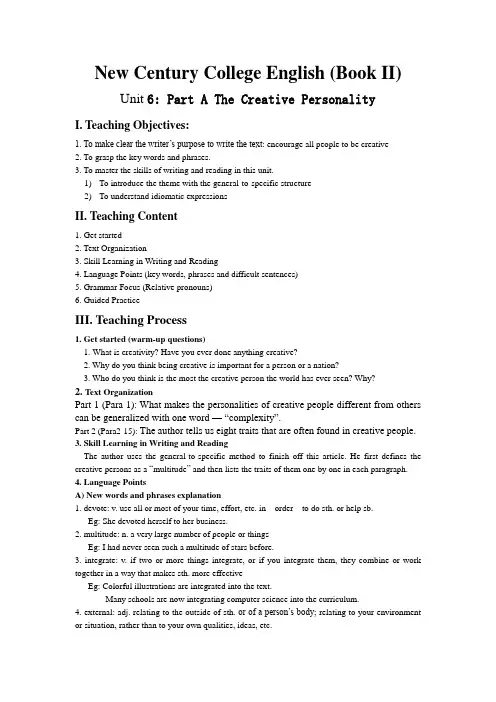
New Century College English (Book II) Unit 6: Part A The Creative PersonalityI. Teaching Objectives:1. To make clear the writer’s purpose to write the text: encourage all people to be creative2. To grasp the key words and phrases.3. To master the skills of writing and reading in this unit.1)To introduce the theme with the general-to-specific structure2)To understand idiomatic expressionsII. Teaching Content1. Get started2. Text Organization3. Skill Learning in Writing and Reading4. Language Points (key words, phrases and difficult sentences)5. Grammar Focus (Relative pronouns)6. Guided PracticeIII. Teaching Process1. Get started (warm-up questions)1. What is creativity? Have you ever done anything creative?2. Why do you think being creative is important for a person or a nation?3. Who do you think is the most the creative person the world has ever seen? Why?2. Text OrganizationPart 1 (Para 1):What makes the personalities of creative people different from others can be generalized with one word —“complexity”.Part 2 (Para2-15): The author tells us eight traits that are often found in creative people.3. Skill Learning in Writing and ReadingThe author uses the general-to-specific method to finish off this article. He first defines the creative persons as a “multitude” and then lists the traits of them one by one in each paragraph.4. Language PointsA) New words and phrases explanation1. devote: v. use all or most of your time, effort, etc. in order to do sth. or help sb.Eg: She devoted herself to her business.2. multitude: n. a very large number of people or thingsEg: I had never seen such a multitude of stars before.3. integrate: v. if two or more things integrate, or if you integrate them, they combine or work together in a way that makes sth. more effectiveEg: Colorful illustrations are integrated into the text.Many schools are now integrating computer science into the curriculum.4. external: adj. relating to the outside of sth. or of a person’s body; relating to your environment or situation, rather than to your own qualities, ideas, etc.Eg: They did it in response to external pressures.5. recharge one’s batteries: (informal) rest or relax in order to get back your energyEg: I ’m going to spend a week in the mountains to recharge my batteries.6. trial: n. a process of testing to find out whether sth. works effectively and is safeEg: The new drug is undergoing clinical trials.7. (go) hand in hand: if two things go hand in hand, they are closely connected;Eg: Wealth and power go hand in hand in most societies.8. insight: n. a sudden clear understanding of sth, especially a complicated situation or ideaEg: The article gives us a real insight into the causes of the present economic crisis.His speech gave us an insight into the problems of education.9. correlate: v. if two or more facts, ideas, etc. correlate or if you correlate them, they are closely connected to each other or one causes the otherEg: He’s trying to find out if these behavior patterns correlate with particular changes in diet.10. superior: adj. 1) of very good qualityEg: This handbag is made of superior leather.2) better, more powerful, more effective, etc. than a similar person or thing, especially one that you are competing against. Eg: This western restaurant is superior to the one we went to last week.11. alternate: v. if two things alternate, or if you alternate them, they happen one after the other ina repeated patternEg: Work alternated with sleep. His moods alternated between happiness and gloom.12. distinguish: v. recognize and understand the difference between two or more things or peopleEg: Small children can’t distinguish between right and wrong.distinguish普通用词,指有能力辨别或实际观察到的区别,强调辨别所需的技巧。

新视界大学英语综合教程2 Unit 6一、Unit 6 概述Unit 6是新视界大学英语综合教程2的第六个单元,本单元主要涉及到“音乐与音乐家”的相关话题。
通过学习本单元,学生们将会了解到不同类型的音乐以及相关的音乐家,提升英语听说读写能力,了解西方文化。
二、学习目标在本单元学习过程中,学生们的学习目标主要包括:1.掌握和使用本单元中的词汇和短语;2.能够理解和运用本单元中的语法知识;3.能够听、说、读、写和翻译与音乐及音乐家相关的话题;4.了解并能够谈论不同类型的音乐及其特点;5.了解并能够介绍一些著名的音乐家。
三、教学内容本单元的教学内容主要包括以下几个方面:1. 词汇与短语本单元中的重要词汇和短语包括:音乐、音乐家、乐器、演奏、作曲家、歌曲、合唱团等。
2. 语法本单元将进一步学习并巩固现在进行时的用法。
3. 阅读与写作学生们将会阅读有关音乐和音乐家的文章,并学习如何写一篇关于自己最喜欢的音乐风格的短文。
4. 听力与口语通过听音频材料和与同学之间的对话练习,学生们将提高他们的听力理解能力和口语表达能力。
5. 文化与背景知识本单元将介绍一些不同类型的音乐和著名音乐家,让学生们了解西方音乐文化。
四、教学方法与活动安排在教学过程中,老师将采用多种教学方法和活动来帮助学生们更好地理解和掌握本单元的内容。
1.多媒体教学法:通过使用多媒体资源,如音频、视频和图片,来提供丰富的学习素材和视听体验,激发学生的学习兴趣。
2.小组讨论与合作学习:通过小组活动和合作学习,让学生们在语言运用和交际能力方面得到锻炼和提高。
3.朗读、听力和口语练习:通过朗读课文、听力练习和口语对话练习,训练学生们的语音语调、听力理解和口语表达能力。
4.互动游戏和角色扮演:通过互动游戏和角色扮演,激发学生的学习兴趣,提高他们的语言运用能力和创造力。
五、评估与考核方式为了检查学生对本单元内容的理解和掌握程度,可以通过以下方式进行评估和考核:1.课堂小测验:在课堂结束时进行小测验,检查学生对本单元重点知识的掌握情况。