附加疑问词与虚拟语气
- 格式:docx
- 大小:290.40 KB
- 文档页数:8
附加疑问词1.当陈述句部分的主语是名词时,反意疑问句的主语必须用人称代词来代替。
Your brother has gone to the library, hasn’t he?The first class begins at eight, doesn’t it?2.当陈述句的主语是指示代词this, that时,反意疑问句的主语用it代替;指示代词是these, those时,反意疑问句的主语用they代替。
That isn’t a useful book, is it?These are important reading materials,aren’t they?3.陈述部分若用指人的不定代词everyone,everybody,someone,no one,somebody,nobody作主语时,其附加问句的主语常用they,有时也用he;若陈述部分用something,nothing,everything 作主语,疑问部分用it.No one is at school now ,aren’t they?Everything is ready now,isn’t it?4.当陈述部分是一个带有that-分句做宾语的主从结构时,附加问句部分一般应与主句的主语和谓语保持对应关系。
You think (that) you are funny, don’t you?He thinks (that) he is going to become a do ctor, doesn’t he?但是以I think,believe ,I suppose, I suspect, I imagine引导的宾语从句,附加疑问部分的主语应与从句的主语保持一致.但要注意否定的转移.I think (that)he is clever,isn’t he?I don’t believe (that) he likes English,does he?5.当陈述句部分是I am…时,反意疑问句部分通常要用aren’t I;如陈述句部分的主语是I am not时,反意疑问句部分通常要用am I。
例I’m late for the meeting, aren’t I?I’m not doing well, am I?6.反意疑问句是“否定陈述句+肯定附加问句”时,英语与汉语的回答习惯存在差异。
英语回答时只看实际情况,若答语的具体内容是肯定的就用“Yes+肯定结构”,答语的具体内容是否定的就用“No+否定结构”,而译成汉语时,则必须把yes译“不是”,把no译成“是的”。
---I don’t think she’ll come by bike, will she?我认为她不会骑自行车,会吗?---Yes, she will.不,她会骑自行车来。
---No, she won’t.是的,她不会骑自行车来。
He is from the USA, isn’t he?Yes, he is . 是的,他是。
No, he isn’t. 不,他不是。
He isn’t from the USA, is he?Yes, he is . 不,他是。
No, he isn’t. 是的,他不是。
7.如果陈述句中含有否定副词never(从不,决不),hardly(几乎不)或其他表示否定代词或形容词,如nothing, no,none no one, nobody, neither, few, little,never ,hardly,seldom 等,则附加问句只能用肯定式。
如:They hardly write to each other, do they?He has found nothing, has he?Few people knew the secret, did they?There is little milk in the bottle, is there?You never saw her ,did you?如果陈述部分的否定词仅带有否定前缀,那么,该陈述部分当肯定句处理,附加问句部分一般仍用否定形式。
He was unhappy, wasn’t he?8.祈使句用于反意疑问句中Let me+动词原形+其它,shall I?--Let me open the door, shall I?--Yes, please. No, thanks.Let’s+动词原形+其它,shall we?--Let’s go for a walk, shall we?--Good idea! /Sorry, I can’t.Let us+动词原形+其它,will you?--Let us play outside,will you?--I’m afraid you can’t.You must finish you homework at first.句型3: 其它形式的祈使句,will you/ won’ t you/ would you?--Come into the classroom, will you?--Please be careful, will you?--Don’t smoke,will you?9.陈述部分带有情态助动词used to 时,附加问句部分可用used to 形式或did 形式。
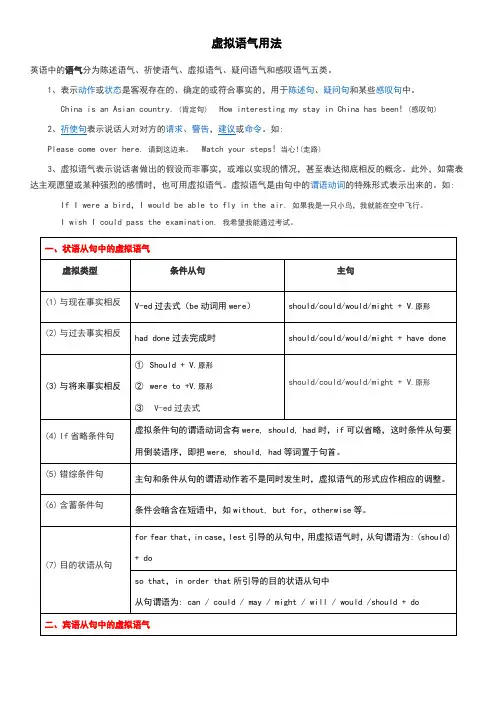
The Allens used to live in the country, usedn’t they?He used to smoke fifty cigarettes a day, didn’t he?10. 另外请注意陈述部分有have(has, had)的情况.(have has为实义动词)You often have headaches, don’t you?She had a good time, didn’t she?Tom has to walk to school, doesn’t he? (现在完成时have has为助动词)He has already had his breakfast, hasn’t he?They haven’t been to Beijing,have they?You’d better turn off the computer, hadn’t you?11.he students must study hard, mustn’t they?(表必须)注意:You must go home now, needn’t you?Yes, I must. No, I needn’t.must be..,isn’t +主语?wasn’t主语(表推测,疑问部分根据其后的动词原形选用适当的形式)He must be a docter,isn’t he?You must be at home yesterday,weren’t you?The groud is wet.It must have rained last night, didn’t it?虚拟语气1.虚拟语气2.错综时间条件句If he were alive now, he might have finished his scientific researches on the bridge building three years ago.如果他现在还活着,他可能三年前就完成了他的桥梁建筑科研工作了。
If it had not snowed yesterday, we would be on the way to Shanghai.要是昨天不下雪的话,我们现在就应该在去上海的路上了。
3.倒装从句中有were, had 或should 时,省略if ,而把它们放在句首。
1. If I were you, I would not do that.Were I you, I would not do that.2.If he should fail in the experiment this time, he would try again.Should he failed in the experiment this time, he would try again.3. If you had not helped me,I should have failed.Had you not helped me, I should have failed.4.含蓄的条件可以用下列方式来表达:(1)介词或介词短语常见的有:but for(要不是), with, without, in that position(在那个位置), in the absence of(没有), under, in, for the fear of…Under a better condition, we would have done much better.Without air, there would be no wind or rain.(2) 连接词常见的可以用来引导虚拟语气的连接词有:and, but, but that, or, or else, other,otherwise(否则)等。
I’m really busy; otherwise, I would certainly go with you.I would not have been late for class but there was a terrible traffic accident.5.insist / suggest 各有两种意思,要用不同的语气Insist 表示“坚决要求”时,用虚拟形式,即should + do;Insist 表示“坚持认为,坚持说”时,用陈述语气,表示事实。
Suggest 表示“建议”时,用虚拟形式。
Suggest 表示“表明、暗示”时,用陈述语气。
6.虚拟语气在主语从句中的运用在“It is + 某些形容词(或过去分词)+主语从句”的句型中,主语从句中的动词形式用“should + 动词原形(should可以省略)”。
常用的形容词有:necessary, important, essential, obligatory, vital, impossible, strange,urgent, desirable, natural, advisable, preferable等等常用的过去分词通常是表示提议、要求、命令等动词的过去分词。
例如:decided,arranged, suggested, required, demanded, urged, proposed, recommended, ordered, desired, advised…It is advisable that a general announcement be made to the staff.最好给全体人员发个通知。