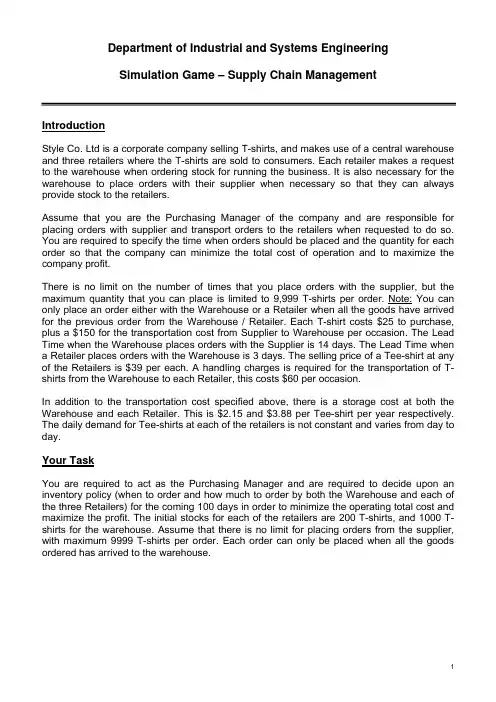
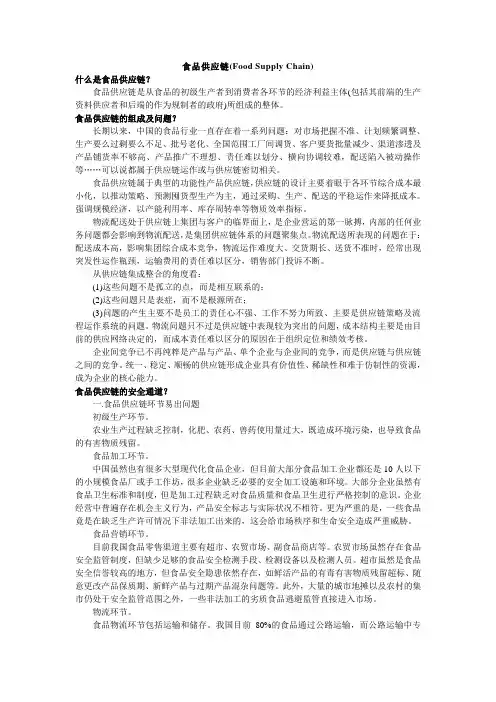
SUPPLY_CHAIN
- 格式:doc
- 大小:155.50 KB
- 文档页数:17
Supply Chain and e-Supply Chain: Structures, Strategies and Drivers
page 1
Supply Chain and e-Supply Chain:
Structures, Strategies and Drivers
1. SUPPLY CHAIN DESCRIPTION
Supply Chain: Activities involved in fulfilling a customer request
Actors: Suppliers, Sub-Contractors, Manufacturers, Transporters,
Warehouses, Retailers, Customers
Functions: Product, Development, Marketing, Procurement, Manufac-turing, Operations, Distribution, Finance, Customer Service
Objective: Maximize value generated through customer satisfaction
Decision Phases
1. Strategy (Design)
Locations, Capacity channel design, Warehouses, Manufacturing, Out-sourcing
2. Planning
Supply scheme, Inventory policy, Subcontracting
3. Operations
Allocation of individual orders to inventory or production, allocation to
transportation routes, etc.
Prof. P. Miliotis
Supply Chain and e-Supply Chain: Structures, Strategies and Drivers
page 2 Process view of the Supply Chain
Cycle view
1. Customer Order Cycle
Customer arrival
Customer order entry
Customer order fulfilment
Customer order receiving
2. Replenishment Cycle
Retail order trigger
Retail order entry
Retail order fulfilment
Retail order receiving
3. Manufacturing Cycle
Order arrival
Production scheduling
Manufacturing and Shipping
Receiving
4. Procurement Cycle
Supplier / Manufacturer interface
Sources Converters Retailers
Suppliers Distributors Consumers Product and Service Flow
Information Flow
Funds Flow Prof. P. Miliotis
Supply Chain and e-Supply Chain: Structures, Strategies and Drivers
page 3 Customer
Order
Replenishment
Manufacturing
Procurement Pull
Push Customer arrival
Customer order entry
Customer order fulfilment
Customer order receiving
Retail order trigger
Retail order entry
Retail order fulfilment
Retail order receiving
Order arrival from distributors
Production scheduling
Manufacturing and Shipping
Receiving (distributors, retailers,
customers
Cycles Prof. P. Miliotis
Supply Chain and e-Supply Chain: Structures, Strategies and Drivers
page 4 Push-Pull view of S.C.
Pull Process: Execution is initiated in response to a customer
order (increased responsiveness)
Push Process: Execution is initiated in anticipation to a customer
order (increased efficiency)
Push-Pull Boundary: Which processes are of each type
Push Systems MRP supported
Pull Systems Require fast information transmission and sharing
2. STRATEGIC FIT
Matching of the company’s competitive strategy to supply chain strategy
Competitive Strategy: Define ways to satisfy customer require-ments through products and services
Product Development Strategy
Marketing and Sales Strategy
Supply Chain Strategy: Design strategy to achieve the right mix of
efficiency and responsiveness
Products with high demand uncertainty (and usually high profit margins) require
responsive supply chains. This usually occurs early in the life cycle of the prod-uct.
Products with low demand uncertainty (and usually low profit margins) require
effective supply chains. This usually occurs late in the life cycle of a product.
Supply chains serving multiple products and multiple customer segments require
the right balance between effectiveness and responsiveness.
Achieving strategic fit: Matching S.C. to customer segment require-ments
Understanding the cus-tomer: Volumes, variety, response time, service level,
price innovation rates
Prof. P. Miliotis
Supply Chain and e-Supply Chain: Structures, Strategies and Drivers
page 5
Understanding the supply
chain: Responsiveness
Response to wide range of quantities
(excess capacity)
Meet short lead time
Handle a large variety of products
Meet a high level service
Efficiency
Economies of scale
Low capacity (excess costs)
Low cost transport
Supply chain Characteristics
Efficient Responsive
Primary goal Lowest cost Quick response to demand
Product design Max per. at min cost Modularity for postpone-ment of product differen-tiation
Pricing Lower margins price
prime customer drive High margins
Manufacturing
strategy Lower costs through high
utilization Capacity availability to
meet unexpected demand
Inventory strat-egy Minimize inventory to lower cost Maintain buffer inventory to meet unexpected de-mand
Lead time Reduce but not at expense
of cost Reduce aggressively even
if costs are significant
Supplier strat-egy Select based on cost and
quality Select based on speed,
flexibility and quantity
Transportation Low cost models Responsive models