Personal Statement 教程
- 格式:docx
- 大小:414.73 KB
- 文档页数:45
Personal Statement
What is a personal statement?
How long should a personal statement be?
Why is your personal statement important?
How do you structure a personal statement?
What must you include in your personal statement? 10 tips
10 things NOT to put in your Ucas personal statement
What not to write in your personal statement
The overkill opening & Some tutors’ suggestion
Five cliche beginnings to avoid
Hobbies in your personal statement
work experience: make your experience count
10 more things to put in your Ucas personal statement (提升品质)
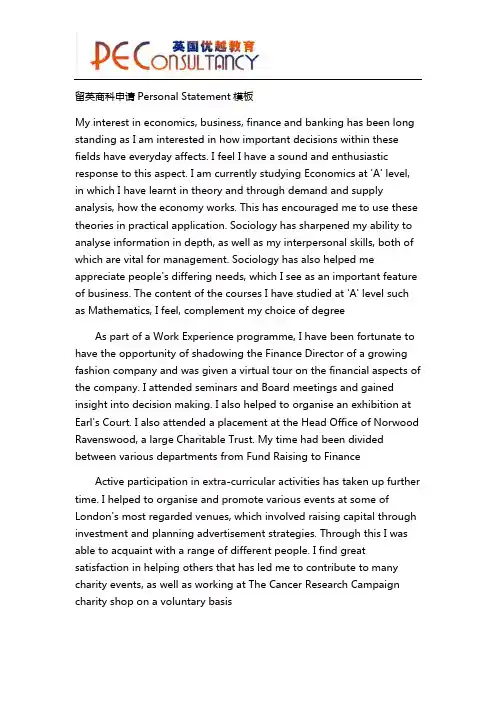
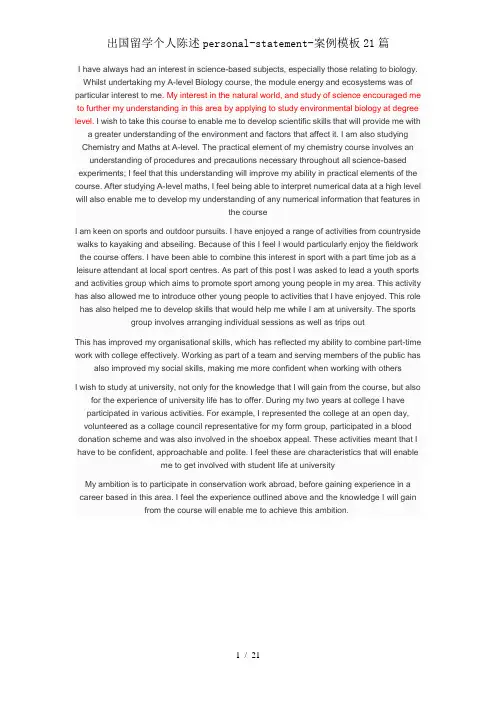
举个PS栗子
中文版PS指南
No two personal statements should be the same (the clue's in the 'personal'). But
there ARE certain rules including it needs to achieve, length and more...
What is a personal statement?
A personal statement is like a short reflective essay you write about why you’re the
perfect candidate for the undergraduate degree course/s you’re applying to.
It’s a key part of your Ucas application – alongside your predicted or achieved
A-level, Scottish Higher, BTEC etc. grades – and is read by admissions tutors at the
universities you apply to, who’ll decide whether to offer you a place or not.
It’s important to note that you only write one personal statement, which is seen by all
the universities you apply to.
Also, a university personal statement works differently to a personal statement you'd
write when applying to a job – so don't confuse the two.
How long should a personal statement be?
You have a maximum of 4,000 characters and 47 lines to write your personal
statement.
That might seem a lot (or maybe not enough) from the outset, but your perspective
might change as you begin writing and have to boil down all those relevant thoughts,
skills and experiences.
It’s best to draft your statement and get it finalised in a Word document, and then
copy this over to Ucas’ system to submit it, rather than make changes afterwards.
Some admissions tutors will recommend that you leave a blank line to separate
paragraphs, as any indentation or formatting will be stripped out. Others will argue
that each blank line will count as one of your 47 lines to play with. Rather than leave
a blank line, try and finish your paragraphs midway along the line. That way it looks
as if it’s still a paragraph.
Why is your personal statement important?
While many students may apply to the same university course with the same grades
as you, they aren’t you as a person, with your skills, experiences and thoughts. You
need to stand out as a real person to an admissions tutor, as opposed to one of the
many applicant numbers that will pass before their eyes.
Your personal statement is where you can distinguish yourself from these other
candidates. It’s where you can fill in the picture a tutor has of you in their head, and
where you can leave a real impression that makes them want to meet you, or offer
you a place.
How do you structure a personal statement?
Your personal statement should show have you’ve made an effort to engage with
your subject already, what you’ve learned, and how this relates back to the course
(and possibly other future plans). This is known as the ‘ABC rule’: Action, Benefit
and Course.
Introduction: why you want to study this course at university. Remember, your
personal statement is seen by all your Ucas choices; so don’t make references to a
specific institution.
Section one: academics – specifically subjects that are relevant to the
course/subject you’re applying to. If you’ve taken an EPQ, this is the place to talk
about it.
This section should make up the majority of your personal statement – around 75%
according to some careers experts – but this might vary depending on where/what
you’re applying to. For example, Oxbridge are more interested in your academic
interests than extracurricular activities.
Meanwhile, a law or medicine applicant may want to invest more time talking about
relevant experience they've accumulated, to stand out from those applying with
similarly high grades.
Section two: interest in and engagement with your subject beyond the classroom
(thus demonstrating your deep interest). This could be through books you’ve read,
events you’ve been to etc.
Section three: relevant work experience (paid or unpaid) that has developed either
your understanding of the subject, or the skills that applicants should have. To get an
idea of what these are, read the course description for all the courses you’re applying
to – search for a course on Which? University to find this in one place - and see
what's common across all.
Section four: hobbies and interests – this section should be brief, sticking to the