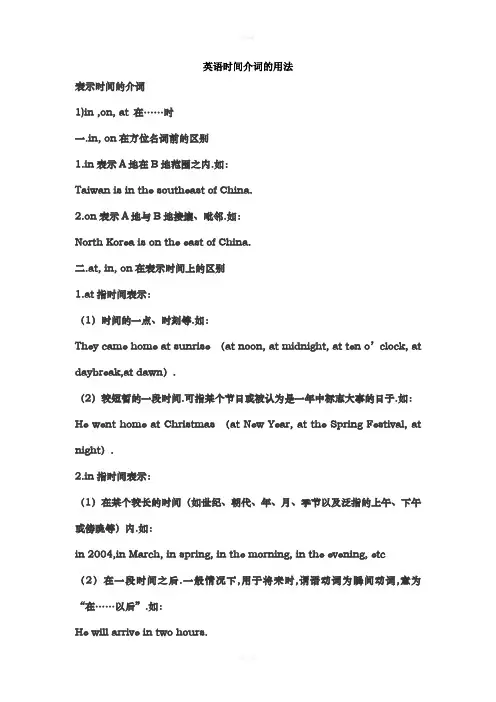
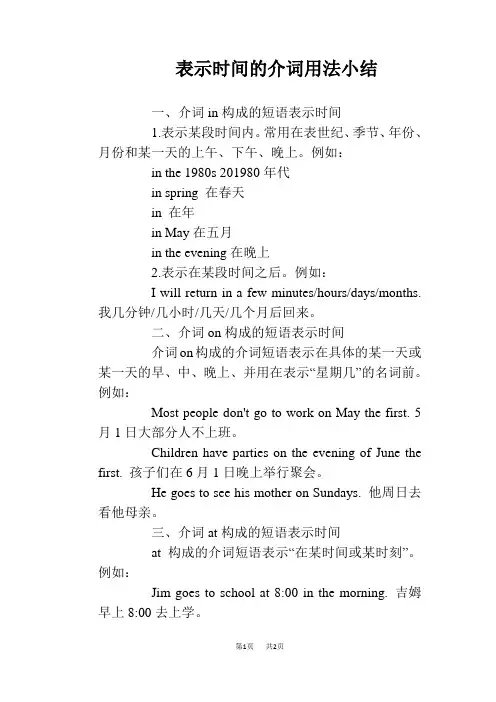
表示时间的介词的用法
- 格式:doc
- 大小:43.50 KB
- 文档页数:5
表时间介词的用法____ a terrible rainy night, many farmers’ houses were destroyed.A. InB. ForC. OnD. At答案:C【解析】介词用法。
在具体某一天前应该用介词on,因此答案为C。
The famous writer William Shakespeare was born ____ 1564.A. inB. onC. atD. of答案:A【解析】某一年前用in; on用于具体的某一天;at表示时刻,时间的某一点;of不用于时间前,因此答案为A。
-- What time do you expect me back, Mum?-- Say, ______half an hour.A. atB. beforeC. inD. for答案:C【解析】介词用法。
这里句意是“半小时后”而不是“在几点、几分”,所以用介词in,而不是at.The car accident happened ____ a cold winter morning. Luckily, no one was hurt.A. inB. onC. atD. of答案:B【解析】介词。
在一天中某个时段如morning, afternoon, evening前用in,而noon, night前用at。
但在具体哪一天或特定条件下的某个时间前应用on。
The plane will take off _________ three hours. I must get to the airport right now.A. inB. forC. onD. at答案:A【解析】介词的用法。
过多久之后做某事要用介词in。
句意为再过三个小时飞机就要起飞了,我必须马上去机场。
故选择A。
The earthquake which happened in Yushu________ 14th April 2010 was a big disaster.A.at B.on C.in D.to答案:B【解析】介词的用法。
at 与具体时刻连用,on 与具体的时间连用,in与一时间段连用。
故选B。
We will celebrate the 90 th birthday of the Chinese Communist Party _____ July 1st, 2011. A. on B. at C. in D. during答案:A【解析】A 考查点:考察介词辨析。
解题思路:具体到某一天用介词on。
故选A。
A terrible earthquake happened in Japan_____ March, 2011.A. toB. onC. inD. at答案:C【解析】考查介词用法。
in 可用于年、月、星期之前;而on通常用于具体的某一日或特定的某一日之前。
“March, 2011 ”意为“2011年3月”,故选C。
The wedding of Prince William was held in Westminster Cathedral ______ April 29 , 2011 .A. atB. inC. onD. by答案:C【解析】考查介词的用法。
在具体某一天前用介词on。
故选C。
My parents usually take a walk ______ dinner to keep healthy.A. atB. ofC. duringD. after答案:D【解析】介词的用法。
本句句意:我父母亲通常在饭后散步来保持健康;after dinner意为“饭后”,符合句意。
—When and where were you born?—I was born _______ October 1st, 1998________ Suzhou.A. on; onB. in; inC. on; inD. in; on答案:C【解析】考查介词。
在具体某天用介词on,地点前用in。
故选C。
—Look! There so many people in the park.—Nobody likes to stay at home ______ Sunday morning.A. inB. onC. atD. to答案:B【解析】介词。
具体到某一天的上午、下午或晚上,要用介词on.A big earthquake hit Japan_____ the afternoon of March 11th,2011A. inB. onC. at答案:B【解析】介词用法。
in用于年、月、季节、早中晚。
具体日期用on。
具体时刻用at。
故选B。
—My old friend White is going to visit me.—We haven't seen each other _____ five years.A. since B after C. for答案:C【解析】介词的用法。
since+一段时间+ago;after+时间点;for+一段时间。
本句中five years.为一段时间。
故选择C。
-Oh, so many people in the park?-Nobody likes to stay at home ______ Sunday morning.A. inB. onC. at答案:B【解析】介词考查。
in表示在某年、某月、某星期;on表示在某天或某天的早上、中午、晚上;at表示在某时某刻。
根据句意:在周日早晨用介词on。
I hear our teacher will be back three weeks' time.A. atB. inC. forD. after答案:B【解析】选B。
考查介词用法。
at 一般加时间点;in +一段时间表示将来时;for加一段时间,通常用于完成时;after通常用于引导过去时的从句。
由will提示,应该选B。
—have you stayed in this hotel?—Not long, just this Monday.A. How soon, fromB. How long, sinceC. How many days, forD. How often, on答案:B【解析】疑问词和介词的用法。
问句意为:你已经在这家酒店住多久了?答语意为:时间不长。
从上周一到现在。
how soon意为―多久‖,对将来的时间提问;how long意为―多久‖,对时间段或物体提问;how many意为―多少‖,对可数名词提问;how often意为―多久一次‖,对频度副词提问。
在现在完成时态中,since后接时间点或者一般过去式的句子;for后接时间段。
. More and more young people In China celebrate ________Christmas DayDecember 25th.A at B. on C. in答案:B【解析】本题考查介词的用法。
根据题意,越来越多的中国年轻人在12月25日庆祝圣诞节。
at后接时刻,on后接具体时间,in后接模糊时间。
12月25日是具体时间,故本题选B。
I usually get up _____ 7:00________ the morning.A. in; atB. at; inC. in; inD. at; on答案:B【解析】考查介词的使用。
在时间点前用at;在morning 前用in。
故选B。
– I joined the League ________ May,2009. What about you?– I’ve been a League member _______ three years.A. in; forB. on; inC. on; forD. in; since答案:C【解析】考查介词的辨析。
年月日的前面用介词in或on, 其具体用法为:in 表示在某周、某年或某月;on表示在具体的某一日。
上半句中“May,2009”意思为“2009年5 月”,故应选介词“in”;由下半句“我是个团员已经3年了”可知,此处应是“for +一段时间”,故选C。
Shanghai Disneyland has started to be built and it will be open five years.A. inB. forC. fromD. before答案:A【解析】介词的语法。
in 后加时间段表示“在……后”,一般用于将来时;for后加时间段一般与现在完成时连用,表示“主句的动作持续多长时间”;from和before后加时间点。
故选A。
If you sit in a chair _____a long time, your back may begin to hurt.A. atB. inC. onD. for答案:D【解析】介词的用法。
介词for 用来引导一段时间,本身无具体意义,有时可译为“计,达”等。