英语语法介词连词
- 格式:doc
- 大小:77.50 KB
- 文档页数:15
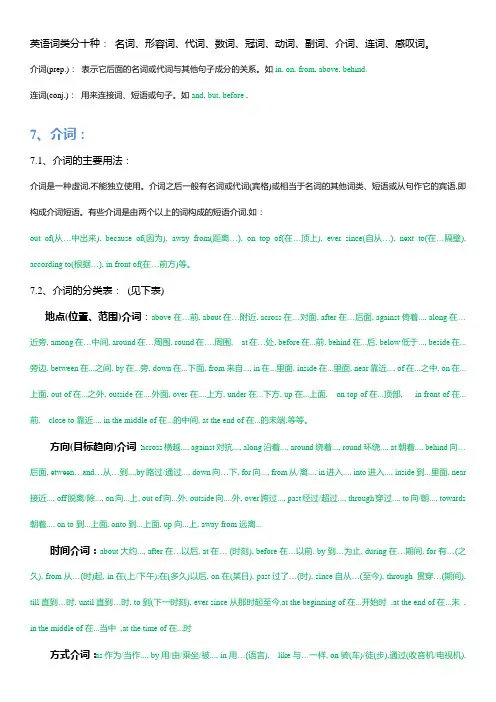
介词概述介词是一种用来表示词与词、词与句之间的关系的虚词,在句中不能单独作句子成分。
介词后面一般有名词代词或相当于名词的其他词类,短语或从句作它的宾语。
介词和它的宾语构成介词词组,在句中作状语,表语,补语或介词宾语。
介词可以分为时间介词、地点介词、方式介词、原因介词和其他介词,目录[隐藏]一、概念:二.相关知识点精讲1.表示地点位置的介词2.表示时间的介词3.表示运动方向的介词:4.表示“在……之间”的介词:5.表示其他意义的介词三.巩固练习其它常用介词介词英文缩写:介词用法口诀[编辑本段]一、概念:介词是英语中最活跃的词类之一,特别是一些常用介词的搭配力特别强,可以用来表示各种不同的意思。
英语里大部分习语都是由介词和其他词构成的。
介词在句中一般不重读。
在定语从句“介词+who/which”的结构中,不能用that 代替who/which。
She is a good student from who we should learn.[编辑本段]二.相关知识点精讲介词口诀:自从以当为按照,由于对于为了到;和跟把比在关于,除了同对向往朝;用在名词代词前,修饰动形要记牢。
.[编辑本段]1.表示地点位置的介词1)at ,in, on, to,forat (1)表示在小地方; (2)表示“在……附近,旁边”in (1)表示在大地方; (2)表示“在…范围之内”。
on 表示毗邻,接壤,“在……上面”。
to 表示在……范围外,不强调是否接壤;或“到……”2)above, over, on 在……上above 指在……上方,不强调是否垂直,与below相对;over指垂直的上方,与under相对,但over与物体有一定的空间,不直接接触。
on表示某物体上面并与之接触。
The bird is flying above my head.There is a bridge over the river.He put his watch on the desk.3)below, under 在……下面under表示在…正下方below表示在……下,不一定在正下方There is a cat under the table.Please write your name below the line.4)in front [frant]of, in the front of在……前面in front of…意思是“在……前面”,指甲物在乙物之前,两者互不包括;其反义词是behind (在……的后面)。
There are some flowers in front of the house.(房子前面有些花卉。
)in the front of 意思是“在…..的前部”,即甲物在乙物的内部.反义词是at the back of…(在……范围内的后部)。
There is a blackboard in the front of our classroom.我们的教室前边有一块黑板。
Our teacher stands in the front of the classroom.我们的老师站在教室前.(老师在教室里)5)beside,behindbeside 表示在……旁边behind 表示在……后面[编辑本段]2.表示时间的介词1)in , on,at 在……时in表示较长时间,如世纪、朝代、时代、年、季节、月及一般(非特指)的早、中、晚等。
如in the 20th century, in the 1950s, in 1989, in summer, in January, in the morning, in one’s life , in one’s thirties等。
on表示具体某一天及其早、中、晚。
如on May 1st, on Monday, on New Year’s Day, on a cold night in January, on a fine morning, on Sunday afternoon等。
at表示某一时刻或较短暂的时间,或泛指圣诞节,复活节等。
如at 3:20, at this time of year, at the beginning of, at the end of …, at the age of …, at Christmas,at night, at noon, at this moment等。
注意:在last, next, this, that, some, every 等词之前一律不用介词。
如:We meet every day.2)in, after 在……之后“in +段时间”表示将来的一段时间以后;“after+段时间”表示过去的一段时间以后;“after+将来的时间点”表示将来的某一时刻以后。
3)from, since 自从……from仅说明什么时候开始,不说明某动作或情况持续多久;since表示某动作或情况持续至说话时刻,通常与完成时连用。
since表示"自(某具体时间)以来",常用作完成时态谓语的时间状语。
since liberation(1980)自从解放(1980年)以来They have been close friends since childhood.他们从小就是好朋友。
(1)since the war是指"自从战争结束以来",若指"自从战争开始以来",须说"sincethe beginning of the war"。
(2)不要将since与after混淆。
比较:He has worked here since 1965.(指一段时间,强调时间段)自从1965年以来,他一直在这儿工作。
He began to work here after 1965.(指一点时间,强调时间点)从1965年以后,他开始在这儿工作。
4)after, behind 在……之后after主要用于表示时间;behind主要用于表示位置。
时间名词前介词用法口诀年前周前要用in具体日子却要用on遇到几号要用on上午下午又是in要说某日上下午用on换in记清楚午夜黄昏用at黎明用它也不错at用在时分前说“差”可要用上to说"过''要用past[编辑本段]3.表示运动方向的介词:across, through 通过,穿过across表示横过,即从物体表面通过,与on有关,为二维through穿过,即从物体内部穿过,与in有关,为三维。
[编辑本段]4.表示“在……之间”的介词:表示“在……之间”的介词在英语中属于方位介词,如in front of ,behind ,on,in,near,under,upbetween, amongbetween指在两个人或两个事物之间;among指在三个或三个以上的人或事物之间。
[编辑本段]5.表示其他意义的介词1)on ,about 关于on 表示这本书,这篇文章或演说是严肃的,或学术性的,可供专门研究这一问题的人阅读;about表示内容较为普通,不那么正式。
2)by, with, in 表示方法、手段、工具by 以……方法、手段或泛指某种交通工具;with 表示用…工具、手段,一般接具体的工具和手段;in 表示用…方式,用…语言(语调、笔墨、颜色)等;3)except, besides 除了except 除……之外,不包括在内;besides 除……之外,包括在内。
Except for Mr. Wang, we went to see the film.(王先生没去)Besides Mr. Wang, we also went to see the film.(王先生也去了)[编辑本段]三.巩固练习1. Taiwan is in_______ the southeast of China.(in, on, to)2. Go ____on_____ the bridge ___to______ the river, you’ll find the shop.(across, through; over, above)3. I go to school ______at____7:30 every morning.(in, on, at)4. He would like to meet her ______at____8:00 and 9:00 tomorrow morning.(between, among )5. The Greens have lived in China _____for___ three years.(in, for, after)6. We go to school every day ___on_____ Saturday and Sunday.(except, besides)7. He wrote the letter _________ ink.(by, with ,in)8. She returned to her country _____for____five years.(in, after, for)9. There is a big tree _________ our classroom.(after, behind)10. I usually go to work _________ bike.(by, on, with)1. There’s something _______ her that I really don’t like.A. withB. forC. toD. about2. I was angry _______ him for keeping me waiting.A. withB. toC. aboutD. on3. _______ going to French evening classes twice a week she does yoga on Wednesdays.A. Because ofB. ExceptC. BesidesD. But for4. _______ cooking, writing and running the farm, she was very busy.A. AmongB. BetweenC. OverD. As5. _______ one old lady, the bus was empty.A. ExceptB. Except forC. ButD. Besides6. They promise that the work would all be finished _______ next week.A. untilB. inC. byD. to7. We didn’t live together. We kept in touch _______ writing often.A. withB. ofC. onD. by8. It was very kind of her. She insisted _______ her car to us.A. to lendB. lendingC. on lendingD. in lending9. We’ve talked a lot _______ cars. What about trains?A. ofB. withC. aboutD. in10. “How long have you been here?”“_______ the end of last month.”A. InB. ByC. AtD. Since11. The chemistry teacher required the students _______ more attention _______ the lab clean.A. to pay, to keepB. to paying, to keepingC. to pay, to keepingD. paying, keeping12. “Is your car equal _______ hers in speed?”“No, mine is faster. But my old one equals _______ hers in speed.”A. to, toB. 不填, 不填C. to, 不填D. 不填, to13. This exam is very important for her. She won’t go home ______ the exam.A. until afterB. after untilC. untilD. from14. This suit fits me well _______ the trousers are too long.A. onlyB. except forC. except thatD. except15. After a quick dinner, they set off ______ car and made ______ the nearest town.A. by, toB. in, toC. by, forD. in, for[编辑本段]其它常用介词介词在英语词汇中所占比例很小,但它们的用法却非常灵活,复杂。