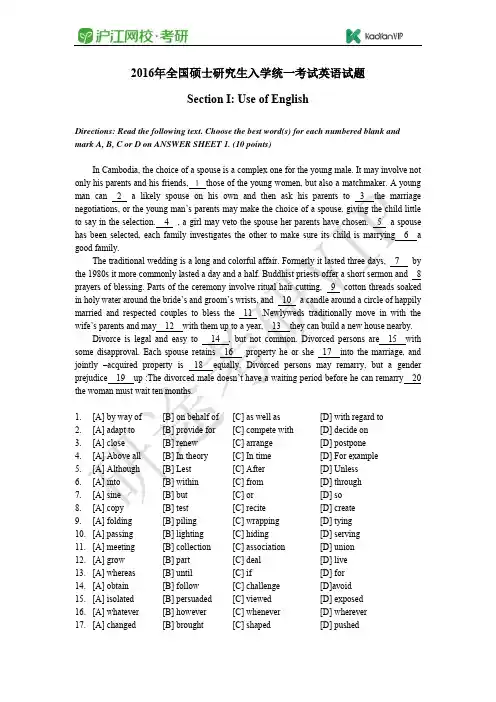
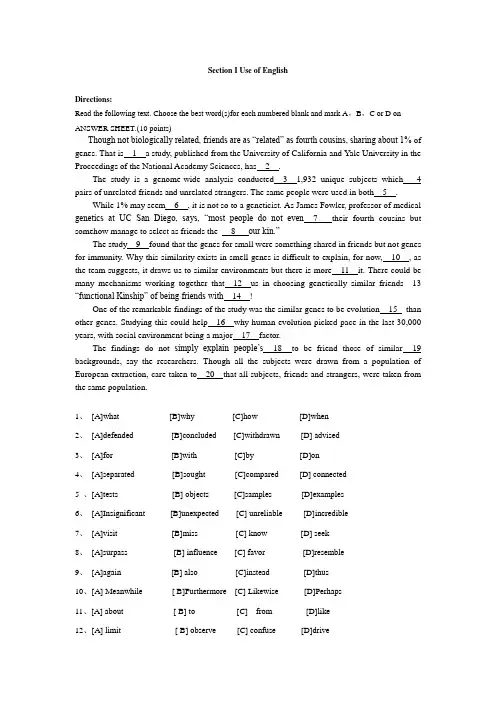
考研英语2016真题
- 格式:docx
- 大小:37.36 KB
- 文档页数:3
考研英语2016真题
2016年考研英语真题解析
Introduction
The Graduate Record Examination (GRE) is one of the most important
and challenging exams for students aspiring to pursue a higher education
degree in an English-speaking country. In this article, we will analyze and
discuss the 2016 GRE English exam, providing insights and strategies to
help students better prepare for this demanding test.
Section 1: Reading Comprehension
The reading comprehension section is designed to evaluate a candidate's
ability to comprehend and analyze written passages. It consists of multiple-choice questions and requires a strong command of vocabulary, as well as
critical thinking skills.
One of the passages in the 2016 exam focused on the impact of climate
change on marine ecosystems. The passage discussed various factors
contributing to the alteration of oceanic biodiversity and emphasized the
importance of conservation efforts. To succeed in this section, candidates
should underline keywords, identify the main idea of each paragraph, and
practice time management to ensure they can complete all the questions
within the allocated time frame.
Section 2: Sentence Equivalence and Text Completion
This section assesses a test taker's understanding of the meaning of
words and phrases in context. It includes both sentence equivalence questions, where students must select two choices that produce sentences
with the same meaning, and text completion questions, where students fill in
the blanks with appropriate words.
An example of a sentence equivalence question from the 2016 exam is as
follows:
"Although the children grew up in the same neighborhood, their
personalities and interests were ________."
To excel in this section, candidates should develop a strong vocabulary
by learning new words and their contextual usage. They should practice
identifying the relationships between words and understand how they
connect to form coherent and meaningful sentences.
Section 3: Analytical Writing
The analytical writing section consists of two tasks: analyzing an issue
and analyzing an argument. For the issue task, candidates are presented with
a statement and are required to provide arguments supporting or opposing it.
In the argument task, test takers must critically assess the reasoning behind a
given argument and provide a well-structured analysis.
In the 2016 exam, the issue task focused on the ethical implications of
animal testing, while the argument task evaluated the validity of a proposal
to implement a new public transportation system in a city. To demonstrate
strong analytical writing skills, candidates should develop a clear and
concise thesis statement, provide relevant examples and evidence, and
carefully structure their essays with well-constructed paragraphs.
Conclusion The 2016 GRE English exam posed significant challenges for test takers,
requiring a high level of language proficiency, critical thinking skills, and
time management abilities. By actively practicing reading comprehension,
expanding vocabulary, and honing analytical writing skills, candidates can
greatly enhance their chances of success in this rigorous examination.
Remember, diligent preparation is key to achieving your desired scores
on the GRE English exam. Good luck!