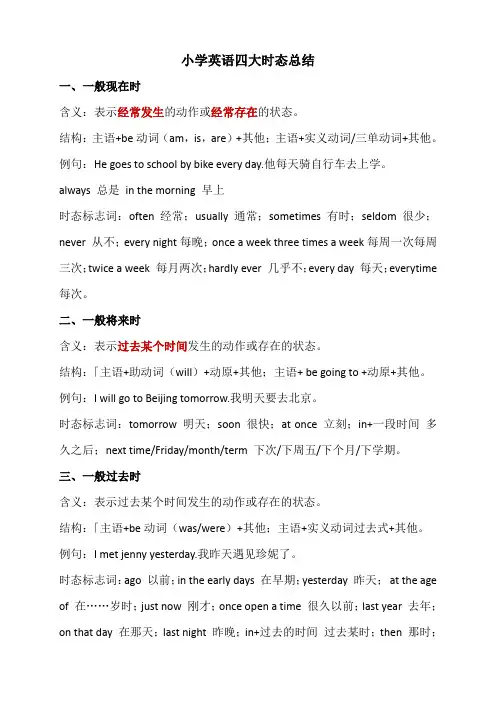
小学英语 六年级四种时态总结
- 格式:doc
- 大小:45.00 KB
- 文档页数:14
学习资料收集于网络,仅供参考
学习资料 小学英语四种时态总结
1. 一般现在时。主要描述经常会发生的动作、状态或不变的真理。句末常出现every day/week/year/Monday , in the morning, 句中常有always, usually, often,
sometimes
口诀:“经常有每没(美眉^^)总星周”
经常:often
有:sometimes (记住,“有”不是have,而是“有时”)
每:every week/month/year 等
没:never 总:always, usually等
星周:on Mondays, on Tuesdays等
组成:主语+be+名词(形容词)
I am a student. He is tall.
1. He is in New York with his cousin.他和他的堂兄在纽约。
2. These postcards are great.这些明信片真棒!
3. It’s a picture of the Great Wall.这是一张关于长城的明信片。
4.It’s more than twenty thousand kilometers long.它超过两万公里长
5.It’s in the east of China.它在中国的东部。
6.There is a Chinatown in New York. 纽约有一个唐人街。
7.There are lots of Chinese shops and restaurants there.那里有许多中国商店和餐馆。
8.There are lots of beautiful lakes in China.在中国有许多偏凉漂亮的湖泊。
9.It’s a big family dinner.它是一次大的家庭晚餐。
否定句:在be 后加not
I am not a student. He is not tall.
1.
2. 学习资料收集于网络,仅供参考
学习资料 3.
4.
5.
6.
7.
8.
9.
疑问句:be 动词提前到第一位。
Are you a student? Is he tall?
Yes, I am. / No, I am not.Yes, he is. / No, he isn’t.
1.
2.
3.
4.
5.
6.
7.
8.
9.
主语+动词+地点+时间
We go to school on Monday.
He goes to the park on Sunday.
否定句:主语+don’t/doesn’t’t+动词原形+地点+时间
We don’t go to school on Monday.
He doesn’t’t go to the park on Sunday.
疑问句:在句首加do或does
Do you go to school on Monday? Yes, we do./ No, we don’t.
Does he go to the park on Sunday? Yes, he does./ No, he doesn’t’t.
动词单三变化:1. 在原单词末尾加s , 如:like – likes
2. 单词以o, sh, ch, s, x 结尾加es, 如:go – goes
3. 单词末尾为辅音+y结尾去y加ies 如:study- studies 学习资料收集于网络,仅供参考
学习资料 2. 现在进行时:主要叙述正在发生的事情。句末常出现now, 句首常出现look,
listen
组成:主语+be +动词ing形式
I am reading English.
They are swimming.
He is playing football.
否定句:在be后加not
I am not reading English.
They are not swimming.
He is not playing football.
疑问句:将be 放到第一位。
Are you reading English? Yes, I am./ No, I am not.
Are they swimming? Yes, they are. / No, they aren’t.
Is he playing football? Yes, he is. / No, he isn’t.
动词变ing形式:1.在动词末尾加ing. 如:play- playing
2. 末尾有e 要去e加ing. 如:ride – riding
3. 末尾以辅音元音辅音结尾 双写末尾一个辅音如:swim-swimming
3. 一般将来时。 主要描述将来要发生的事情。句末常出现next Monday/week/
year, tomorrow
组成:主语+be going to +动词原形
I am going to visit Ann.
They are going to draw a dog.
She is going to ride a horse. 学习资料收集于网络,仅供参考
学习资料 否定句:在be后加not
I am not going to visit Ann.
They are not going to draw a dog.
She is going to ride a horse.
疑问句:将be提前
Are you going to visit Ann? Yes, I am. / No, I am not.
Are they going to draw a dog? Yes, they are./ No, they aren’t.
Is she going to ride a horse? Yes, she is. / No, she isn’t.
组成:主语+will+动词原形
I will go to the library.
They will clean the house.
She will eat breakfast at home.
否定句:在will 后加not 或将will not 写为won’t
I will not go to the library.
They will not clean the house.
She will mot eat breakfast at home.
疑问句:将will 提前
Will you go to the library? Yes, I will./ No, I won’t.
Will they clean the house? Yes, they will. / No, they won’t.
Will she eat breakfast at home? Yes, she will. /No, she won’t.
4.一般过去时:主要描述过去发生的事情. 句末常出现last
night/week/Monday/year, yesterday, ago 学习资料收集于网络,仅供参考
学习资料 组成:主语+动词过去式
I was a pilot.
They were busy.
He went to the market.
否定句:在be后加not
在普通动词前加didn’t 动词恢复原形。
I was not a pilot.
They were not busy.