
Elias' story
- 格式:ppt
- 大小:1.21 MB
- 文档页数:18
Elias’Story伊莱亚斯的故事My name is Elias. I am a poor black worker in South Africa. The time when I first met Nelson Mandela was a very difficult period of my life. I was twelve years old. It was in 1952 and Mandela was the black lawyer to whom I went for advice. He offered guidance to poor black people on their legal problems. He was generous with his time, for which I was grateful.我的名字叫伊莱亚斯。
我是南非的一个穷苦的黑人工人。
第一次见到纳尔逊•曼德拉的时候,是我一生中非常艰难的时期。
(当时)我才12岁,那是在1952年,曼德拉是我寻求帮助的一位黑人律师。
他为那些穷苦黑人提供法律指导。
他十分慷慨地给予我时间,我为此非常感激。
I needed his help because I had very little education. I began school at six. The school where I studied for only two years was three kilometers away. I had to leave because my family could not continue to pay the school fees and the bus fare. I could not read or write well. After trying hard, I got a job in agold mine. However, this was a time when one had got to have a passbook to live in Johannesburg. Sadly I did not have it because I was not born there, and I worried about whether I would become out of work.由于我所受的教育很少,所以我需要他的帮助。

eliasstory知识点总结Elias' Story is a novel written by author Mauricio Segura. The novel tells the tale of a young boy named Elias, who grows up in a small village in the mountains of South America. This novel is filled with rich and complex characters, a compelling storyline, and thought-provoking themes. In this knowledge summary, we will explore the various aspects of Elias' Story, including the plot, characters, themes, and symbolism.Plot SummaryThe novel begins with Elias as a young boy living in a small village with his mother and father. The village is a close-knit community, and Elias' family is well-respected within the village. However, Elias is different from the other children in the village - he is sensitive, introspective, and curious about the world beyond the mountains. As Elias grows older, he begins to question the traditions and customs of the village, and he yearns to explore the world beyond his home.Elias' journey takes him on a path of self-discovery and self-realization. He encounters various challenges and adversities along the way, but he remains determined to pursue his dreams. As Elias travels to different places, he meets a diverse cast of characters who shape and influence his life. Through his experiences, Elias learns about love, loss, friendship, and the complexities of human nature. Ultimately, Elias' journey leads him back to his village, where he must confront his past and make peace with his present.Character AnalysisElias is the central character of the novel, and his character undergoes significant development throughout the story. He is a multifaceted character who is both compassionate and determined. Despite facing numerous challenges, Elias remains resilient and optimistic, and he is driven by an unwavering sense of purpose.Other important characters in the novel include Elias' parents, his childhood friends, and the various individuals he meets during his travels. Each character brings a unique perspective and dimension to the story, and they all contribute to Elias' growth and evolution as a character.Themes and SymbolismSeveral themes are prevalent throughout Elias' Story, including the following:- The search for identity and belonging: Elias grapples with his sense of identity and belonging throughout the novel. He struggles to reconcile his individuality with the expectations of his community, and he yearns to find his place in the world.- The power of resilience: Elias demonstrates remarkable resilience in the face of adversity. He encounters numerous setbacks and challenges, but he perseveres with unwavering determination.- The importance of empathy and understanding: Throughout his journey, Elias learns the value of empathy and understanding. He develops deep and meaningful connections with the people he meets, and he realizes the importance of compassion and kindness.- The complexity of human relationships: The novel explores the intricacies of human relationships, including love, friendship, and family dynamics. Elias' interactions with others shed light on the nuanced nature of human connections.Symbolism also plays a significant role in Elias' Story. The mountains, for example, are a powerful symbol of both limitation and liberation. The mountains represent the constraints of Elias' upbringing but also the potential for growth and exploration.ConclusionElias' Story is a profound and moving novel that delves into the complexities of human existence. Through the character of Elias, the novel explores the universal themes of identity, resilience, empathy, and human relationships. The richly developed characters, compelling storyline, and thought-provoking themes make Elias' Story a captivating and resonant read.。
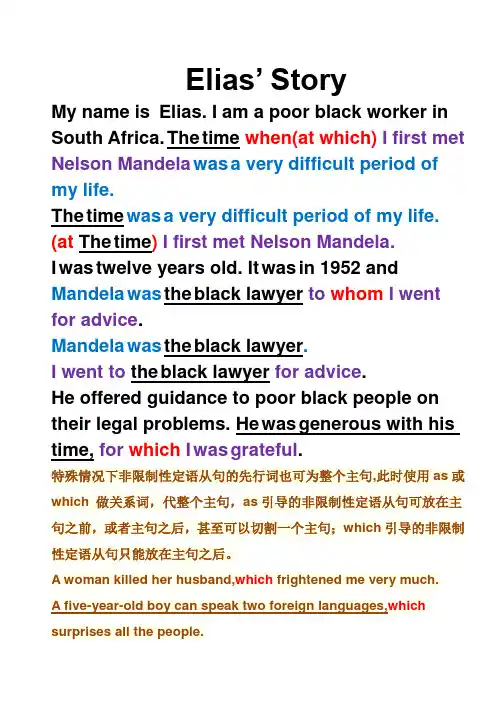
Elias’ StoryMy name is Elias. I am a poor black worker in South Africa.The time when(at which) I first met Nelson Mandela was a very difficult period of my life.The time was a very difficult period of my life. (at The time) I first met Nelson Mandela.I was twelve years old. It was in 1952 and Mandela was the black lawyer to whom I went for advice.Mandela was the black lawyer.I went to the black lawyer for advice.He offered guidance to poor black people on their legal problems. He was generous with his time, for which I was grateful.特殊情况下非限制性定语从句的先行词也可为整个主句,此时使用as或which 做关系词,代整个主句,as引导的非限制性定语从句可放在主句之前,或者主句之后,甚至可以切割一个主句;which引导的非限制性定语从句只能放在主句之后。
A woman killed her husband,which frightened me very much.A five-year-old boy can speak two foreign languages,which surprises all the people.As we know, smoking is harmful to one's health.As can be seen from his eyes, he is angry.I needed his help because I had very little education. I began school at six.The school where(in/at which)I studied for only twoyears was three kilometers away.The school was three kilometers away.I studied (in/at The school) for only two yearsI had to leave because my family could not continue to pay the school fees and the bus fare.I could not read or write well. After (I was)trying hard, I got a job in a gold mine.状语从句中的省略省略句的规则1.当从句的主语和主句的主语一致(或者从句的主语为it).2.从句谓语中包含be动词be doing,be done,be to do,be+adj满足这两个条件可以省去从句的主语和be动词.保留be之后的部分,被保留部分常为现在分词、过去分词、不定式、形容词等。