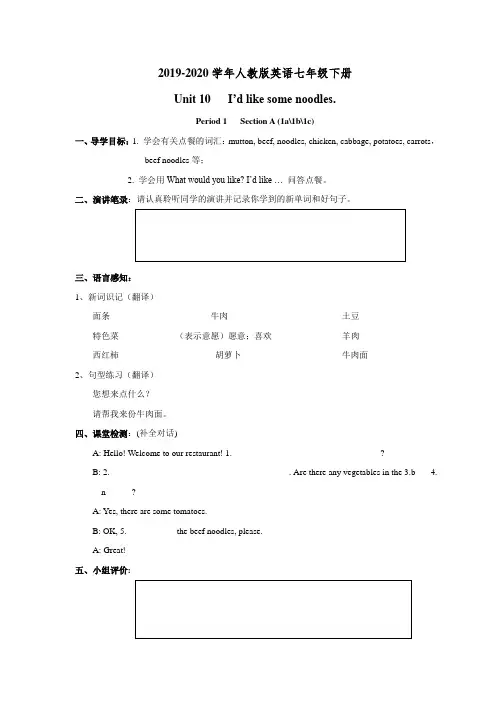
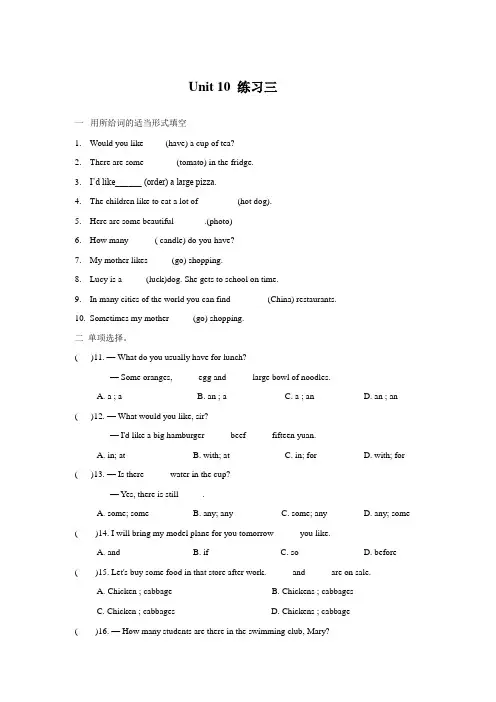
2019-2020学年人教版英语七年级下册Unit10I’dlikesomenoodle
- 格式:docx
- 大小:28.45 KB
- 文档页数:18
2019-2020学年人教版英语七年级下册Unit10I’dlikesomenoodle
2019-2020学年人教版英语七年级下册Unit 10 I’d like some
noodles.
全单元教案
主编人:审稿人:
学习目标
1.知识目标:能够识记并运用本单元重点单词和短语(详见单词表),以及重点句型(详
见课本第57页Grammar Focus)。
语法:(1.)表达意愿would like 的句型结构:肯定句、否定句、一般疑问句、特殊疑问句。
询问意愿句型:Would you like …?的应答Yes , please./No,
thanks.
(2.)可数名词与不可数名词:
1.)可数名词变复数的规则变化:
(a.)一般情况加s,例:book-books,map-maps
(b.)以s/x/sh/ch结尾加es,例:box-boxes, bus-buses, watch-watches.
(c.)以辅音字母加y结尾,变y为i加es,例:city-cities, family-families。
(d.)以f或fe结尾,变f/fe为v加es,例:knife-knives, leaf-leaves.
注意:以o结尾的名词变复数时多数情况加s.如radio-radios,
photo-photos等。我们以初中阶段学过的以o结尾的名词复数,只有hero, tomato, potato三个词后加es。我们可记为:“英雄吃西红柿拌土豆意有意思(-es)。”
2.)可数名词变复数的不规则变化:
(a.)改a为e型:man-men, woman-women, Frenchman-Frenchmen.
(b.)改oo为ee型:foot-feet, tooth-teeth.
(c.)在词尾加en:child-chidren, ox-oxen.
(d.)其他特殊变化:mouse-mice.
(e.)有些名词的单复数相同,如:sheep, deer, Chinese,
Japanese.
3.)不可数名词的表达:
数词+表示数量的名词(可数名词)+of+不可数名词。例:
two pieces of paper 两张纸
three bottles of orange 三瓶橘汁
six bags of rice 六袋大米
ten cups of tea 十杯茶
2.能力目标:能够表达自己的意愿和对别人提供的意见做出肯定和否定回答,注意礼貌性;
能够清楚掌握名词的可数和不可数分类并能掌握可数和名词复数的变化规则和不可数名词数量的表达;能够用于日常生活中点餐;能够为自己的餐馆写份广告。
3.情感目标:通过实践学习让学生体验学习的快乐,并能用于展示将所学知识用于生活中,
通过小组学习培养团队精神。
Section A
课前自学
一.语法:句型:What would you like…?你想要点什么?
would like 表示“想;想要”,would 没有人称和数的变化,主语是人称代词经常用缩写形式’d。例如:I’d like some dumplings
for dinner. 晚饭我想吃水饺。
They’d like some food and drinks.他们想要一些食物和饮料。
拓展:would like 后面也可以跟动词不定式:(1.)would like
to do sth. 表示“愿意做某事;想做某事”,相当于want to do sth.。
例:He’d like to see you today.他今天想见你。 (2.)wold like sb. to do sth.表示“想要某人做某事”,相当于“want sb. To do sth.”。例:They would like me to stay here.他们想要我留下来。
随堂演练:改写同义句。
1.)I want some rice.
I ___ ___ some rice.
2.)Do you want to have a try?
____ you ____ me to have a try?
二.重点句型
1.Special 1 1号特色面
Special可数名词,作“特色菜,特价菜”讲。例如:What’s
today’s special?今天的特色菜是什么?
拓展:special还作形容词,“特别的,特殊的”,作定语或表语。
例:用括号内所给的单词适当形式填空。
1.)This lock has two___(special) keys.
2.) In our restaurant, we have some____(special).
2.I’m not sure yet.我还不确定。
1.)be sure意为“确定”。例如:
Are you sure?你确定吗?
be sure 后经常跟to do结构,意为“务必做某事”。例如:Be
sure to telephone me.务必打电话给我。
2.)yet副词,用在否定句中,意为“已经”。例如:Is
everything ready yet? 一切都准备好了吗?
随堂练习:按要求改写句子。
a.)I am sure I can pass the exam this time.(改为同义句)
I ____ ____ ____ pass the exam this time.
b.)They are still at work.(改为否定句)
They are ____ at work ____.
3.I’d like some beef noodles, please.我想要牛肉面。
beef不可数名词“牛肉”; beef noodles意为“牛肉面”。Beef在这里修饰noodles。修饰面条的这些原材料即使是可数名词也该用单数。类似的有:tomato
noodles 西红柿面
egg noodles 鸡蛋面
随堂演练:单项选择
—What would you like, sir?
—I’d like a bowl of ___ noodles.
A.potato and beef
B.potatoes and beefs
C.potatoes and beef
4.May I take your order?现在可以为你们点菜了吗?
1.)May I…?表示征求对方许可,“我可以…….吗?”
例:May I come in?
拓展:
回答may开头的疑问句有如下表达方式:
—May I sit here?
—Yes, you may./Yes, please./Sure.
—No, you can’t./No, you mustn’t.
2.)order意为“菜单”名词,还可作动词“点菜;订购”。例:He wants to order himself the suit on the Internet.他想在网上给自己订购这件衣服。
随堂演练:单项选择。
—Mum,may I go out to play football for an hour?
—No, you ___. The air outside is not very clean.
A.can’t
B. needn’t
C. couldn’t
5.We’d like one bowl of beef soup.我们想要一碗牛肉汤。
对于不可数名词的量化表达还有:
a cup of tea 一杯茶 two pieces of paper两张纸
运用:单项选择:
—Mum, I’m thirsty. Could you get me ___?
—OK,I’m coming.
A.two cup of tea
B. two cups of tea
C. two cup of teas
D. two cups of teas
6.What size would you like?
你想要多大碗的?
size名词“大小,尺寸”what size用来尺寸,规格。What可与名词size, kind, class, grade, color 等共同引导特殊疑问句,用来询问尺寸、种类、年级、班级、颜色等。而疑问副词how常与形容词long,wide,far等共同构成疑问词,询问多久、多长、多远等。
运用:
Look! The kites in the sky are in different___. Some are big
and some are small.
A.sizes
B. colors
C. prices
D. names
7. Large, please.请来大碗的。
Large是形容词,意为“大号的;大的”
注意:large常与medium, small一起描述物品的尺寸型号,分别意为“大的”“中等”“小的”。衣服等常见标识字母L,M和S分别是large, medium,smal的缩写。
辨析:big,great, large
big指具体事物的大小,强调比正常形体的标准大。可用来指人的身材高大。
large 特别强调远远超过标准的大,指体积、面积、容积、数量之大。
great指抽象的程度,常常有“伟大”“大得令人吃惊”等意思,含有一定的情感色彩。
运用:选词填空(big, large, great)
1.)The bag is very____. Please help me carry it.
2.)Mo Yan is a _____ Chinese writer.
3.)The farm is very____.
4.)I want a _____ size T-shirt for me.
8.We’d also like gongbao chicken and some mapo tofu with
rice.我们想要一些宫保鸡丁和麻婆豆腐,再加些米饭。
with 意为“和,同,跟,一起”
拓展:1.)with介词,意为“带有”
2.)with介词,意为“用……”,表示使用工具、手段。
例:He’d like a hamburger _____ some cabbage.
A.in
B. for
C. with
D. on
9.---Is there any meat in the tomato and egg soup?西红柿鸡蛋汤里有肉吗?
------No, there isn’t any.不,没有肉。
1.)meat 是不可数名词,对它的量化,我们可用piece(片,块)。例:a piece of meat
一块肉
2.)应答语中,there isn’t any (meat).= there’s no meat.由于no本身是一个限定词,不可
与另一个限定词连用如any, a等,因此在出现上述限定词时,必须用not。
助记:“没有”也能公式化:
no +不可数名词= not any +不可数名词