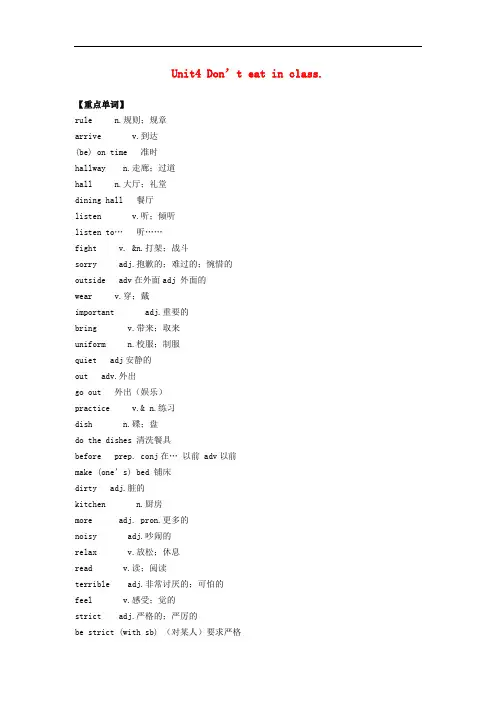
七下Unit4 Don’t eat in class重点知识单元总结
- 格式:docx
- 大小:20.42 KB
- 文档页数:7
Unit 4 Don’t eat in class重点知识单元总结一、重点短语1.arrive late for class上课迟到2.after breakfast早饭后3.after that 在那之后4.be quiet in the library在图书馆保持安静5.be strict with sb in sth 在某方面对某人严格6.bring music players to school把音乐播放器带到学校来7.do the dishes清洗餐具8.eat outside在外面吃9.feel/be terrible感到/是很糟糕的10.fight with sb 和某人打架11.follow the rules遵守规则12.go to bed before 10:00 10点之前睡觉13.have more rules有更多规则14.have to clean the classroom必须打扫教室15.have to wear a school uniform必须穿校服16.have too many rules有太多规章制度17.help his mom make breakfast帮他妈妈做早饭18.in the dining hall在餐厅19.in the music room在音乐室20.keep my hair short留短发21.know how you feel知道你的感受22.learn to play the piano学会弹钢琴23.make one's bed铺床24.make rules制定规章制度25.on school days 在上学日26.on school nights在上学晚上27.practice (playing) the guitar练习(弹)吉他28.read books/read a book读书29.run in the hallways在走廊上跑30.some of the rules其中一些规章制度二、重点句型1.—What are the rules at your school?在你们学校有什么规章制度?—We can't arrive late for class./We must be on time for class.我们上课不能迟到。
/我们必须准时上课。
2.—Can we eat in the classroom?我们能在教室里吃东西吗?—Yes, we can./No, we can't.是的,我们可以。
/不,我们不能。
3.—Do you have to wear a uniform at school?你在学校必须穿校服吗?—Yes, I do./No, I don't.是的,我要。
/不,我不用。
4.—What do you have to do?你们必须做什么?—We have to be quiet in the library.我们在图书馆里必须保持安静。
5.Don't go out on school nights.不要在上学期间的晚上出去。
6.Don't listen to music in the classroom.不要在教室里听音乐。
7.Don't be noisy in class.上课不能吵闹。
8.I can't play basketball after school.放学后我不能打篮球。
9.You can watch TV after you read a book.看过一本书后你可以看电视。
10.There are a lot of things (that) you can do.你可以做很多事情。
11.We can't listen to music in the hallways, but we can listen to it outside.我们不可以在走廊里听音乐,但在外面可以听。
12.After dinner, I can't relax, either.晚饭后我也不能放松。
三、词法精选1.have more rules有更多的规定more是much和many的比较级,意为“更多”,可修饰可数名词,也可修饰不可数名词。
如:more water 更多水,more friends 更多朋友。
2.practice the guitar练习吉他practice 意为“练习”,可作动词,后面跟名词或者动名词,也可作名词,不可数。
如:practice playing the guitar练习弹吉他,do a lot of practice 做很多练习。
3.make one's bed铺床也可以说make the bed, 但make a bed意为“制作一张床”。
4.be strict严格的be strict with sb.对某人严格要求,be strict in sth.在某方面严格要求。
如:Our teacher is very strict with us in our studies. 我们的老师在学习上对我们严格要求。
四、句法精析1.—What are the rules? 规章制度是什么?—We must be on time.我们必须守时。
must意为“必须;一定”,是情态动词,后面接动词原形。
如果后面是介词短语或者形容词,则需加be。
如:①We must follow the rules.我们必须遵守规定。
②He must be in the classroom.他一定是在教室里。
③You must be hungry.你一定是饿了。
2.I have to learn to play the piano.我不得不学习弹钢琴。
learn to do sth.意为“学会做某事”。
动词不定式作宾语。
用动词充当宾语、状语等,可用动词不定式,即to+动词原形。
本单元中出现的还有:go to the kitchen to get food for Grandpa 去厨房为爷爷拿食物,it's best to do sth.最好做某事,help my mom (to) make dinner 帮助我妈妈做饭,make rules to help us 制定规章制度来帮助我们。
五、语法精讲1.祈使句通常用来表示命令、请求、禁止、建议、警告等语气。
它的主语you(听话人)通常省略。
通常有以下几种形式。
1)Be型(即:动词原型be+表语+其他)。
如:Be quiet, please. 请安静。
否定句Don't+be+表语+其他。
如:Don't be angry. 不要生气。
2)Do型(即:实义动词原形+宾语+其他)。
如:①Open the window, please.请打开窗。
②Remember they make rules to help us.记住他们制定规章制度是为了帮助我们。
否定句Don't+实义动词原形+宾语+其他。
如:Don't talk in class.不要在课堂上讲话。
3)Let型(即Let+宾语+动词原形+其他)。
如:①Let me help you.让我帮助你。
②Let's go home at six o'clock. 我们六点回家吧。
否定句一般在宾语后加not。
如:Let him not watch TV.不要让他看电视。
4)No+v.ing型(此种形式通常用于公共场合的提示语中,意为“禁止做某事”)。
如:No smoking! 严禁吸烟!No parking! 不许停车2.have to 的用法have to意为“必须;不得不”,它侧重于客观上的必要和外界的权威。
1)结构:主语+have to+动词原形+其他一般现在时,主语是第三人称单数时,用has to。
如:①We have to wear sports shoes for P.E. class. 在体育课上我们必须穿运动鞋。
②Tom has to practice (playing) the guitar every day.汤姆每天必须练习弹吉他。
③I have to get up at 6:30 a.m.on school days.在上学的日子里,我不得不早上6点半起床。
2)否定形式:主语+don't have to+动词原形+其他一般现在时,主语是第三人称单数时,用doesn't have to。
如:①Nick doesn't have to wear a uniform. 尼克不必穿制服。
②We don't have to clean our classroom in the morning. 我们不必在早上打扫教室。
3)疑问句:Do (Does)+主语+have to +动词原形+其他?如:—Do you have to stay at home on weekends?周末你必须待在家里吗?—Yes, I do./No, I don't.是的,我必须。
/不,我不必。