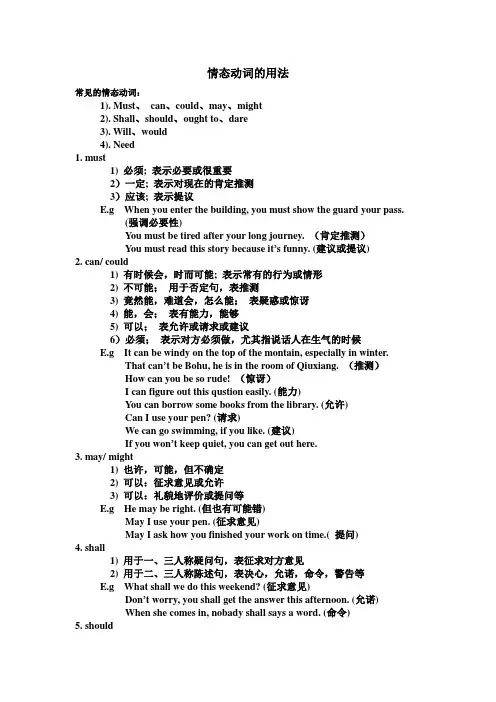
情态动词的用法完整详细
- 格式:docx
- 大小:40.03 KB
- 文档页数:11
让知识带有温度。
第 1 页/共 11 页
情态动词的用法完整详细
情态动词
定义:
情态动词是一种本身有一定的词义,但要与动词原形一起使用,给谓语动词增添情态颜色,表示说话人对有关行为或事物的态度和看法,认为其可能、应当或须要等。
情态动词后面加动词原形。
分类:
情态动词有四类:
①只做情态动词:must,can(could),may(might),ought to
①可做情态动词又可做实义动词:need,dare
①可做情态动词又可做助动词:shall(should),will(would)
①具有情态动词特征:have(had) to,used to
位置:
情态动词在句中放在谓语动词之前, 谓语动词前若有助动词,则在助动词之前,疑问句中, 情态动词
则在主语之前。
I can see you. Come here.
千里之行,始于足下
第 2 页 /共 11 页
我能看见你,过来吧。
He must have been away.
他一定走了。
What can I do for you?
我能帮你吗?
How dare you treat us like that!
你怎能那样对待我们!
特点:
情态动词无人称和数的变化, 情态动词后面跟的动词需用原形,否定式构成是在情态动词后面加"not"。个别情态动词有现在式和过去式两种形式, 过去式用来表达越发客气, 委婉的语气, 时态性不强,
可用于过去,现在或未来。情态动词属非及物动词,故没有被动语态。情态动词没有非谓语形式,即没有不定式,分词,等形式。
He could be here soon.
他很快就来。
We can't carry the heavy box.
我们搬不动那箱子。
I'm sorry I can't help you.
对不起,我帮不上你。
让知识带有温度。
第 3 页/共 11 页
基本助动词与情态助动词最主要的区分之一是,基本助动词本身没有词义,而情态助动词则有自己的词义,能表示说话人对有关动作或状态的看法,或表示主观设想:
What have you been doing since? (构成完成举行体,本身无词义)
I am afraid I must be going. (一定要)
You may have read some account of the matter. (或许已经)
除此之外,情态助动词还有如下词法和句法特征:
1)除ought和used以外,其他情态动词后面只能接不带to的不定式。假如我们把ought to和u sed to看做是固定词组的话,那么,全部情态动词无一例外地只能接不带to的不定式:We used to grow
beautiful roses.
I asked if he would come and repair my television set.
2)情态助动词在限定动词词组总是位居第一:
They need not have been punished so severely.
3)情态助动词用于第三人称单数现在时的时候,没有词形变化,即其词尾无-s形式:
She dare not say what she thinks.
4)情态动词没有非限定形式,即没有不定式和分词形式,也没有相应的动名词:
Still, she needn't have run away.
5)情态助动词的“时”的形式并不是时光区分的主要标志。在不千里之行,始于足下
第 4 页 /共 11 页
少场合,情态助动词的现在时和过去时形式都可以表示现在、过去或未来时光:
Would you mind very much if I ask you to do something?
She told him he ought not to have done it.
6)情态助动词之间是互相排斥的,即在一个限定动词词组中只能浮现一个情态助动词,但有时却可以与have和be基本助动词连用:
You should have washed the wound.
Well, you shouldn't be reading a novel.
用法
首先它是动词,而且不同于行为动词,行为动词表示的是可以通过行为来表达的动作(如写,读,跑),而情态动词只是表达的一种主意(如能,大概,敢)。
用法是:情态动词+行为动词原形
例句:I can read this sentence in English.
我能用英语读这句话。
情态动词是一种本身有一定的词义,表示说话人的心情,态度或语气的动词,但不能单独作谓语, 只能和其他动词原形构成谓语。
We can be there on time tomorrow.我们明天能按时去那儿。
May I have your name? 我能知道你的名字吗?
Shall we begin now?我们现在就开头吗? 让知识带有温度。
第 5 页/共 11 页
You must obey the school rules.你必需遵守校规。
情态动词数量不多,但用途广泛,主要有下列:
can (could), may (might), must, need, ought to, dare (dared), shall
(should), will (would),h ave (to) ,had better.
功能
助动词(auxiliary)主要有两类:基本助动词(primary auxiliary)和情态助动词(modal auxiliary)。基本助动词有三个:do, have和be;情态助动词有十三个:may, might; can, could; will, would; shall, should;
must, need, dare, used to, ought to. 上述两类助动词的共同特征是,在帮助主动词构成限定动词词组时,具有作用词的功能:
1)构成否定式:
He didn't go and neither did she.
The meeting might not start until 5 o'clock.
2)构成疑问式或附加疑问式:
Must you leave right now?
You have been learning French for 5 years, haven't you? 3)构成修辞倒装:
Nowhere can he obtain any information about his sister. Hardly had
he arrived when she started complaining.
4)代替限定动词词组:
千里之行,始于足下
第 6 页 /共 11 页
A: Who can solve this crossword puzzle?
B: Tom can.
A: Shall I write to him?
B: Yes, do.
情态动词的用法要点
10.特殊说明:
(1)could用来表示哀求时,语气委婉,主要用于疑问句,不能用于绝对句,答语应用can(即:could不能用于现在时态的简略答语中)。如:
——Could I use your dictionary?
——Yes, you can.(否定回答可用:No, I’m afraid not.)
此时可与may互换。在疑问句中还可用could,
might代替,不是过去式,只是语气更委婉,不能用于绝对句和答语中。
---- Could I come to see you tomorrow?
---- Yes, you can. ( No, I’m afraid not. )
(2)can和be able to辨析
让知识带有温度。
第 7 页/共 11 页
can(could)和be able to都可以表示能力,意思上没有区分。但can惟独现在式和过去式,而be able to则有更多的形式。如:
I’ve always wanted to able to speak fluent English.
Those bags look really heavy, are you sure you’ll be able to carry
them on your own?
但是,表示在过去某时的某一场合经过一番努力,最终做成了某事,通常不用could,而用was/were able to来表示。could:有潜能,但并未做到
这时,was/were able to相当于managed to do或succeed in doing。如:
After the accident it was a long time before she was able to walk
again.
The fire was very big, but most people were able to escape from the
building.
I can sing many English songs.我会唱许多英文歌曲。
We were able to return to our campsite before the heavy rain.我们在下大雨前设法会到了野营地。
He was able to swim across the river and escaped being caught.他游到了河对岸,没有被抓住。
在否定句中,can/could与be able to几乎没有什么差别,两者可以互换。例如:She wasn’t able to/couldn’t cook French dishes.她不会做法国菜。
(3) 惯用形式“cannot …too…”表示“无论怎么……也不(过分)”。